The short answer: a content ecosystem is everything a company publishes, on every channel, working together for one purpose: the big films, the regular series, the short answers people search for, and the pages, people and AI answers that carry them. You build one by starting from your purpose, choosing a few subjects you can own, and reading every idea before it is made. At Casual we read a company's content ecosystem in three parts: observations, opportunities and objectives.
12 of 17
how-to series beat the rest of their own YouTube channel
0 of 13
series of whole-event footage did the same
1 in 20
business buyers is in the market in a given quarter
What is a content ecosystem?
A content calendar lists what goes out and when. A content ecosystem is the system behind it: why each piece exists, who it is for, where people meet it, and how one piece leads to the next. It has six parts.
| Part | What it is | The question it answers |
|---|---|---|
| Purpose | The reason the company exists, in its own words | Why should anyone care what we publish? |
| Subjects | Three or so subjects the company can own, one for each strand of its purpose | What do we want to be known for? |
| Formats | One or two big films, a regular series, and short answers to the questions buyers ask (YouTube calls these hero, hub and help) | What do we make, and how often? |
| Channels | Your site, YouTube, LinkedIn, email, events, and the AI tools buyers now ask | Where do people meet it? |
| People | The employees, customers and experts who appear in it and share it | Who carries it? |
| Measures | What people remember, return to, search for and do | Is it working? |
The formats come from YouTube’s hero, hub and help framework. The rest is what we have learned making films for companies since 2006.
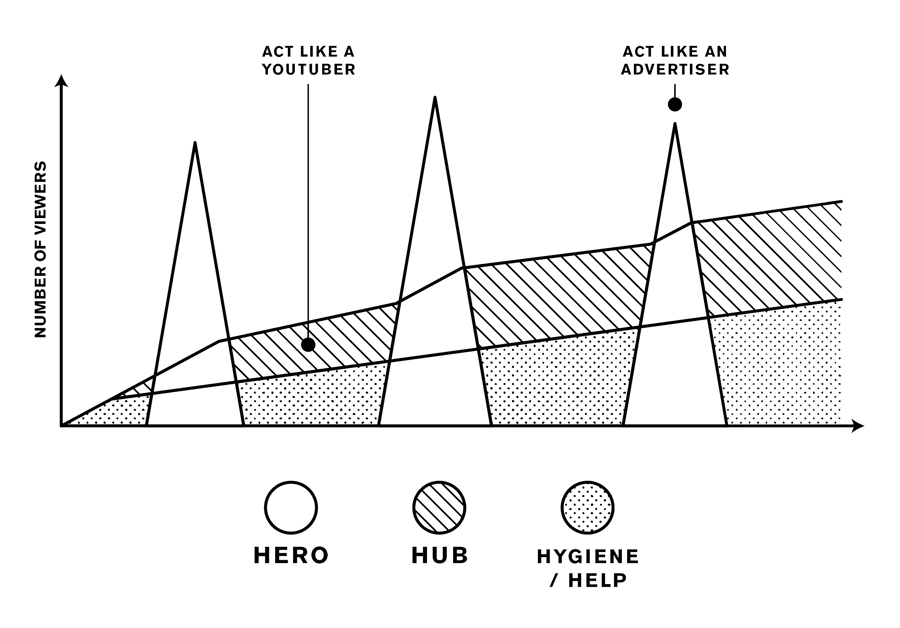
Hero, hub and help together draw a growing audience. From our guide to the hero, hub and help structure.
Why build an ecosystem instead of one-off films?
- Most buyers are not buying yet. Only about 1 in 20 business buyers is in the market in a given quarter, and when they start, 95% of the time they choose from the shortlist they had on day one. The work that pays is the work people remember before they need you.
- Programmes beat archives. In our audit of more than 1,600 company YouTube channels, how-to series beat the rest of their own channel in 12 of 17 tests. Series of whole-event footage did so in none of 13.
- Showing up counts. The busiest third of channels earned 3.6 times the views per subscriber of the quietest third, though each upload drew fewer views.
- AI answers draw on all of it. YouTube is one of the two websites most cited by Google’s AI Overviews, AI Mode, Gemini and Perplexity. In our own study of 210 AI answers, AI named no video company at all when buyers asked how to plan or measure content. It linked to whoever had written the clearest page.
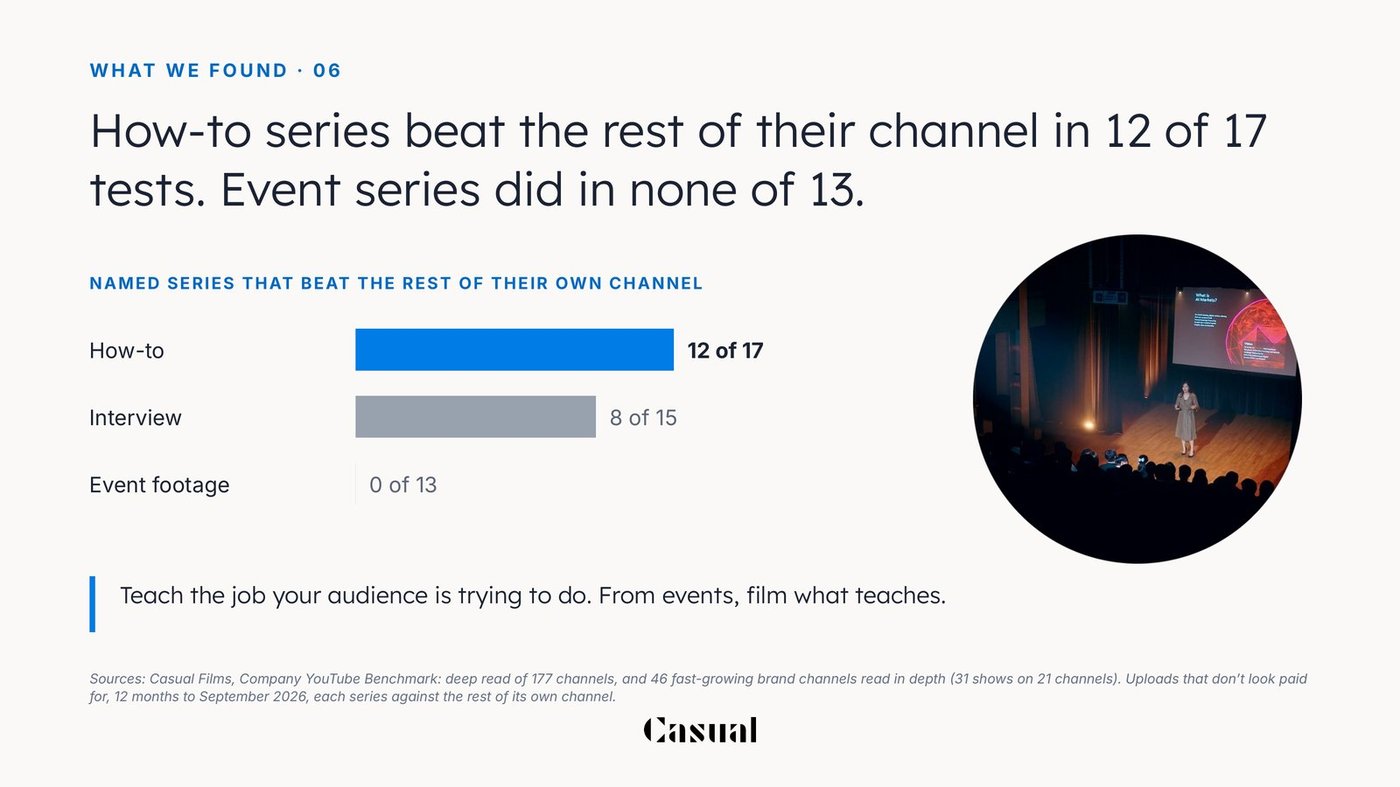
How-to series beat the rest of their channel in 12 of 17 tests; event series in none of 13. From The YouTube channel audit.
How Casual reads a content ecosystem
When we look at a company’s content for the first time, we write it up in three parts: observations (what is there now), opportunities (where it could win) and objectives (what it should set out to do). Six reads feed it:
- What people engage with. Which films people choose to watch, like and share, and which views look paid for.
- What annoys people. What the comments complain about, read by two separate passes.
- Where your competition sits. Which subjects rivals already hold, and which are open.
- What people talk about. The subjects your audience returns to, and the tone of what they say.
- How people come to you. Search, social, email, events and referrals, and which films lead somewhere.
- What AI says about you. Whether ChatGPT and Perplexity name you when buyers ask about your category, and which pages they rely on.
How do you build a content ecosystem?
- Start from your purpose. Find it in your own words, on your site or in your annual report. If you don’t have one written down, write the sentence your best work already says.
- Split it into three strands. Each strand gets one subject your company can own. Pick subjects where nobody else is the obvious answer yet.
- Answer three questions only you can answer. What is the channel for? Who is it for? What do you want them to think, feel and do?
- Plan a programme, not a film. One or two big films a year, a regular series, and short answers to buyer questions. How to plan a year of video shows one way to lay it out.
- Read every idea before it is made. We read each idea through four lenses with Storypulse: will they stop (attention), will they remember it was you (memory), will they feel it (emotion), and will they do something (action).
- Plan every version at the brief. So one shoot gives you the long film, the cut-downs and the Shorts. How to turn one big film into a month of content has the detail.
- Read, push, drop, every month. Keep what works, put more behind it, and stop what doesn’t. How to measure whether your content strategy is working lists what to count.
Questions people ask
Is a content ecosystem the same as a content strategy?
They overlap. A content strategy is the plan. The ecosystem is everything the plan has to work with: what you already publish, where your audience is, what rivals hold, and what AI says about you. We read the ecosystem first, then write the strategy.
How is it different from hero, hub and help?
Hero, hub and help describe the formats. An ecosystem also covers purpose, subjects, people, channels and measures.
How long does it take to build one?
The first read takes days. Building the habit of a regular series takes most of a year. Give the whole thing two years before you judge what it returns.
Who should own it?
One person with the authority to say no. Ecosystems fail when every team adds its own message to every film.
Keep exploring


Where these figures come from
- Casual Films, Company YouTube Benchmark, September 2026: 1,621 channels with a year of uploads each, read through the YouTube API. Series results are each series against the rest of its own channel; small tests, and links show no cause.
- Dawes, Ehrenberg-Bass Institute, for LinkedIn’s B2B Institute, 2021 (about 1 in 20 buyers in market each quarter). 6sense, B2B Buyer Experience Report 2025, about 4,000 buyer responses (95% day-one shortlist).
- Ahrefs Brand Radar, September 2026 (YouTube’s rank among sites cited by AI tools); Ahrefs sells SEO tools.
- Casual AI answer study, 21 November 2026: 210 answers from ChatGPT and Perplexity to 35 questions.
- The six reads and the observations, opportunities and objectives structure are Casual’s own method.
Read the full papers on our research page.
About Casual. Casual makes business films that change what people do. Since 2006 we have made films for companies such as Google, HSBC, BMW and GSK, from eight offices in seven countries. Want to know what your content ecosystem looks like from the outside? Brief us and a producer will reply within two working hours.