The short answer: when buyers ask AI tools how to plan, make or measure video, the tools name no video company at all. They give advice and link to whoever wrote the clearest page, or they answer from memory without searching. We asked ChatGPT and Perplexity 35 questions that marketing, communications and talent leaders ask, three times each: 210 answers and 1,431 sources, on 21 November 2026. In 150 answers to how, why and what questions, no video production company was named. Only 15 of the 1,431 sources were videos.
0 of 150
answers to how, why and what questions named a video production company
92 of 210
answers cited no sources at all
15 of 1,431
sources were videos
What we did
We wrote 35 questions in the words buyers use: 20 about choosing, costing and measuring video, and 15 about content strategy, from “How do I plan a year of video content?” to “Which agencies offer video content strategy, not just production?”. We asked each one three times of ChatGPT (with web search on) and three times of Perplexity, and saved every answer and every source. Two AI models read each answer separately and listed the companies it named. Counts are what these answers said on one day.
What we found
- Advice answers name nobody. On 25 how, why and what questions (what a film costs, how to measure it, how to plan a year of video, what a content ecosystem is), no video production company was named in any of 150 answers. The only way in is to be the page the answer links to.
- AI often doesn’t search at all. 92 of 210 answers had no sources: 71 of 105 from ChatGPT and 21 of 105 from Perplexity. On “How do I plan a year of video content?”, “How do I measure whether our content strategy is working?” and “How do I turn one big film into a month of content?”, neither tool searched in any of 18 answers. Those answers come from what the models learned in training.
- Shortlists lean on review sites. On six “who are the best…” questions, a review directory (Clutch, The Manifest or DesignRush) was a source in 18 of 36 answers.
- Research bodies lead on strategy. On “What content should a B2B brand make in 2027?”, the Content Marketing Institute’s research was a source in 6 of 6 answers. LinkedIn’s own pages, and individual people’s LinkedIn articles, were sources on video strategy, employer brand and CEO thought leadership.
- Named ideas get credited to their author. Asked “What is Big Rock content?”, ChatGPT credited the idea to Jason Miller’s work at LinkedIn. Pages that explained the idea were used as sources without being credited.
- Asking for an agency changes everything. “Which agencies offer video content strategy, not just production?” named agencies in 6 of 6 answers. “Who can help us build a video content strategy?” named none in 5 of 6.
- Video is rarely the source. 15 of 1,431 sources were videos, nearly all on YouTube. They appeared on questions about YouTube, employer brand films, Fortune 500 work and company change: when the question was about film itself, a clearly titled video could be the source.
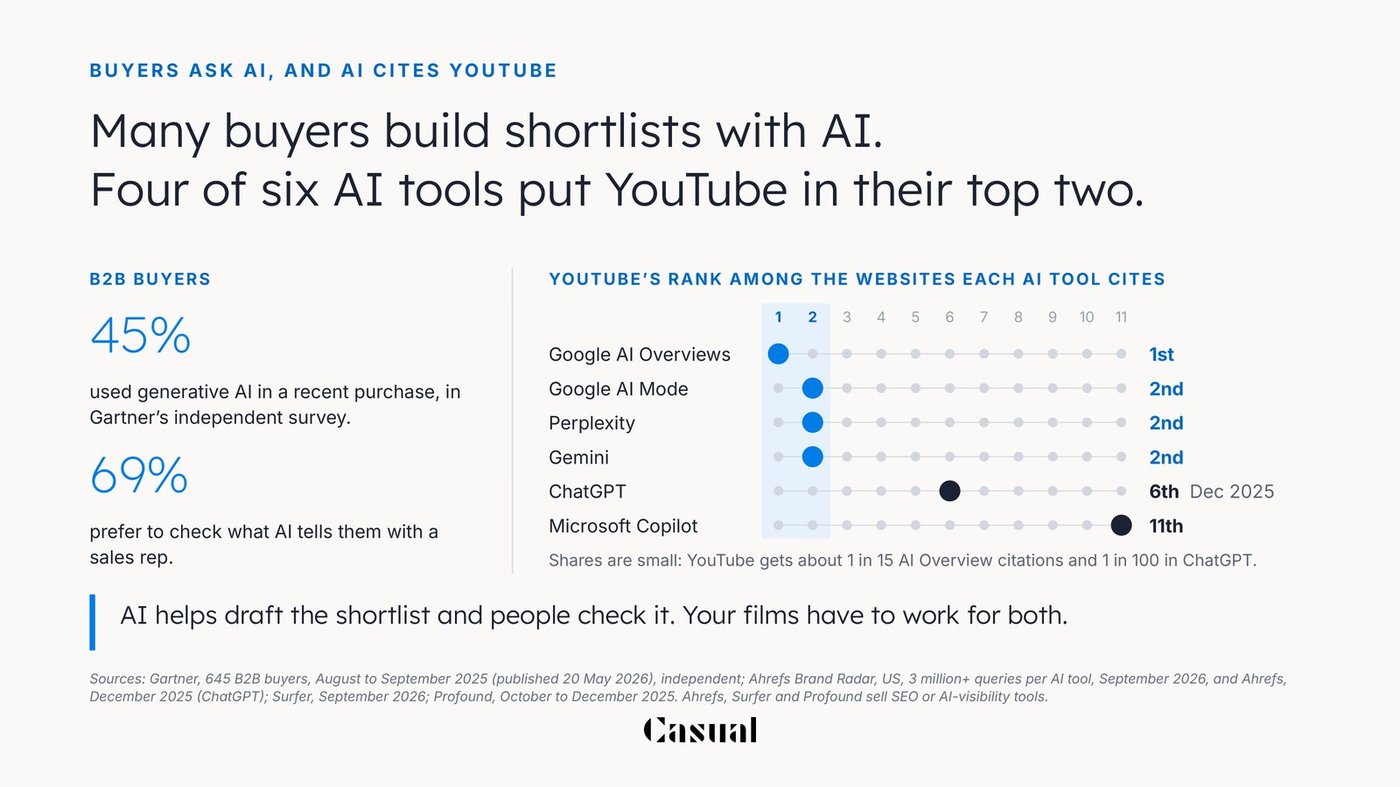
YouTube is first or second among the websites cited by four of six AI tools across all topics. From Video for AI answers and agents.
How do companies make their content show up in ChatGPT and AI search?
From this study and our earlier research, five things:
- Answer the question in your first two sentences. Advice answers link to the clearest page. Put the answer first, then the evidence.
- Give your ideas a name, and use it everywhere. AI credits named ideas to whoever is known for them. Answers given from memory only include ideas that are widely written about and repeated.
- Be where AI already looks. Review directories for shortlists; research bodies, LinkedIn and trade press for strategy. Publish research others will quote.
- Publish your films with their words. Clear titles, full transcripts, chapters named as questions, on YouTube and on your own site. Most AI tools read a film’s words, not its pictures. Our paper has the set-up.
- Track the same questions every month. Run each question several times, in each tool, and report ranges. One answer on one day proves little.
| What we counted | Result |
|---|---|
| Questions | 35 (20 buying video, 15 content strategy) |
| Answers | 210 (105 ChatGPT, 105 Perplexity; 3 runs per question) |
| Sources | 1,431 |
| Answers with no sources | 92 of 210 |
| Video production companies named in answers to how, why and what questions | 0 of 150 answers |
| Review directory among the sources, shortlist questions | 18 of 36 answers |
| Videos among the sources | 15 of 1,431 |
Limits
- Two AI tools, on one day. Gemini, Google’s AI Overviews, Claude and Copilot were not included.
- AI answers change from run to run and with every model update; these counts are a snapshot, not a score.
- Two AI models listed the companies named in each answer, separately; the lists were not checked name by name by a person.
- We do not name the production companies AI recommended on shortlist questions.
Questions people ask
Can I see the questions?
Yes. Ask us for the full list and the method, so you can run it on your own category.
Did you include your own company?
Yes. We ran the study on our own category first, and we are acting on it: pages like What is a content ecosystem? and How to plan a year of video content answer questions where AI named nobody.
Will you repeat it?
Yes, with the same questions, so changes over time show up.
Can you run this for my company?
Yes. We run the same read for clients as part of our first look at their content.
Keep exploring



Where these figures come from
- Casual AI answer study, 21 November 2026: ChatGPT (gpt-5.4 with web search) and Perplexity (Sonar with web search) through their APIs; 35 questions, 3 runs each per tool; 210 answers, 1,431 sources. Raw answers kept on file.
- Ahrefs Brand Radar, September 2026 (YouTube’s rank among sites cited by AI tools); Ahrefs sells SEO tools.
Read our other papers on the research page.
About Casual. Casual makes business films that change what people do. Since 2006 we have made films for companies such as Google, HSBC, BMW and GSK, from eight offices in seven countries. Want to know what AI tells your buyers? Brief us and a producer will reply within two working hours.