The short answer: plan backwards from the moments in your year. Build it around one or two big films, a series that comes out every week or fortnight, and a growing library of short answers to buyer questions. Plan every version at the brief, so each shoot also gives you the cut-downs and Shorts. Aim to publish every week, and review every month: keep what works, push it harder, drop what doesn’t.
3.6x
the views per subscriber on the busiest third of company channels, against the quietest
5.8
uploads a week on the best FTSE 100 B2B channels; the median posts 0.24
1 in 9
full-length videos on the median leading B2B channel has chapters
How often should a B2B company publish video?
Every week if you can, all year. In our audit of company YouTube channels, the busiest third earned 3.6 times the views per subscriber of the quietest third, though each upload drew fewer views: the channel grew even as single films got smaller audiences. The median FTSE 100 B2B channel uploads 0.24 times a week, about once a month. The best upload 5.8 times a week. Weekly does not mean a new big film every week. It means a rhythm people can rely on, fed by cut-downs, series episodes and short answers.
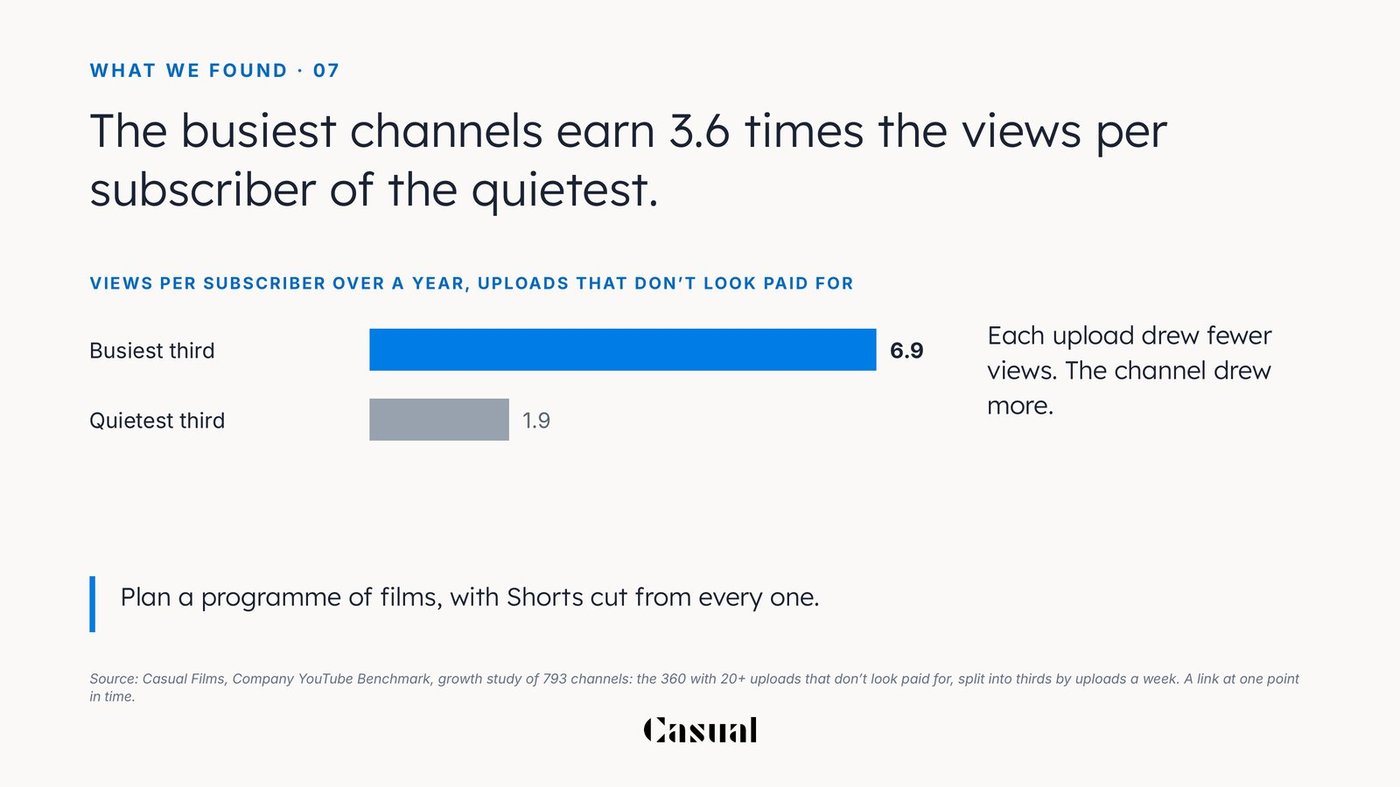
The busiest third of channels earn 6.9 views per subscriber a year; the quietest third 1.9. From The YouTube channel audit.
How do you plan a year of video content?
- Mark the moments. Launches, results, events, hiring peaks, the dates your customers care about. These are where the big films go.
- Choose one or two big films. Each one should be big enough to cut down for months. Big Rock content is one name for this idea.
- Set the series. One regular series with a named host and a fixed slot: weekly or fortnightly. Interview shows beat the rest of their channel in 8 of 15 tests; how-to series in 12 of 17.
- List the buyer questions. Every question your sales team hears becomes a short film and a written answer. These are what search and AI tools find. Our study of 210 AI answers found AI named no video company when buyers asked how-to questions; it linked to the clearest page.
- Plan every version at the brief. Long film, chapters, cut-downs per person, vertical Shorts, stills and quotes, decided before the shoot. One big film into a month of content shows how.
- Batch the shoots. Film several episodes or several sites in one go. It costs less per film and keeps the series on schedule.
- Read, push, drop, every month. Look at returning viewers, earned views and enquiries each month. What to measure lists them.
An example year
| Quarter | Big film | Series | Answers and cut-downs |
|---|---|---|---|
| 1 | Plan and shoot big film one | Series launches: four to six episodes banked | Answers to your top ten buyer questions |
| 2 | Big film one launches, with its cut-downs | Weekly or fortnightly | Cut-downs from big film one; more answers |
| 3 | Plan and shoot big film two | Continues; first monthly read decides what to push | Answers to the next ten questions |
| 4 | Big film two launches | Continues; plan next year’s season | Cut-downs from big film two; refresh any answer whose facts changed |
This is an illustration, not a template. Your moments decide where the big films land.

Questions people ask
How many videos does a B2B company need in a year?
Enough to keep a weekly rhythm. For many companies that is one or two big films, a series episode every week or fortnight, and a library of short answers, most of it cut from fewer shoots than you’d think.
How much should we budget?
Our corporate video cost guide gives ranges by type and city. A series costs less per film than one-offs.
What if we only have budget for one film?
Make it the big film, and plan its cut-downs, chapters and answers at the brief. One well-planned shoot can fill a month or more.
Should we plan Shorts separately?
No. Cut them from every film. In our audit, Shorts made up 38% of B2B uploads, against 56% for consumer brands.
Keep exploring



Where these figures come from
- Casual Films, Company YouTube Benchmark, September 2026: growth study of 793 channels (the 360 with 20+ unpaid-looking uploads, split into thirds by uploads a week); FTSE 100 company channels; 49 leading B2B channels (chapters); deep read of 177 channels (Shorts). Links at one point in time show no cause.
- Casual AI answer study, 21 November 2026: 210 answers from ChatGPT and Perplexity to 35 questions.
- Prudential: Casual project, as shown on casualfilms.com.
Read the full papers on our research page.
About Casual. Casual makes business films that change what people do. Since 2006 we have made films for companies such as Google, HSBC, BMW and GSK, from eight offices in seven countries. Want help planning your year of video? Brief us and a producer will reply within two working hours.