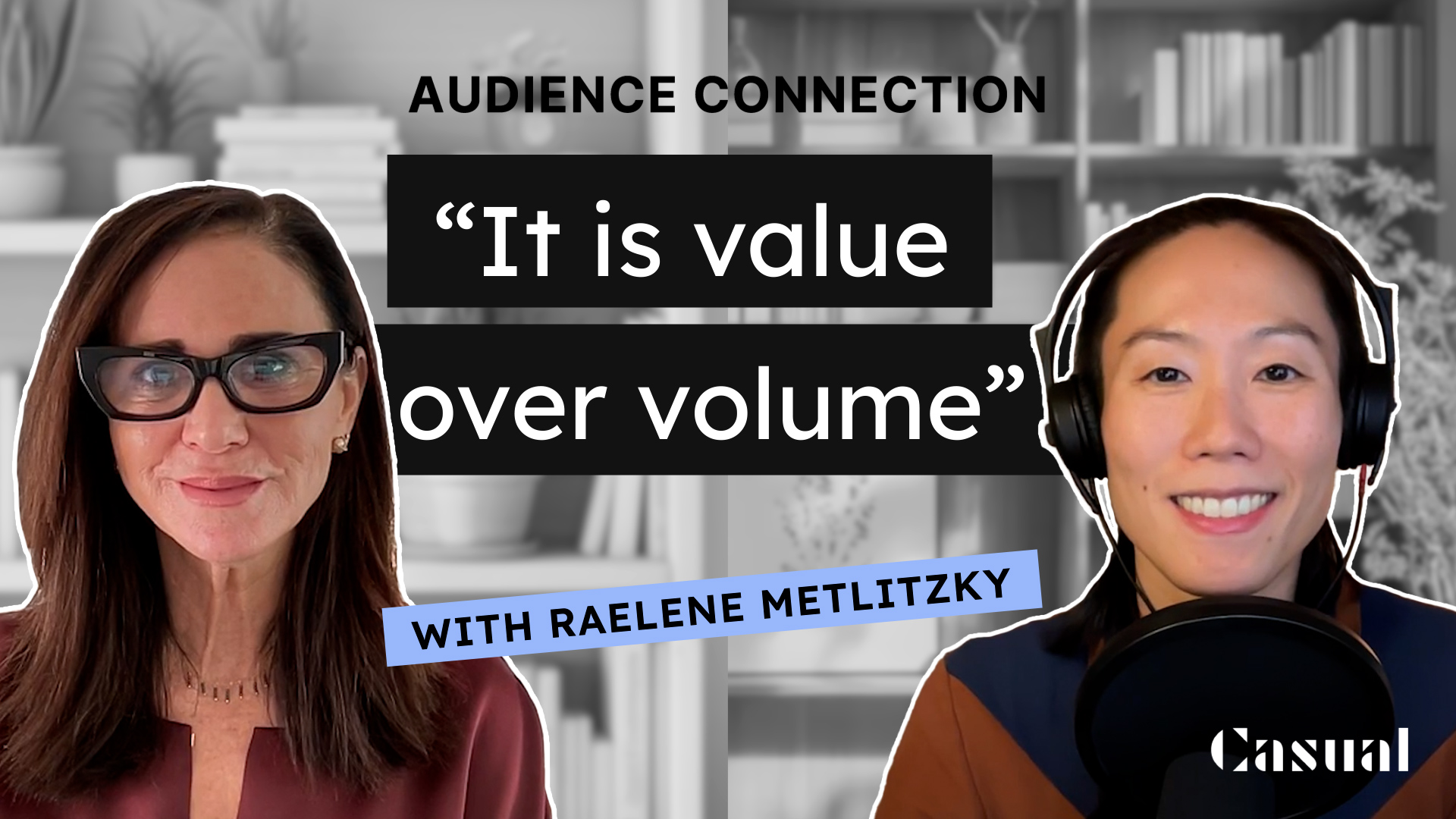
Acts Over Ads: Stories That Are On Brand with Raelene Mitlitzky
What if the biggest mistake brands make isn't fighting for attention, but forgetting that attention has to be earned in the first place?
Lydia Chan sits down with Raelene Mitlitzky, Head of Content and Editorial at IAG, Australia's largest insurer, to explore why brand storytelling isn't the story of your brand, but a story that's on brand. Raelene's path runs from apartheid-era South Africa, listening to voices on her father's ham radio, through theatre and radio journalism to leading brand storytelling inside a 100-year-old insurance business. She brings a rare, human-first view of what actually connects.
The centrepiece is A Fire Inside, the feature-length documentary Raelene drove about Australia's Black Summer bushfires. Funded by an insurer, it reached over 50 million people, became a number one film on a major streaming network, and grew into an ecosystem of 900 pieces of content, a book, a mapped school curriculum, and a movement to build the country's largest organisation of helpers. As she puts it, the goal was never a piece of content but "a community, an advocacy piece, a shared value system."
Along the way she breaks down the attention deficit economy: attention spans down from 12 seconds to 8.2 (below a goldfish), and a roughly 25,000% rise in content volume over a decade while watch time stays flat. Her answer is to narrowcast, not broadcast, and to prioritise acts over ads. She walks through the Queensland highway advocacy campaign that delivered the brand's first consideration lift in 20 years, why brands should become the show rather than interrupt it, and why trust is a strategic growth lever.
If you're a marketer, creative, brand leader, or internal comms professional, this one is packed with ways to build loyalty that lasts. The through-line: stop fighting for attention, start fighting for alignment.
Podcast Transcript
[INTRODUCTION]
Oliver: This is Audience Connection, the podcast where we go into what content actually connects and why it sticks. Sponsored by Casual, where behavioural science meets storytelling to build trust with your audiences. And here are your hosts. I'm Ollie Atkinson.
Lydia: And I'm Lydia Chan. Welcome back to Audience Connection, everyone. Today's guest is Raelene, Head of Content and Editorial at IAG, and that is Australia's largest insurer. She is the force behind A Fire Inside, a feature-length documentary about the Black Summer bushfires that reached over 50 million people and became a number one film on a major streaming network. This was funded by an insurance company, and it didn't stop at the film. It became 900 pieces of content, a book, a school curriculum, and what Rae describes as a movement to build the largest organisation of helpers in the country.
Oliver: Yeah, definitely a case study of creating a content ecosystem that all brands can learn from. And we talk about that a lot on the show: content can't sit alone, it has to be part of a larger ecosystem of work. And Rae has such a diverse background, which is a theme we see again with content creators who just truly understand what will connect with people. She went from theatre to radio journalism to now brand storytelling within an insurance provider, of all places.
Lydia: We see this again and again, don't we? Filmmakers who have these diverse experiences are quite adept at understanding humans and human behaviour. I really like Rae's philosophy: brand storytelling isn't the story of your brand, it's a story that's on brand. And that is just pretty spot on. We also get into the attention deficit economy, which you've talked about, Ollie, with previous guests on the show.
Oliver: Yeah, a couple, in fact. The one that sticks out, though, is Imran Rashid. He called this algorithmic content "digital junk food." And his argument was that we need to move away from this attention economy to an intention economy, and stop asking how you grab people's eyeballs, which is a weird thing to say, and start actually asking what we want them to do after you've got their attention, and how it leaves them better off. Which is basically what Rae's done here.
Lydia: Yeah. So apparently we have attention spans that are less than a goldfish. So we're just swimming around the world aimlessly, not paying attention. And her point is that brands aren't just competing with their industry rivals anymore. They're competing with every scroll, every notification, every algorithm that's already decided what we're going to see in the first place.
Oliver: What are we doing again? Well, I've been officially lapped by the goldfish. All right, if you're trying to build brand awareness, stop fighting for attention and learn how to earn it, this one's for you. Here's Lydia's conversation with Raelene.
[NOT THE STORY OF YOUR BRAND, A STORY THAT'S ON BRAND]
Lydia: All right, welcome back to the show, everyone. Today I'm joined by Raelene, Head of Content and Editorial at IAG, Australia's largest insurer. Rae's career spans theatre, radio and hardcore journalism in both the UK and Australia, before she moved into telling stories in the insurance space. And she's also the force behind some amazing brand storytelling content initiatives at IAG that have been recognised by a lot of industry awards and picked up by major networks. Rae, welcome to the show.
Raelene: What an introduction. Thank you so much. I'm so delighted to be here, Lydia. It's great to chat.
Lydia: I'm really excited for our chat. We're going to dive into why brand storytelling is not the story of your brand, but rather a story that's on brand. But before we get into that, Rae, tell us a little bit about your background, and what's your philosophy and approach to storytelling that truly connects?
Raelene: I've always said that context is everything, and for me, context is in and around who I am. I grew up in South Africa. I grew up in apartheid, at a time when media was not just highly regulated, it was completely controlled by the state. And I grew up with a dad who had a ham radio, an AM radio he could use to tap into different people from different countries. And I got to sit and listen to people share and tell their stories. From a very, very early age, that probably sparked my career into journalism and storytelling. It was that element of curiosity and engagement, finding something that really sparked an interest in me and gained my attention.
I speak a lot about brand storytelling not being the story of your brand, but a story that's on brand. And I think what is so vital in this attention deficit economy is human connection. It is so important to create that connection with another human. Storytelling goes back to the times when we would sketch drawings on caves. It's how humans connect, it's how they share information. And brands need to take a page out of that book. Stories are as old as time, and it is that human connection that really draws people in and creates a value system that we recognise, understand, and potentially want to be a part of or engage in.
Lydia: When you look at the audience for the content that you create, who are they? What speaks to them, and why?
Raelene: I love this question, because this should be the starting point for any brand story. I always say: begin with the end in mind. Who is the audience? I've seen briefs land across my desk where the audience is "Australia." It blows my mind, because today, with the technology we have, with behavioural insights, with the ability to slice and dice data, we can get so incredibly granular with who our audience is.
For context, as you mentioned, I work for an insurance company. When you look at the category of insurance, it is a low-interest category. It is a grudge purchase. So you don't instantly have that engagement. On the contrary, people only know they need insurance when they actually need insurance. The interesting thing about the brand I work for is that it's a heritage brand, it's 100 years old, and we have an audience that is really rusted on, and it's an aging demographic. What we have at our fingertips now is the ability to slice and dice that audience right into the minutiae. Whether it's by product, car insurance or home insurance, we can break it down by gender, by risk. We can look at our audience in the state of New South Wales and say, well, this particular person in this postcode is potentially more susceptible to flooding, whereas this person in this postcode is more susceptible to fire.
So our challenge with this aging demographic and this heritage brand, as we look into this current zeitgeist, we've had a consistent rise in interest rates, we're in a cost of living crisis, people are feeling very unsure about the geopolitical lens, I think it's even more important to truly know who we're speaking to and focus not just on the audience, but on their value system, and not just the demographic.
[NARROWCAST, DON'T BROADCAST]
Lydia: How do you create content for such a wide segment of audiences? Because at the end of the day, it's always a budget discussion, it's always a resource discussion. But we know from the insights that what truly connects, what connects with me, is when I feel like it was made for me. But that could be hundreds of pieces of content. So how do you prioritise, or make the case for creating content that's very specific to a specific risk group, or behavioural group, or psychographic profile?
Raelene: It's really interesting, and with a broadcast background, watching the landscape shift so phenomenally over the last decade or so, I always try to apply the lens of: let's narrowcast, not broadcast. We're able to narrowcast not just from an audience segmentation perspective, but on a platform. One of the most important things is being very authentic in creating content that is platform specific. I have no doubt the audience listening to this will know the frustration of a content creator when the budget goes to a really beautiful, shiny 60-second TVC, and then, "let's cut it down to a 30." And why didn't we pull out 15 seconds for a little VO or a radio ad? That is just incredibly off the mark, because different people consume content at different times on different platforms. So first and foremost, we need to ensure the content is fit for platform. What is fit for platform on TikTok is not going to be fit for platform on radio.
The other aspect is really integrating the content, not just from a selling perspective, but within a broader ecosystem, whether it's through a media partnership or earned media. And if you have a really great insight or multiple insights, it's about building out this content ecosystem, which I've mentioned for A Fire Inside, an extraordinary feature-length brand storytelling documentary we did on behalf of the brand. We really made sure that every single piece of content aligned with the audience at a particular point. So what I'm referring to is a phased approach: build it, ensure there is a long tail as well. Your content shouldn't be a start and a stop. So there's a lot in there, but I don't think there's one particular answer to that question. It's nuanced, and it's quite complex.
Lydia: Absolutely. Everyone we've had on this show makes the argument that making the hero film and then doing your cut-downs is old school, like five years ago. But why are we still doing it now? At Casual, we still receive briefs like that. And I think it's a bit of fear on the commissioner side, to say, "actually, this is not the right way to go, and we need to look at our budgets in different ways," and to be very intentional, creatively, about what we're creating and on what platform. That piece of content can still be under the same campaign or creative umbrella, but needs to be executed differently. And we're still not seeing that on our end.
Raelene: On the one hand I can empathise, and on the other there's almost solace in knowing we're not the only ones in Australia experiencing this. I do feel there is a paradigm shift. Structurally, we've gone from a marketing team to a customer experience team, and I feel what that suggests is an understanding that both media and creative need to be much more connected. When you're creating a comms plan, you need to be really intentional about what content is going to fit within that plan, and at what point. We still exist in a very traditional media landscape. We're getting better at it, the landscape is shifting. And it's not to suggest we shouldn't have a hero film or hero piece of content, but in reference to creating that content ecosystem that lives around it, I refer to it as the "and" within brand. It's a multi-layered structural framework, a scaffold and support system for the hero film. It shouldn't be nice-to-have, it should be so connected.
[BELOW THE GOLDFISH: THE ATTENTION DEFICIT ECONOMY]
Lydia: We'll talk more about the content ecosystem later, but I want to talk about the attention deficit economy you mentioned. McKinsey put out a report last year called the attention equation, and a stat that stood out for us was that there's been over a 25,000% increase in the volume of content available to your audience over the past ten years. This is a proliferation of content, and especially with AI coming into the stage over the past year or two, that's even gotten worse. Yet watch time per consumer per year hasn't really changed much. So let's talk a little more about that. What is the challenge here?
Raelene: Gosh, a challenge it is. Human attention is the currency, and the economy is absolutely booming. And to your point, we just continue to create more and more content. But what we can't create is more time to engage in it. Time is a finite thing. Attention is a finite thing. We only have 24 hours in a day. So in this endless sea of digital noise, the ability to capture someone's attention is incredibly important and incredibly valuable. I read a stat that the human attention span has dropped within a decade from 12 seconds to 8.2. And the average goldfish's attention span is nine seconds. So we are really at or below the goldfish.
Over my career, I've watched this landscape shift from state-controlled radio to being able to hold an audience during breakfast television. And every one of those jobs has the same problem wearing a different costume: how do you earn someone's attention when they're being pulled in so many directions? Brands are also not just competing with industry rivals anymore. They're competing with every scroll, every notification, every algorithm that has already decided for us what we're going to see. And brands are competing for trust, for loyalty, and for influence. That's where brand storytelling comes into it. It's about creating that human connection and not chasing fleeting moments or vanity metrics. Brands are competing for attention, to be liked and to be loved. But the goal, in my opinion, isn't to maximise time spent on your content. It's to maximise the value that your audience is going to get from your content. For me, it's value over volume that will build long-term loyalty and connection.
[VALUE OVER VOLUME, AND MEASURING FOR ALIGNMENT]
Lydia: How do you measure that? How do you know you're maximising value?
Raelene: This is the million-dollar, billion-dollar question. It's a discussion they have at brand storytelling events the world over. And it comes back to: begin with the end in mind. What do you want to measure? Be intentional about it. If you want to measure for likes, those are vanity measurements. They're great, and you can show your CMO, "wow, we've got this incredible uptick in likes." But is that truly engagement? Are people really engaged to such a degree that they'll act on a purchase decision, a behavioural change? So the measurement piece is incredibly important. I always encourage my team to remember that the metrics we choose to prioritise will shape the outcome we get. We should be fighting more for alignment than attention. And you can measure those things, in consideration, in brand uplift and so on. But they're not going to be those hardcore metrics of reach and frequency and eyeballs, as we traditionally have done with television.
Lydia: That's really interesting. We tried to do a survey last year, and it sort of went pear-shaped, but we wanted to connect creative storytelling to alignment within organisations. We didn't get enough responses for any data to come out of it. But it's really interesting hearing you say that the measurement should be alignment. We were on the same page, going down that route of: how do we create stories that create better alignment between employees and their employers, between the brand and their audience? And those last two points you've made are very clear metrics that go back to choosing to prioritise what we measure, and therefore working backwards.
Raelene: It's a really interesting and ongoing discussion, and it's worthwhile inserting the notion of advocacy here, because I've certainly noticed that with brand storytelling. Consumers are four to six times more likely to engage with a brand if there is a level of advocacy. And it's this notion of acts over ads, which is really interesting. People want to value something. They want that value exchange. And if they recognise a brand that is advocating on their behalf, or advocating for something they feel deeply about, you're going to get alignment and connection. I have a number of case studies where we've proved that. And it's all the things we've discussed: having the insights, cutting the data, understanding your audience, beginning with the end in mind, making sure you are narrowcasting, not broadcasting. It's a multitude of steps and stages and considerations before we shoot one frame or decide on a comms plan.
Lydia: How does that show up for the content you create? What were you creating before, with certain goalposts, and now that it's shifted, it's not about likes, it's about maximising value, it's about alignment. How does that change the type of content you've been creating?
Raelene: Interestingly, we've seen shifts in big metrics such as consideration when we've done advocacy pieces. Most recently, we had a consideration issue in Queensland, one particular state in Australia. We were a national brand, but we had very little recognition in Queensland. Not dissimilar to the US states, every state is very parochial. So we needed to discover a particular insight that would align and resonate with the people of Queensland, and then layer on: well, what is the role of the brand? What we discovered was really pertinent. The longest stretch of road in Queensland, and arguably in Australia, is also the most dangerous and the most ill-equipped to handle wild weather, potholes, accidents. There are single lanes, and this really impacts the people of Queensland.
So as a brand, we aligned ourselves with a media partner who was quintessentially Queensland, heart and soul, a heritage legacy media publisher, and created a platform where we could advocate on behalf of the people of Queensland. I can't say lobby, because we're not in that space, but to really encourage local and federal government to help fix the highway. We did this act, this brand act over a brand ad, and we layered it with editorial and advertorial, and pulled our own data, which was then leveraged by the newspaper itself. We ultimately saw a shift in consideration that was historic, the first time in 20 years we'd had this incredible uplift.
So as a business, we now have a number of case studies that showcase when there is brand storytelling and connected communication that aligns with the consumer. You can shift hearts and minds. You can not just move people, but move the needle.
[TRUST AS A STRATEGIC GROWTH LEVER]
Lydia: I really like that, because you're showing up, and you mentioned the word trust a few minutes ago. Trust is built over small acts, over being there, showing up. It's not built through, like you said easily, a brand ad, or a donation, one big act. So when you're looking at a heritage brand, at how to continue to build trust with a maybe skeptical consumer, you have to show up in those ways.
Raelene: We know categorically that trust is eroding. We know media outlets are struggling with trust issues. But what I love about that notion is that trust can and should be a strategic growth lever. We've got to work harder as brands to elicit that trust. We also have to be authentic, because in this AI world, which leaves us so confused as to what is real and what is not, we have to work even harder to earn the trust, the attention, and the loyalty of consumers. That is no mean feat. But as a heritage brand, we have over 100 years of trust, and that is what we need to build on. In the current climate, the cost of living crunch, leveraging that trust, that we have your back, that we've done it before and we'll do it again, is an incredibly powerful lever to keep pulling and building upon. We're a premium brand, we're a grudge purchase, so we can't be pulling huge offers and huge sales. As a brand that is more expensive, our role when it comes to trust is ensuring you can trust that we will deliver on that premium promise when things go bad.
[INSIDE A FIRE INSIDE: BUILDING A MOVEMENT, NOT A FILM]
Lydia: You mentioned A Fire Inside, so I want to shift to talking about that feature documentary specifically. To tee it up for our audience, this documentary grew out of the horrific bushfires in 2019 to 2020 in Australia. It's quite rare that an insurance company would fund a feature-length documentary. The campaign reached over 50 million people, generated hundreds of news stories, and even became a number one documentary on a major streaming network. There was also curriculum-mapped educational material that helped thousands of students. So it goes back to that content ecosystem you were talking about. How do we create, where do we start, when we're looking at a project like A Fire Inside and the plethora of content that's come out of it?
Raelene: Great question. I think the starting point is bravery. And I also think the starting point is always going to be context. We'd come off the back of three years of horrendous drought. What we experienced, which ultimately became known as the Black Summer bushfires, was possibly the most apocalyptic fires in the history of our country. Lives were lost, homes were damaged. And it's important, from a contextual perspective, that no sooner had the fires been extinguished, and they burned for nine months, than Covid hit, and we went into the first of a series of lockdowns. So it was genuinely understanding. We felt as a brand that it was almost our duty to share these stories. We had a lot of our own people, our assessors, our major events team, on the ground, spending weeks at a time within those communities, leaving their own homes and families for lengthy periods over Christmas and so on.
From an ecosystem perspective, we knew we had these incredible stories to share, and we knew we had multiple platforms to share them on. The film was the hero piece, and it was very organic. As we began to go into the field and speak to people and eke out these stories, they began connecting. It was a fairly altruistic strategy, because what we were building was not a piece of content. Ultimately, what we wanted to build was a community, an advocacy piece, a shared value system, the call to action. It wasn't just this one-way piece of content. It was an opportunity for people to get involved, to recognise and feel proud of the help that was provided during those fires, but moreover, to join a community. The aim of the film was to create the largest organisation of helpers, because we know that climate is changing, we will be hit with more fires, there will be more floods.
Nine hundred pieces of content were created across multiple platforms, from out-of-home to podcast to social to digital. We were also very particular and intentional about the stories being narrowcast, being specific and bespoke to certain areas. So if there was a character in the documentary from a particular place, we ensured their content was shared specifically with the network or broadcaster, or narrowcast to that particular audience.
The other thing that's really important is that we should never underestimate staff pride. Staff pride is a very important metric for corporates and brands. If you get your staff and employees to feel a sense of pride, and you're able to get into culture, that is the ultimate level of success. These are the people who drive your company. If they feel connected to who they're spending eight, sometimes ten, twelve hours a day working for, that's really important. And showing up in that way, the advocacy, them being able to be proud to work for this brand, they'll talk about it.
Lydia: This comes back to what you were talking about, the long tail and creating community. How do we create content that extends beyond the content? How do we create content that garners conversation, that people, through their association to the brand, can wear the brand with pride?
Raelene: And I love that you mentioned the edutainment piece, because that was really important. There were lessons to be learned, and our role as a brand was not to preach. We felt a responsibility to share the stories, because we deal a lot in risk, and all our data from our climatologists, hydrologists, meteorologists and scientists tells us this will happen again. So the role was not shock and horror and fear-mongering. It was ultimately about building resilience. How do we as a nation, as a country, build resilience? And the way to build resilience is to connect people. That is exactly why we wanted to create a movement. So the film led to a book, led to a movement. And surrounded by all of that, within this ecosystem, was an opportunity to share an educational piece with students across various years in primary and high school, all leading to elements of resilience, and not just staff pride but Australian pride, as a nation of helpers. We have the largest volunteer firefighting service in the world.
Lydia: For our listeners who are maybe in B2B roles or professional services, how do they apply this approach? How do you identify that core story to start building off, or is this based on a particular event that occurred that allowed the company to do that? The fires were absolutely an anomaly.
Raelene: It's a really interesting question, because the way I respond is that irrespective of B2C or B2B, you're still human to human. So you still want to ensure you're making that human connection: the right story on the right platform at the right time, in the right context. The same rules apply. That said, we spoke earlier about the insight. So many times as creatives and content creators, we rush, we have an idea before we really understand the why. We need to start with the curiosity and the context. Why am I telling this story, and why am I telling it now? And who am I telling the story to? And what do I want them to do with the story? The same principles apply. From a B2B perspective, it's very much the language, the emotional language, the emotional connection, what you're asking your audience to do, or build, or bring, or change, or feel, or act upon. So the same principles really apply, if we just put on the lens as content creators and makers that, irrespective of what content we're creating, we're still creating content for humans.
[BECOME THE SHOW, DON'T INTERRUPT IT]
Lydia: You mentioned something I want to double-click on: the importance of contextual justification. Why are you telling me the story, and why are you telling me the story right now? We've all experienced this, where we're watching a certain show, or even a sporting event, and you get hit with ads that are just so out of the blue. And you're like, you could have done something a little bit different and I would have engaged. So let's talk a little about that.
Raelene: As the landscape began to shift, 100 years ago in my career, I began working in the area of what we called integration. And what I loved about this notion, and it still holds firm today, is that brands shouldn't interrupt the show, they should become the show, integrated into that story. For example, with our particular brand, we sponsor the cricket, which is absolutely huge in Australia. We'd feel very foolish to put a brand TVC in the middle of the cricket. So we ensure that our brand TVC, our radio, and all the content surrounding it during the summer of cricket is heavily and seamlessly integrated into cricket. So we're not talking about insurance, we're talking about communities and cricket and local communities. The term integration is incredibly important. Brands should not interrupt the show, brands can become the show. It's not that difficult.
Context is everything. With elements that are anomalies, like a fire, or something that is big and is happening, we need to respond faster, and respond with agility, to be able to pivot and scale so we can respond to something that is in culture. So we can get into culture and have a voice or an opinion within a cultural moment. The idea of a heavily regulated, systemised, process-driven brand is really going to struggle in the here and now, if they don't find ways to become more agile, more nimble, and more immediate.
Lydia: I completely agree. It's about giving your teams autonomy to respond, and also the freedom to be proactive about it. Without, like you mentioned, going through so many layers, that by the time the idea reaches sign-off, the moment is gone. And you can't get it back. This is one of the frustrations with many content creators. This is not a TVC, this is about being responsive and immediate.
Raelene: It comes back to my days of journalism. There are frustrations working for a really big, highly regulated corporate, because we do have an opinion, we do have subject matter expertise. And if we respond fast to a situation, we have more impact, and more ability to leverage another area of the ecosystem, which is earned media and PR. That cannot be underestimated, because if your brand has a voice within the cultural context of news, and you're responding to something rapidly with a point of view, in our case with a way that we're helping, you'd be foolish not to, because you're missing an opportunity to leverage the news media, broadcast, a whole other area of mainstream media and audience.
Funny enough, I was at a corporate comms conference earlier in the year, and the last talk was about whether comms and marketing should become one department. This is so interesting to me. One of the first things I did when I joined, and bear in mind, I joined an insurance company, I didn't even know if I had insurance, for me it was just about storytelling, one of the first things I did was build a relationship with our corp comms team. And they'll hate me for saying this, but a long time ago they were almost a gatekeeper. They felt obstructive, like a blocker. And I did my level best to build that relationship and find ways to navigate. Insurance is highly regulated, and risk is one of our top KPIs. I think there is an argument for corp comms and content becoming more aligned and joined and immersed. But I also think corp comms has a different role depending on what brand you're working for, and they do need to be very much across risk and reputation. So I don't believe they should join. I think that would be a little tricky. The tension between the two is really great.
Lydia: It's interesting, because as we continue to work with a lot of large brands and organisations, we work with the comms team and sometimes the marketing team, and you see a lot of crossover in the type of content created. So when we're looking at how to become more efficient, how to be more aligned, there are some efficiencies there. But as you mentioned, they're separate for a reason. It'll take a lot of effort, and an individual champion, to really be the glue that balances both teams' priorities.
Raelene: Agreed. And it comes back to an even more overarching principle: the importance of breaking down silos. I keep saying begin with the end in mind. If every piece of content we're creating, every story we're putting out into the universe, has the audience, the customer, the other person in mind, to create some sort of response or reaction, we should all be singing from the same hymn sheet. We need to feel connected. When you have large, highly matrixed, complex organisations, so often the case is that there are so many silos. The sooner we're able to break down those silos between risk, product, legal, corp comms, media, all the different areas within a brand, the sooner we're able to put the customer first, not the brand first, and the sooner we have a much more connected and cohesive ecosystem. So what the recipient of the content is receiving is the same message told in different ways. That's on us, and that's a really big challenge.
Lydia: We'll see in a year or two's time if the silos have been broken.
[STOP FIGHTING FOR ATTENTION, START EARNING IT]
Lydia: Well, Rae, I've had a really great time in this conversation. To leave our viewers with something: if every marketer listening tomorrow stopped asking, "how do I get more attention," what should they be asking instead?
Raelene: If I could answer that, and bottle it, and know the answer. But I think in this era of such fleeting attention, the businesses, the brands that build loyal communities have the real competitive edge, because nothing affirms who we are more than connecting through story, and connection is what leads to loyalty. The goal shouldn't be to maximise time spent on content. Our goal should be to maximise the value that our audience gets from the content. So instead of fighting for attention, let's fight for alignment. The brands that win are not going to be the loudest. They're the ones that understand attention must be earned, not taken. It's value, not volume, that is going to build long-term loyalty.
Lydia: It's the brands that are going to do the work, the boots-on-the-ground kind of work, versus the big splash, shouting it from the rooftops where everyone can see it.
Raelene: 100%. In my opinion, it is value over volume. There's a place for volume, but it's the value that really cuts through on a human level.
Lydia: Awesome. Well, great. Thank you so much for the conversation. I appreciate your time.
Raelene: Thank you so much. I've thoroughly enjoyed it, and I hope it sparked some great interest and other conversations. We're very privileged to have this opportunity to share stories, and I've been very privileged to share mine with you.
Lydia: If this episode sparked something, curiosity, a new way of thinking, or something you're going to take back to the team, we'd love to hear about it.
Oliver: Absolutely. Make sure you're subscribed, leave us a rating, and drop us a comment. Tell us what stuck and what you want us to explore next. We want to know. This is Audience Connection, sponsored by Casual, the video partner for global brands trying to build trust with their audiences. We'll see you next time.

Fix up quick smart.
Find out more about how Smart-Casual can help
improve your video content
