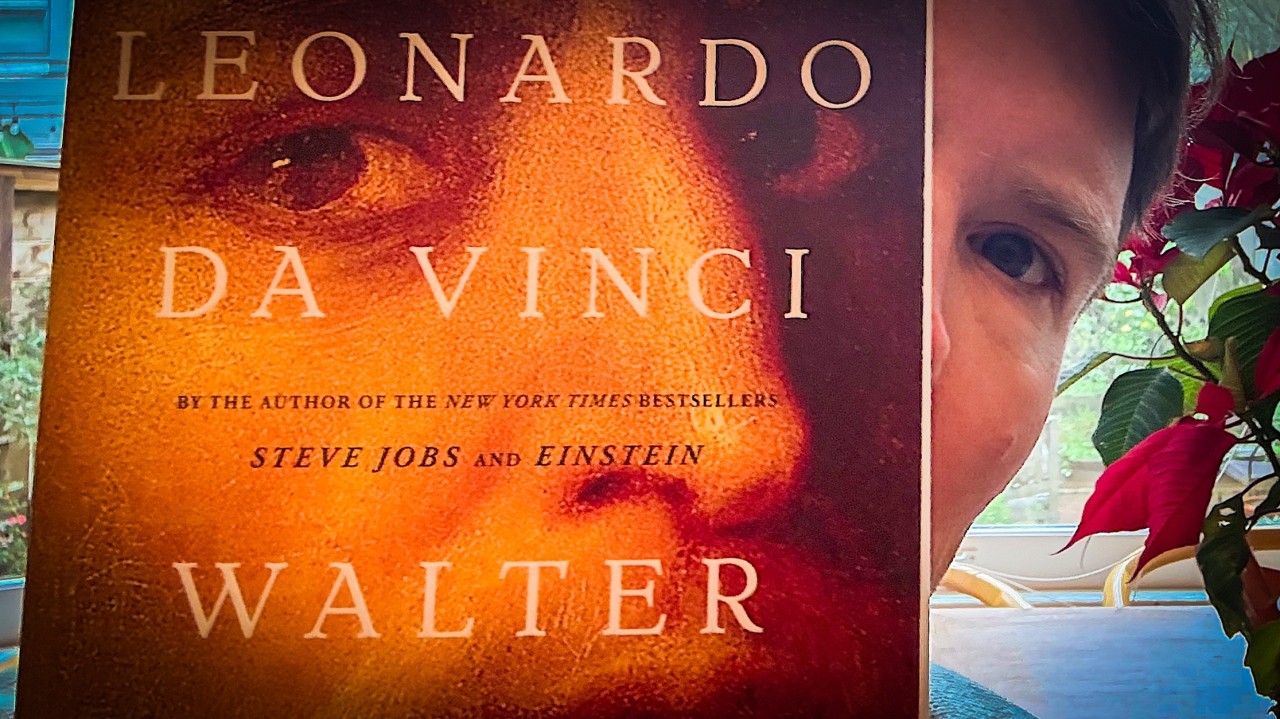
I recently read Leonardo da Vinci by Walter Isaacson. It's quite the book, and it has shifted the way I look at the world. I appreciate that's quite a claim, so I thought I'd share why here.
Leonardo wasn't just an extremely talented artist; he was a scientist, engineer, thinker, inventor and dreamer all rolled into one. His life story, as told by Isaacson, is a masterclass in curiosity, creativity and resilience.
In this blog, I want to highlight some of the most powerful insights from the book and share how I think we can apply them in our professional and personal lives.
1. Embrace boundless curiosity
"To develop a complete mind: Study the science of art; Study the art of science. Learn how to see. Realise that everything connects to everything else." Attributed to Leonardo da Vinci
Leonardo's approach: Perhaps the thing that stood out most for me in the book was Leonardo's endless perceptiveness and curiosity. Leonardo questioned everything around him. He'd fill notebook after notebook with sketches, diagrams and observations of water flows and eddies, human anatomy, and even birds in flight. No detail was too small or fleeting to investigate.
My takeaways:
- Ask more questions. Challenge assumptions. If something puzzles you, research it, experiment with it, or talk to someone who really knows the topic.
- Keep a notebook. Whether it's a digital app or a physical journal, record your sparks of ideas and random curiosities.
- Cross-pollinate ideas. Talk to people outside your field. Attend webinars or read articles on subjects that aren't in your usual wheelhouse. Fight the algorithms in our digital lives that just feed us more of what we're already interested in.
2. Blur the lines between disciplines
Leonardo's approach: Instead of labelling himself strictly as an artist or inventor, Leonardo revelled in the in-between spaces: applying geometry to perspective in painting, bringing knowledge of anatomy into lifelike portraits, and using engineering principles to conceive flying machines. His ability to stand astride the sciences and the arts let him combine them in new and unusual ways. This was the core of his genius.
My takeaways:
- Interdisciplinary thinking. Avoid the temptation to over-specialise. Never say "I am not creative" or "I am not mathematical". We can all use so much more of our abilities if we seek combinations. Look for intersections between your main expertise and other fields: technology, design, psychology and so on.
- Collaboration. Seek out colleagues or friends with different skill sets and try a creative side project together. You might discover new solutions or entirely new ways of seeing a problem.
3. Nurture your sense of wonder
Leonardo's approach: Isaacson's biography portrays Leonardo as a perpetual observer. He didn't just look at the world; he studied it, counting the wings of a dragonfly, examining how sunlight reflected on water, dissecting cadavers to understand human anatomy in minute detail.
Isaacson quotes a to-do written in one of Leonardo's notebooks:
"Describe the tongue of the woodpecker."
This description could have had no direct benefit to his work, but he wanted to understand it because it was there. We lose that sense of wonder at far too young an age. The desire to understand is what gave Leonardo's life such incredible depth.
My takeaways:
- Slow down and observe. Even in a fast-paced environment, take a moment to notice your surroundings. Ask yourself, "Why does this work this way?" or "What if this were done differently?"
- Record daily observations. Whether it's a new insight about your team's dynamics or an intriguing piece of data from your latest project, note it. This practice trains your eye (and mind) to see details others might miss.
4. Turn failures into fuel
Leonardo's approach: Many of Leonardo's ideas, like his flying machines, never fully materialised. Many of his greatest commissions were left unfinished. Yet every attempt was a step forward in learning and discovery.
My takeaways:
- Fail fast, learn fast. Instead of fearing failure, treat it as a natural part of the creative and innovative process.
- Embrace iteration. Whenever you launch a new project or pitch a new idea, expect refinements. Prototypes, pilot programmes and beta launches let you gather data, iterate and improve.
5. Pursue passion projects
"Learning never exhausts the mind." Attributed to Leonardo da Vinci
Leonardo's approach: Beyond commissioned works like The Last Supper and the Mona Lisa, Leonardo spent countless hours investigating optics, architecture and even stage design. These pursuits haven't left many artefacts for us to enjoy today, but they satisfied his relentless curiosity, and they made the work that has survived all the more superlative.
My takeaways:
- Carve out personal time. Dedicate a portion of your week to projects or hobbies that genuinely excite you, outside of your main job.
- Stay intrinsically motivated. Genuine interest in your work fosters creativity and can even lead to unexpected career opportunities.
6. Cultivate kindness and compassion
Leonardo's approach: Despite his many incredible talents, one aspect that stands out in Isaacson's biography is Leonardo's humanity. He was known for treating the people in his life with kindness and generosity. He often shared his workshop and resources, favouring collaboration and mentorship over secrecy or competition.
My takeaways:
- Mentor and encourage. Whether you're managing a team or simply have valuable experience to share, look for opportunities to help others. You'll help build a culture of collaboration while improving your own leadership skills.
- Celebrate differences. Recognise and appreciate the diverse talents and perspectives within your community. Leonardo embraced multiple disciplines and people from many backgrounds, using their unique strengths to fuel collective innovation.
Applying a bit of "da Vinci thinking"
- Set a curiosity goal. Choose one topic you've always been intrigued by but never explored deeply. Spend 30 minutes researching, sketching or brainstorming about it.
- Ask "What if?" more. It could be about a process at work or a product you love. Give yourself permission to imagine new possibilities.
- Collaborate outside your comfort zone. Approach a colleague from a different department or a friend with a completely different background. Propose a mini project or an informal brainstorming session.
- Reflect and share. At the end of the week, write down your most intriguing findings or ideas. Share them with a mentor, a friend or on social media to spark conversation and gain fresh perspectives.
- Practise daily kindness. Whether it's giving someone a genuine compliment, writing a thank-you note or simply offering to help, look for one opportunity each day to show compassion. Small acts can build a stronger, more supportive professional and personal network.
Walter Isaacson's Leonardo da Vinci really underlined that genius often arises at the intersection of boundless curiosity, interdisciplinary exploration and endless dedication, even in the face of unfinished projects and failures. Adopting a "Leonardo mindset" doesn't require extraordinary talent; it calls for continuous observation, relentless inquiry and the courage to look beyond what's familiar.
I hope these reflections inspire you to look at things with fresh eyes. If you decide to experiment with any of these ideas or have insights of your own, I'd love to hear about them. And if you've read the book, I'd love to hear what you took from it too.
This piece first appeared in Beyond Casual, Nick's newsletter on LinkedIn, on 19 February 2025.