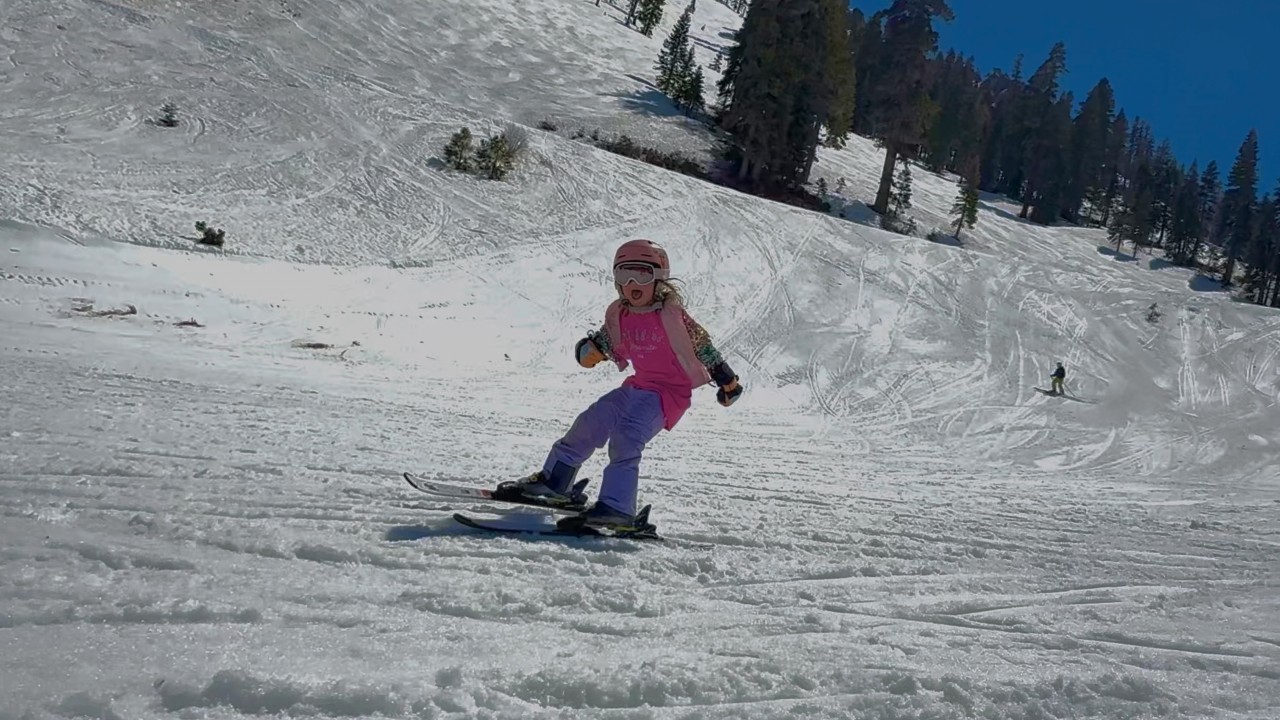
"I don't think we can risk it."
Being with kids lets you experience some of life again.
The first time seeing an elephant. "Apparently they're related to mice."
The first time eating ice cream. "Yes. It is surprisingly cold."
The first time hitting a jump on a bike. "You have to carry your speed. Don't slam on the brakes."
I was talking to a client a couple of weeks ago, and we were discussing a series of talking-head interviews with some of their senior executive team.
The client looked at the creative treatment, which was about as straight down the line as you can ask for in a comms project, and yet felt they couldn't take the leap.
They were paralysed.
Paralysed by workload. Paralysed by the layoffs they know are looming. Paralysed by executive-level expectations of AI that don't match reality.
Since we started Casual, we've tended to share several ideas for our clients' projects. A "push the boat out" one, a safe one, and one somewhere in the middle. Far more often than not, the safe idea gets chosen.
It's understandable. You're better off producing something safe and underwhelming than taking a swing for the fences and missing.
Underwhelming is hard to measure. Missing isn't.
Video placement has always had an opportunity cost
Chances are your audience will make a decision about you from the first piece of content they see from you. Whether that is opening a conference, sitting on your homepage, or fighting for air in the shifting sands of social media.
So you should make it as good as you can.
And yet, when everyone should be more risk-tolerant than ever, certain areas of the market seem to be moving the other way.
What is crazy is that the perception of what constitutes risk has shifted. It's a reflection of our times. 2026 and all that.
The future can feel so uncertain, so frustratingly unknowable, that it is understandable to want to play safe with the elements you can control.
The thing is, we know safe gets forgotten. No one sets out to be forgettable. But knowing it and doing what it takes to avoid it are different things.
Safe isn't cheaper
Nielsen looked at nearly 500 campaigns and found creative was the single biggest driver of sales lift, bigger than targeting, bigger than reach. Good creative means good returns.
Over half of UK B2B advertising produces no response at all. Not dislike. Nothing. And that work needs 2.6 times the media budget to deliver the same market growth.
In the US alone, dull B2B advertising costs $3.1 billion in extra media spend to buy the results the work should have earned on its own.
Safe isn't cheaper. You just pay more in media.
The asymmetry of sign-off
It is always easier to make the case for safe, whether that is in your own head or in a project group.
Richard Thaler (of Nudge fame) once offered 23 executives a theoretical deal with equal odds: a 50% chance they would make $2 million, and a 50% chance they would lose $1 million.
The CEO, who was present, wanted them all to take the deal, as across the group they would be well ahead. Mathematically, it was a great deal, and yet only three out of 23 took it.
So Thaler asked the 20 who declined why. They said that getting it right would have earned them a pat on the back and a bonus. Getting it wrong would have cost them their job.
Film project sign-offs face the same asymmetry. The potential upside is huge, yet the (smaller) personal risk feels far more real.
This risk-aversion tax is hugely damaging because it undermines the power of compounding creativity.
Bold ideas get sanded down. The edges go.
The radical form that made it memorable, compelling and special gets softened into something nobody could object to. They don't object. To be honest, they don't even notice.
You spend the money, make the investment, and are immediately forgotten.
That's expensive.
Trying to be safe is itself a risk
Over 20 years, we've produced nearly 20,000 films. One recent hero film earned 784,000 views and counting. More down-the-line profiles sit in the three- or four-figure range.
Of course, some films need to be creatively limited. They're just informational.
But when every piece of content can run across multiple environments, why not create something with its own creative legs?
The paradox, then, is that trying to be safe is itself a risk.
Particularly when so many ways of hedging that risk are available.
We can produce and shoot multiple options, iterate rapidly on what works, and with the latest tools even generate pick-up shots without needing to reshoot.
At a time when the perceived risk is so high, the actual risk has never been lower.
So, that client? I'm happy to say they took the leap. They won't regret it.
Anyone who has watched a skier or a biker hit a jump knows that speed is your friend.
Going slow is, perversely, the best way to stack it.
So drop in, carry your speed, and risk something amazing.
This piece first appeared in Beyond Casual, Nick's newsletter on LinkedIn, on 4 September 2026.