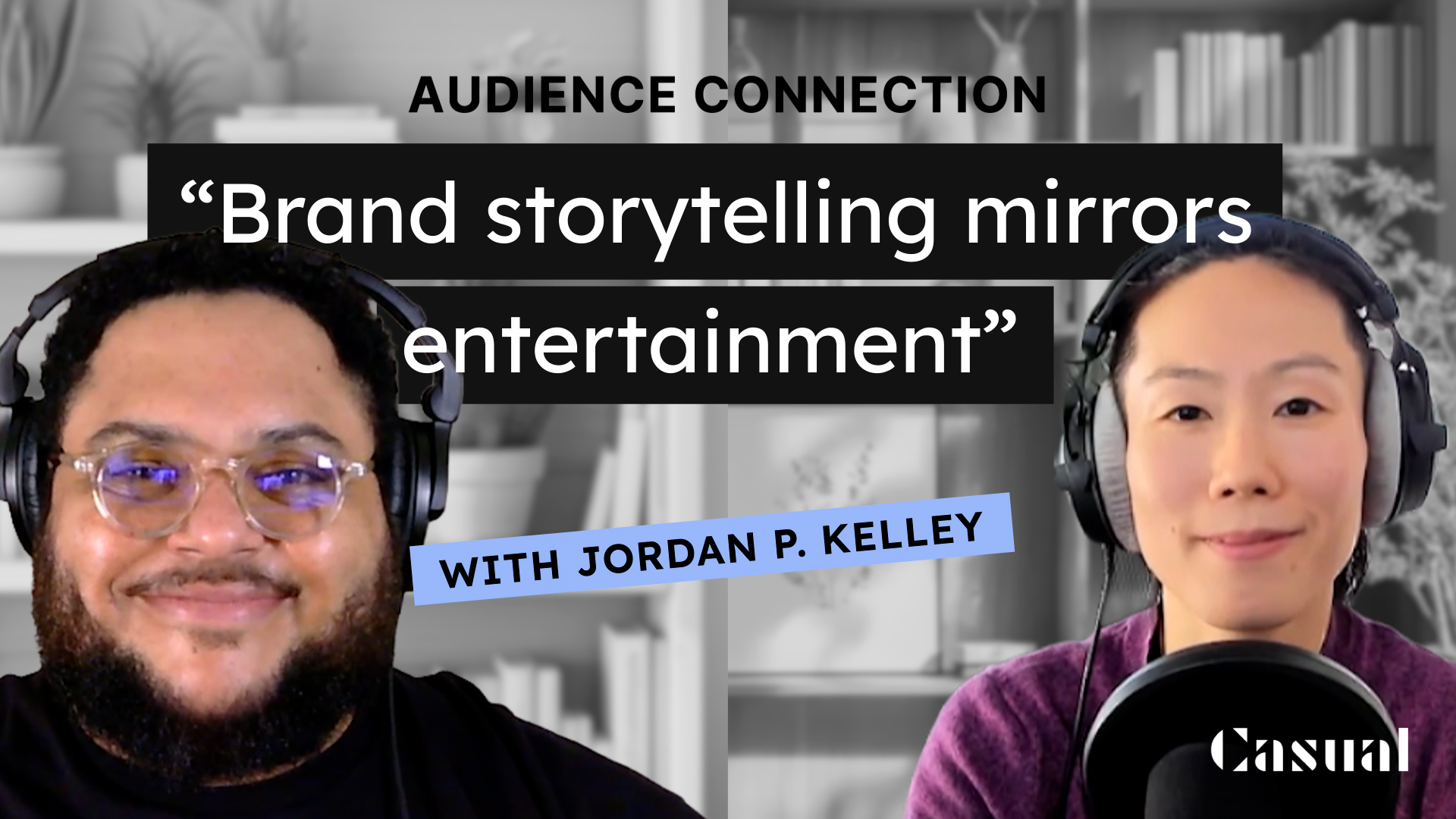
Are you doing brand storytelling right? Jordan Kelley will know
In this episode of Audience Connection, Lydia Chan sits down with Jordan P. Kelley, Director of Content and Editor-in-Chief at Aivanta, to explore what it truly means to do brand storytelling right and why so many brands are still getting it wrong.
With nearly a decade of reviewing brand-funded films and curating the programming for the Brand Storytelling Conference, Jordan shares what separates content that audiences actually choose to watch from content that simply blends into the noise. He explains why brand storytelling is not a long-form ad, how putting humans at the center of a story is the most reliable path to engagement, and why the element of choice is everything in today's on-demand world.
The conversation digs into the real tension that exists between artistic vision and brand objectives, and how the most effective players in the space are those who can bridge both. Jordan also unpacks how storytellers can build internal buy-in by reverse-engineering leadership's metrics and grafting those goals directly onto the creative work, making the case for brand storytelling in a language that resonates in the boardroom.
If you're interested in how brands can move beyond campaigns and create content that builds genuine audience affinity, or how AI and smarter measurement will reshape the future of brand storytelling, this episode is packed with insights you can take straight back to your team.
Key Takeaways:
- 05:37 - Brand Storytelling Is Not a Long-Form Ad: Why stretching a simple A-to-B ad structure into a longer format misses the point entirely, and what brands need to understand about the rules of entertainment
- 07:34 - Put Humans at the Center: Why human stories working through adversity are the most tried and true way to hook an audience, and why this is the simplest but not the easiest first step for brands
- 30:12 - Audience First, Brand Second: Why you cannot sacrifice the audience experience to serve a brand goal, and how today's viewers are far savvier at recognizing when they're being sold to than most brands realize
- 35:37 - Reverse-Engineer Leadership's Goals: How brand storytellers can build internal buy-in by starting with what leadership needs and grafting those mandates directly onto the creative strategy from day one
- 49:27 - AI and the Future of Measurement: Why early adopters who collect data now will be best positioned to leverage AI-driven predictive analytics, and how that will reshape what gets made and for whom
Podcast Transcript
00:00:01:16 - 00:00:08:14
Olly
This is the Audience Connection, the podcast where we go into what content actually connects and into why it sticks.
00:00:08:16 - 00:00:14:05
Lydia
Sponsored by Casual, where behavioral science meets storytelling to build trust for your audiences.
00:00:14:05 - 00:00:16:00
Olly
With your hosts. I'm only Atkinson.
00:00:16:00 - 00:00:17:15
Lydia
And I'm Lydia Chan.
00:00:17:17 - 00:00:41:01
Olly
So on the audience connection, we are always asking pretty much the same simple question what actually make something stick with an audience? Today we're joined by Jordan P Kelly, who is the content director and editor in chief at Avanza and also the driving force behind the programing for the Brand Storytelling Conference. Now, that means Jordan sits in this really unique position.
00:00:41:01 - 00:00:49:05
Olly
He's reviewing hundreds of brand funded films, talking to the people, making them, and spotting patterns that most of us don't get to see.
00:00:49:06 - 00:01:21:06
Lydia
That's right. Ali Jordan directs the content and programing for brand storytelling. They hold flagship events that brings brands, contributors and distributors together to really empower everyone to tell stories that truly resonate, which is what we're all about. On the show, we get into what brand storytelling actually is and may be more importantly, what it's not. And why the best work today looks a lot more like something you see on Netflix than it does a campaign.
00:01:21:08 - 00:01:50:14
Lydia
We also touched on something I think a lot of people are feeling right now, which is this tension between short term performance and long term brand building. So I think storytelling is a really important part of that, of that mix and that fix for that tension. One of my favorite parts is Jordan mentions this idea of choice, the fact that audiences want to watch anything anymore, which means if your story doesn't earn attention, it's just part of the noise.
00:01:50:18 - 00:02:09:13
Olly
You have to earn it because otherwise you won't cut through. And the science backs this up perfectly. Because research shows that when people feel like they're being told what to do and even if it's very subtle, they push back. I mean, we all feel that if you're being forced into a decision, you immediately go the opposite direction. And psychologists call this reactance.
00:02:09:15 - 00:02:36:00
Olly
And that's the moment an audience feels manipulated or obligated in any way. They just disengage. And that means you can't force attention anymore. You have to earn it. And you do that by giving people the feeling that watching it is their choice. Now, the best storytellers, they just understand this instinctively and they don't demand your attention. They make you want to give it.
00:02:36:02 - 00:02:58:04
Olly
So if you're trying to figure out how to create content people actually choose to watch or how brand storytelling is evolving beyond just nice films. This episode is packed with insights you can take straight back to your team. Let's get into it. Here's Lydia with Jordan Kelly.
00:02:58:06 - 00:03:23:14
Lydia
Today we're joined by Jordan P Kelly, who is the content director and editor in chief at, Iveta. He also directs the content and programing for the Brand Storytelling conference. So yeah, I'm really excited to have Jordan on because, he sits right in the middle of it all in regards to brand storytelling. He's a trend watcher, a thought leader, an industry curator.
00:03:23:20 - 00:03:25:15
Lydia
Jordan, welcome to the show.
00:03:25:17 - 00:03:28:07
Jordan
Lydia, thanks for having me. Good to be here.
00:03:28:09 - 00:03:53:15
Lydia
Great to have you. We're so we're all about audience connection on on this show. And you're in such a unique position to close this gap, right? That exists between what filmmakers love, what marketers need, and what audiences actually respond to. So that's what we'll try to do today. But before we jump into that, tell us a little bit about yourself and brand storytelling.
00:03:53:16 - 00:04:25:05
Jordan
Sure. Well, I am a lover of entertainment. I always have been. My concentration inside of my, collegiate experience was was in film and television. And I have always kind of been what I kind of consider like a, like, a high level audience member. I've, I've never not been somebody who sort of ingests and responds to the things I watch, the things I enjoy, the things I don't enjoy.
00:04:25:07 - 00:04:46:12
Jordan
It's it's sort of second nature to me. I can't really help it. Just under a decade ago, when, I was approached to kind of develop a newsletter for brand storytelling, with the intent on trend watching and looking at the space because, you know, it's kind of early at the time. I really jumped right in.
00:04:46:13 - 00:05:20:19
Jordan
I dove in with both feet. I really enjoyed it and recognized that there was something to this thing of brands engaging in sort of non interruptive, entertainment driven content that created brand affinity and lift for those organizations. Just in a way that, that advertising really couldn't. And so, yeah, with time that has just grown and grown, I think I'm kind of been converging with the direction of this thing over the last nine plus years.
00:05:20:19 - 00:05:28:05
Jordan
And, it's really interesting to see where things are now. And, to have had that experience of watching it for this amount of time.
00:05:28:07 - 00:05:37:01
Lydia
Let's talk about maybe some patterns. Are there any patterns that you've consistently seen and stories that truly engage?
00:05:37:03 - 00:06:12:20
Jordan
Yeah, absolutely. I mean, I would say that first there's understanding what brand storytelling is. Not right. And what it is not is it's not a long form ad. I think that something that happens all too often and used to happen a lot was this idea of you introduce the idea of what it means to expand something to a longer format, and that's the only thing that's being paid attention to.
00:06:12:22 - 00:06:57:18
Jordan
And so this sort of, because it's not a story doesn't exist inside of traditional advertisements, right? Yeah, story is there. But that story always tends to follow a really, simple a a part B part. There's, you know, a person who has a problem, introduce product. Product solves problem. Everyone's happy. Right? I think in the early days, when brands were trying to entertain the idea of doing more long form content, which is the way it was being talked about at the time, it was just sort of sort of taking that story structure and stretching it from 15 and 30s to three minutes, five minutes, ten minutes, 15 minutes.
00:06:57:20 - 00:07:34:06
Jordan
And that's not what we sit down to watch and enjoy when we are sort of in our own space, or with our family or with our friends, and are looking to be educated, entertained or informed. Right? That's not where we sit down to watch. So to answer your original question, I think the thing that brand storytelling needs to achieve is that it needs to emulate the things that we want to watch when we're sitting down to to relax, to enjoy ourselves, to, to, have that moment of escape.
00:07:34:06 - 00:07:59:03
Jordan
Right. And so what does that do for us all the time, I think I think that the really on the nose answer, and it might seem obvious when you think about it in the context of the kind of entertainment we enjoy. It's, it's it's putting humans like working through adversity at the center. Right. Human stories are a thing that is tried and true.
00:07:59:04 - 00:08:21:11
Jordan
There is all this time. It is a thing that we love to watch and love to enjoy. It is an incredibly simple, not easy, but simple first step to take when brands are trying to consider what kind of stories they could be telling and when they're seeking to find success telling their stories. So putting humans at the center is a is a surefire way to get people hooked.
00:08:21:11 - 00:08:22:18
Jordan
And engaged.
00:08:22:20 - 00:09:06:16
Lydia
Yeah. Yeah. And, you know, you mentioned, I guess, like conflict, right? Or just having that, you know, even hero's journey, if you will, right. When you're putting, either your customer at the forefront or, someone else that is affected by whether that's your product or your brand. So being able to really tell those stories that resonate, but also is, yeah, is just engaging instead of this, more maybe linear like way of thinking through how we, deliver certain messages in like an ad or five minute, sort of story.
00:09:06:18 - 00:09:34:18
Jordan
Absolutely. I mean, I think that and, and I'm sure we'll talk about this morning when we talk about how to approach and deploy brand storytelling. But, it's it's entertainment. It's it, it, it falls in the category of and should be recognized as entertainment. In today's world, the form that entertainment takes is more diverse than ever before.
00:09:34:20 - 00:09:59:19
Jordan
So I don't think that that's limited to form, but I do think that there is always going to be that element of, you know, I think there's there's really those three pillars. There's there's that inspirational content, there's the educational content. Is that an entertaining content? Those three things, you know, you might not call all three of those entertainment, but for the purposes of our conversation, I think they all fit because they all draw that similar level of engagement.
00:09:59:19 - 00:10:21:09
Jordan
They they take you out of yourself. They engage you in the thing that you're watching. And, you know, the best viewing experience is the ones that you kind of get lost in, right? The ones that you give yourself over to. And that's possible, with brand storytelling. But, again, technically simple, never easy.
00:10:21:11 - 00:11:00:12
Lydia
Have you seen, I guess, you know, over time, you mentioned nine plus years or, you know, or more over a decade. What has changed over time, right? You know, I think I, I think, you know, brands need to always differentiate, right? And stand out. But we also know that when a cultural leader sort of comes out with, a very engaging piece of storytelling or engaging technique or just an approach, then everyone says, I want that right, or I want to do that.
00:11:00:14 - 00:11:25:15
Lydia
And then there's a sea of sameness, and then everything goes to really baseline then, right? Everyone's creating the same kind of content, creating the same stories, but variations depending on your brand. So I guess you know, what is have you seen like, just like changes over time in regards to the type of brand storytelling that's, at the forefront?
00:11:25:17 - 00:11:54:13
Jordan
Oh, absolutely. I think you lay that out really well, and it feels really, reflective of my experience as, a viewer of so many of these projects and the trend watcher, I would say. You know, for a long time there have been existing models that, are really, like, well accepted and commonplace when it comes to integrations between Branded Story.
00:11:54:13 - 00:12:19:11
Jordan
Right. One of the easiest I can point at are, outdoor brands, action brands, things like that. They've been making stuff like this forever. You know, surf companies have been making surf films for as long as there's been surf companies. You know, skate companies have been doing this forever. Outdoor, outdoor adventure brands have been doing this forever.
00:12:19:11 - 00:12:43:11
Jordan
You know, they they put their because that has sort of an acceptable and understood pipeline of of how that works. Right. It's here's an athlete or an individual who uses a product. We're going to feature that person in doing a really watchable activity. And here's the products. They're in the shoes, they're on the surfboard. They're climbing a mountain in the jacket, whatever it might be.
00:12:43:12 - 00:13:15:04
Jordan
Right. I think what we started to see that I think really branches away from that was focusing more on the person doing that stuff than the activity that they're doing. Right. And so suddenly, like, you know, ten ish years ago, I think there was this really strong wave of this character focused content coming from a lot of those brands that I think set the first level of the thing you're talking about.
00:13:15:06 - 00:13:44:08
Jordan
A brand sees that they respond to it, they go, oh, I need to expand this from like action to lifestyle. And that lifestyle isn't you necessarily projecting onto this ambiguous person? It's about relatability with the individual that you're viewing, getting to know them. Right. So that happened. And then we saw a lot of that. I think the other interpretation of that was short docs are the way to go for brands.
00:13:44:10 - 00:14:03:20
Jordan
They're a couple of shoot days. They're less expensive. They don't require the rigor of of, drafting and storyboarding and all these other things. It's kind of like go out, set 2 or 3 days of somebody capture them and move on. Right. So that is still really popular and there's nothing wrong with it. We see a lot of it.
00:14:03:22 - 00:14:32:01
Jordan
But to your point about how that's changed or where new levels have been set. I think the filmic quality of stories like that has risen a lot. Like people have gotten more creative with the way they shoot those kinds of things. People have gotten more creative with the medium, the format, the length, the structure. It's kind of been stretched every which way, you know, in time, in, aspect ratio, you know, whatever it might be.
00:14:32:03 - 00:14:57:14
Jordan
And so once that kind of became like, really pervasive somewhere around five years ago, I would say the pinnacle of that, was what was going on with Yeti films. Yeti's entire department inside of their brand became like the North Star for so many people. But there's a ceiling on that, and I think the ceiling on that has a lot to do with strategy.
00:14:57:16 - 00:15:45:12
Jordan
Strategy is a huge part of this conversation, and I think bringing the strategy part in helps determine the, the, the piece that you're talking about, which is like what is creating evolution of the form. And I think one of the biggest evolutionary drivers was the necessity for other stuff to be happening on camera to drive new outcomes. So when you start seeing our, people trying to branch into these more diversified character stories, multiple characters, people working on doing that within larger, longer formats, really achieving like a full feature length doc or even short docs that feature multiple people and are more about like a larger subject than just about the character.
00:15:45:14 - 00:16:25:14
Jordan
I'm still waiting for the wave to hit on on, narrative. But I'm hopeful and confident that it's coming. I think we've seen more and more narrative examples. It's not quite there yet, haven't quite cracked that nut. But, you know, between all those different, ideas, I think a bunch of branches emerged. And that now what we're seeing is sure a lot of human driven and character driven stuff with one person or multiple people, but they are starting to resemble more and more the existing entertainment formats that are out there.
00:16:25:16 - 00:17:01:08
Jordan
And that, I think, is that next level is that thing where we went from this is sort of a prescriptive type of storytelling that is somewhere between 7 and 14 minutes, features a talking head or two and maybe a little background on them to a fully dynamic, film or a fully dynamic television show or even, you know, great examples of moving into, like the reality genre and emulating the way that those shows are produced with really wonderful brand integration.
00:17:01:10 - 00:17:22:07
Jordan
They've all sort of seeped into the existing categories, and people have had the time to practice and get really good at it. So I think for the people that have been making it, the production quality and value is really high. And the last thing I'll add is we are on the smartphone. Boom. When it comes to the way that stuff like this is being created.
00:17:22:09 - 00:17:40:16
Jordan
You know, the walls are sort of falling on the way. Entertainment is broken out categorically. And so now you're seeing a lot of that production value and quality come to your phone. And I think that's huge. I think that's going to be a big part of what we see happen now. And in the near and continuing future.
00:17:40:18 - 00:18:14:05
Lydia
Yeah. No, no, I, I, I feel like it's, it's a little no holds bar right now. Right where it's just so much opportunity out there for true creatives are true individuals who are kind of thinking outside of the box or like brands who are thinking outside of the box to really try different channels, different mediums. We had a few conversations, with, with some partners, about, you know, using more of a narrative format to deliver on the strategy, right, that, that they're, they're going for.
00:18:14:07 - 00:18:43:17
Lydia
So I also think narrative is a way to go for companies that maybe don't have that, character or that product. Right, as you sort of said in the beginning of your answer. It's like when you have such a, active or outdoor action kind of aspirational brand, I think not to say these stories are easy to tell, but you know that there is that, easier connection to, to sort of draw on and see.
00:18:43:22 - 00:19:10:17
Lydia
But if you're in, say, tech or finance, you know, consulting, which is kind of the, the big brands now that we hear, nowadays. Right. Because, you know, the world of AI and tech is just moving so quickly. How do they tell brand funded stories? And I think, you know, narrative is is the way to go for, for those, for those brands.
00:19:10:19 - 00:19:52:01
Jordan
Sure, absolutely. Like, I can't wait to see what's happening. The next leap that we're going to take with B2B as well, you know, I think those organizations, many of whom are in tech, many of whom work, you know, across other companies, right. There is an opportunity there, to to jump from the thing that's happening now, which is mostly like, you know, something like mid tier to elevated level customer stories to more of a, a journey, that tracks the, you know, implementation of a tool and shows the outcome of that result.
00:19:52:03 - 00:20:16:16
Jordan
I think there's something to that that could be, really interesting and cool and gives you the opportunity to reach a group that you wouldn't otherwise reach. I think so many B2B organizations are so insular. You know, they're known by they're known by their clients, but they're not necessarily known by the people who benefit from, you know, whatever the product is, the technology, the service, what have you.
00:20:16:18 - 00:20:42:08
Jordan
But look, this is all about building goodwill with the audience that lives downhill of your product. Even if you are a B2B organization. Right? So generating affinity and lift with the consumer, even if the consumer doesn't have, like the most intimate understanding of your tool because it's inside of another tool they use, take a microchip that's inside of their favorite computer.
00:20:42:08 - 00:21:06:11
Jordan
It's like, you know, I don't know anybody. I don't know the lay person who has like a favorite microchip, you know? But who's to say that's not possible or not valuable, right? You know, a client is going to recognize that there's a lot of value in partnering with somebody if their product, for some reason, is popular amongst their core user group as well.
00:21:06:13 - 00:21:11:06
Jordan
And, you know, it's like maybe narrative is a way to do that. I'm excited to see what happens with that.
00:21:11:08 - 00:21:31:10
Lydia
Yeah. No. Same same here. Jordan, for for our viewers who are not familiar with the brand storytelling conference, can you tell us a little bit about, the, the events? And, you know, I would love to kind of pivot then to talking about the official selections, you know, program as well.
00:21:31:11 - 00:22:07:15
Jordan
Sure. Absolutely. Brand storytelling, also colloquially known as best is a convener conference that gathers once a year, in conjunction and at the front of Sundance Film Festival. We are sanctioned event of Sundance Film Festival, which makes us a partner with them. And basically, it's an opportunity for brand storytellers and their partners to gather and discuss the business of brand funded content and entertainment, as well as content future, where things, not just how things have been, but where things are going.
00:22:07:17 - 00:22:34:22
Jordan
So it's all about bringing in the brands themselves as well as, you know, their production partners, agents, directors, consultants, everybody that's a part of that community and ecosystem and giving them all an opportunity to interface with one another. Talk about the challenges they're facing. Talk about the opportunities they're facing. Sort of work together to lift the entire space.
00:22:35:00 - 00:22:55:12
Jordan
And something that I love about that is that that's something the space needs. It has needed it for some time. I think it needs it now more than ever because we're very, very close, I think, to what I've just been referring to as this demarcation point between, the way things are and the way things will be.
00:22:55:14 - 00:23:17:21
Jordan
So I think that's something that we've had an eye on for some time, and we're really excited about the fact that that feels more near than ever before. And that is due in large part to getting folks like this together to talk with one another and, you know, kind of share with each other how they're getting the work done, their own best practices, the stuff they've seen that really stands out to them.
00:23:18:01 - 00:23:23:12
Jordan
And then taking those things back to their leadership and their organizations and implementing them.
00:23:23:14 - 00:23:52:21
Lydia
Yeah. Now I, I highly recommend, the best conference to to anyone, really. I've been as well like last year and just watching amazing films. Right. Surrounded by really like minded individuals who just have a passion for storytelling, just have a passion about what really drives brands forward as part of this. Right? You you assemble this, this diverse committee to to judge these films.
00:23:52:21 - 00:24:16:06
Lydia
Right. Talked about directors, producers, consultants, distributors, marketers. So all these groups have, I'm sure, has different opinions on what makes a successful film. Can you touch on, you know, what kind of maybe like what what do you notice sort of each group tends to gravitate towards and perhaps provide a few examples.
00:24:16:08 - 00:24:36:13
Jordan
Sure. And you know, disclaimer before I do that is that there's always outliers. You know, every individual's opinion is different. But if we're talking over the span of the years that this is happening and things that I've observed, like, absolutely, you know, I think that there are some patterns that that are followed. And I don't think you'll be surprised to hear what they are.
00:24:36:15 - 00:25:04:01
Jordan
Right. Because they really accurately reflect kind of what some of the tensions are like in this space in general, and that is that artists put the art first and the audience first. Brands, because it is their job and their responsibility. Put brand first, put brand safety first. And you know, we can talk about the elephant in the room, like there's an inherent tension that exists there.
00:25:04:01 - 00:25:28:20
Jordan
I think sometimes, as has always existed, because art and commerce are always tied and that's always a thing, right? But what I love about putting groups like that together is that you get to see sort of what stands out, but also what exists in the or rather, what stands out for each of them independently. But then what also exists in the Venn diagram, right.
00:25:28:21 - 00:25:59:20
Jordan
Like in the center of the Venn diagram. So, you know, I think it really is safe to say that, you know, when we have directors, on on the panels, like they do tend to be, they do tend to gravitate toward the projects that really have a distinct visual style. Mirror traditional filmic entertainment. The stuff that really puts emotion and some of those, like, intangibles at the fore.
00:25:59:20 - 00:26:45:01
Jordan
Right? And you know, when you have brand representatives on the panels, they are almost always going to champion the ones that they feel have really achieved a good amount of brand presence and brand recognition. Now that I, you know, I want to make it completely clear that that doesn't mean that it's removed from good taste, right? Those are often really tasteful examples, but I think because of just the nature of their work, it tends to be the case that it's like we want to see the ones where audiences are left with an indelible impression that connects right back to the brand.
00:26:45:05 - 00:27:16:14
Jordan
Right. Yeah. So that's a huge thing. I would say that if I had to cite the people that I think have what I would consider, you know, the most dialed approach, it's always going to be the people that exist in between those groups. Right. So it's the agents, it's the consultants. And then there's like a third category, this emerging category of people who are inventing and defining their own roles.
00:27:16:16 - 00:27:45:20
Jordan
Right? These people who are sort of like operating a business and a post agency environment, if you will, where they're kind of taking on, sort of like a hybrid of both their operating as a consultant, their operating as an agent, their operating as developers, like those folks. I think they just have such a keen understanding of what both sides want, and then they're able to bridge that connection.
00:27:45:21 - 00:28:05:08
Jordan
And again, that's not to say that that doesn't happen on one side or the other. I think some of the savviest people that are directors and some of the savviest brands are the ones who can do that work for themselves. But this is still a new space, and it takes some getting used to, which is why there's a ton of value in those people that sort of live in that middle space.
00:28:05:08 - 00:28:14:21
Jordan
They tend to, I think, really be able to see the vision on what makes this kind of content work.
00:28:14:23 - 00:28:44:11
Lydia
Yeah, they're almost like, really that the bridge. Right. Because we we talk about this a lot too, where, you know, you have the, the directors, the artists, really trying to make something beautiful and, just they have a very clear vision. And then you have the brand that, you know, really needs to put all, all the kind of key sort of brand, reasons to believe and messaging in there.
00:28:44:13 - 00:29:15:05
Lydia
But someone needs to be that sort of facilitator of bridging those two groups together. Right? You know, it's it's almost like the the family member that, like, brings together everyone, that sort of fits with each other a little bit. Right? And kind of make that case because I think that, is one of the barriers right now is that, we still need the, the folks who can understand all sides to help make the case for brand storytelling and, you know, push it forward.
00:29:15:07 - 00:29:34:00
Jordan
Absolutely. And it's like, I think it's really important to remember. It's like, let's not be, you know, let's let's not look at it with, with, too much of a rosy outlook. Let's not be naive, if you will. Yeah. We're here for a purpose. Right? It's like we're here to serve a brand goal. I think that has to be understood.
00:29:34:02 - 00:30:12:12
Jordan
But the savviest directors, the savviest producers and those bridge individuals all understand that you can't serve the brand in the way they want to be served. If you aren't willing to take a certain amount of calculated risk. And that is the thing that separates this from marketing, right? Brand storytelling mirrors entertainment. It is not a campaign. It it it follows the rules of entertainment.
00:30:12:14 - 00:30:42:04
Jordan
And so that is where that tension becomes difficult, I think, for the people who inherently understand that these products, these entertainment products, these media products, they have to be audience first. While also serving a brand objective and driving a brand result. That's the balance, right? And it has to be balanced. You can't give up on the brand end, but you can't sacrifice audience to serve a brand goal.
00:30:42:04 - 00:31:14:06
Jordan
Because guess what? It won't serve it at all. Audiences are way too good at pattern recognition. They are way too savvy, much savvier than I think a lot of people give them credit for when it comes to ad exposure, right? And we have a very kind of tenuous relationship with ads these days, right? I think some of us that still watch linear TV have the experience baked into, you know, our viewing.
00:31:14:06 - 00:31:31:09
Jordan
We understand that there's going to be ad breaks. But, you know, the advent of streaming, the advent of recording, we all also now have this layer of expectation that we are able to skip through those moments and find me, the person who's not skipping through those moments. Right?
00:31:31:11 - 00:31:33:15
Lydia
Yeah, I don't get me wrong button.
00:31:33:17 - 00:31:57:20
Jordan
Right, right. And look, I'm not firing shots here like advertising has its place. It's super important. It's not going anywhere. But our relationship as viewers with advertising has changed, right? And so if you try to put something in front of someone that you tell them isn't an ad, but is, they will know that it is plain and simple, right?
00:31:57:20 - 00:32:20:06
Jordan
So you need the artists, you need the producers, and you need those bridge people to help you negotiate that balance between being able to drive that band brand or active and reaching the audience in a way where they choose just to opt in. Because that's the big thing, right, is choice. They need to want to be there and to stay there.
00:32:20:11 - 00:32:23:02
Jordan
And when you can do that, you've won.
00:32:23:04 - 00:32:55:15
Lydia
Yeah, I like I like that you bring that word in choice because we are fully in a, you know, just on demand economy. Right? Everything we do, we have a choice. We need to put that in in the back of our minds when we're producing content. Because that's just how the audience behaves nowadays, or that's how, you know, the technology has, has kind of, sort of laid it out for them to, to give them choice.
00:32:55:17 - 00:33:26:23
Lydia
Jordan, I recently read an article of yours, on the page, referencing this CMO report from, Dentsu that draws, you know, 2000 marketing leaders right across 14 countries. And you wrote, you wrote, quote, CMO has openly acknowledged the difficulty of balancing short term performance metrics against longer term brand equity. This is the most human pressure point in the report and the most actionable for storytellers.
00:33:27:01 - 00:33:35:06
Lydia
How can storytellers really take this and really take it as a jumping off point?
00:33:35:08 - 00:34:15:08
Jordan
Yeah, absolutely. I mean, my thinking on this is that when it comes to, again, trying to negotiate that tension that we were just talking about at a, and like an organizational level, like within the, the boardroom, if you will. There has to be an understanding on the part of the people that want to enact storytelling, that there are directives, and, and, and mandates that need to be met by the leadership who's responsible for greenlighting it.
00:34:15:11 - 00:34:58:18
Jordan
Right. Doing everything you can to stay on top of what those mandates are, should make the job of of speaking to those leaders with conviction. More possible. Right? So that, I think was something that really intrigued me about that report itself, was this idea that here you have, put together for you, nice and neatly packaged, this, this, this document that states, you know, across, a huge, sample source of, of individuals, what the wants, needs, desires and mandates that need to be met by CMO.
00:34:58:18 - 00:35:37:16
Jordan
Those are, the, the I think the simpler way to put it is for a lot of us right now, there is a for a lot of brand storytellers right now. They need to be working to create buy in. And one of the easiest ways, and I shouldn't use easy. I should say simple. It's an important distinction to be one of the simplest ways to do that into, in the current environment, where there's still lots of really valid resistance to doing this work, is to reverse engineer what the needs of leadership are and start with that.
00:35:37:16 - 00:36:34:09
Jordan
When it comes to better understanding what kind of content needs to be built, right. So if you have leadership that, you know, again, like in that report, if you have leadership that needs to be looking at, reducing workflow friction by implementing AI, and that's something that they need to see build that into your strategy for production. If you if they have certain metrics that they need to improve quarter to quarter, find a way for the work that you're putting together to help drive the growth of those metrics by starting with what your individual leadership needs, you can work backwards and graft those goals directly onto the creative work, because ultimately, the thing
00:36:34:09 - 00:37:06:00
Jordan
that the storyteller, whether it's a contractor or somebody inside of a brand, their superpower, is being able to approach the work creatively. Right. And so many creatives will talk about the value of constraints, having having barriers, having constraints, having limitations often results in some of the most interesting ideas that you wouldn't have come up with on your own.
00:37:06:02 - 00:37:33:00
Jordan
I think many would say that it's a lot harder to just be given an unlimited budget and a blank slate and no demands and say, go for it. Make whatever you want. That's a recipe for disaster, because ultimately it's not going to be the thing that somebody needs, right? It should be approached as, you know, an advantage to fully understand what corporate leadership needs to see as a result.
00:37:33:02 - 00:38:01:09
Jordan
And look, that's not going to work every time and for every thing. I think that's really important to to, to to note. And I this is a whole rabbit hole I could go down, but I'll keep it succinct, as succinct as I can, which is basically to say that, look, if you have, goals that emulate, you know, tangibles that can be solved with traditional marketing approaches that already exist, do that, go for that.
00:38:01:11 - 00:38:33:19
Jordan
You know, if it's really about driving sales or if it's really about driving, you know, by customer acquisition, in a measurable and traditionally measurable format. Stick with that. Right. That's not what you should be doing with brand storytelling. And I think that a lot of the skepticism does exist with brand storytelling comes from this idea of leadership going like, well, what can it do for me if I need this thing in this thing, it's like, well, you're you're we're not talking about the same thing.
00:38:33:19 - 00:38:56:07
Jordan
It's apples and oranges. We're talking about. You're talking about an A track that drives a very distinct set of measurable outcomes. But that isn't necessarily what brand storytelling does. It can do that when built into a really unique strategy where you can pull, you know, individual items out and use them as marketing. This is what I mean about pulling down the rabbit hole.
00:38:56:08 - 00:39:28:01
Jordan
But and know we could talk about that all day long. But I think the reality is brand storytelling is the thing that helps you achieve some of those intangibles. Right? Audience affinity, audience lift, perception. These things that are pretty observable be difficult to do in 30s, right? You can't really do that with those items. So if those are the thing, if those are the goals and those are the mandates that need to be met, storytelling can be a really good way to go.
00:39:28:07 - 00:39:35:22
Jordan
And along the way you can hit some of those other things, like some of those those points mentioned in that report.
00:39:36:00 - 00:39:58:21
Lydia
Well, first 100% agree. We always talk about Casual that, you know, it always ladders back to outcomes and goals. Right. And we always have to make sure that whatever created that we're proposing, whatever story that we're proposing, it is very you can tie it literally a straight line. Right. And, you know, people can tie that back to the proposal.
00:39:59:03 - 00:40:27:15
Lydia
And it's very simple to sort of digest and see. Right. Because at the end of the day, that's what we're here to do, right? We're here to achieve business goals with the content that we create. And then another thing, you know, and that that you touched on is that I think a lot of organizations still look at it as like, or it's like it's this or that or, you know, of course, because we don't have unlimited budgets.
00:40:27:15 - 00:40:54:14
Lydia
Right. But it is a and conversation. So how do we do this and that and brand storytelling. Right. Because it's a whole ecosystem of, of content that we need to create for a brand. And it's not just, you know, performance focused ads. It's not just, you know, brand storytelling. Right? It is. Everything needs to flow together.
00:40:54:15 - 00:41:47:12
Jordan
Absolutely. What a fantastic, constrained budget is. And I know that nobody would agree with that or say that, but it really does present, a unique opportunity to engage high level strategy to make something work for you rather than against you. If you can go to leadership and you can talk to them about the idea of what they might determine would be suitable to spend for, say, a single ad by a block of ad buys, like whatever ad production and, and by itself, you know, there is an opportunity to take that number, work with that number and demonstrate that for that number or less, you can create a media product or flight of media
00:41:47:12 - 00:42:17:05
Jordan
products, pull a bunch of content out of those media products, use them in the same way that you anticipated you would use those ads. Maybe not in the traditional space. Maybe they're not landing on, you know, maybe they're not landing in the, traditional commercial block on live programing television. You know, maybe they're not going to the Superbowl, but you could certainly do some programmatic buys or some or some social buys or anything like that for things to appear.
00:42:17:06 - 00:42:48:11
Jordan
You know, where audiences can be, like very acutely targeted. You know, there's there's an entire there's an entire opportunity of, of, of and set of options there for deploying strategy that allows you to then go back to leadership and say, here's the number you want to spend with that number. Or last, we can do Abcde and E and then, you know, best case scenarios, you get the opportunity to prove that out.
00:42:48:11 - 00:43:21:22
Jordan
Right. Take the shot, prove that out. And and again, it all comes back to that idea of, you know, determining what those metrics are, determining what those goals are. Establishing you set it about the brief, right? It's like you want to be able to trace things through. So like the KPIs need to be in the brief, like they need to be establish the front end so that when you get to the back end, you can point back at them and go, you wanted this, we delivered this and we did it all with a media product that, you know, gave life to these other things that were able to be placed as ads.
00:43:21:22 - 00:43:45:09
Jordan
And again, that's just one way to go about it. But I think, and we talked about this a little bit offline, but I'll say it again now, which is I do think that like, we're kind of approaching this sort of inflection point, this demarcation point, and we're living in the before, but the after is soon to come.
00:43:45:11 - 00:44:15:18
Jordan
The thing that's happening in the before is like, you need to beg, borrow, steal, do whatever you need to do to prove internally the value of leadership or, excuse me, the value of brand storytelling to leadership. If leadership is skeptical because we know that that's where the block lives, right? Leadership who's all in? Those folks make great stuff, and they manage to do it and manages to get seen.
00:44:15:18 - 00:44:38:21
Jordan
It manages to work, but it's about getting the opportunity to take those risks. Right. So if there's aversion to risk or there's resistance to risk, then the only way to do that in what I'm calling the before, is to frame things within the existing framework and make them happen, to try and demonstrate that this is the kind of work that can be done.
00:44:38:23 - 00:45:03:09
Jordan
What I think will happen and what will happen, and what I think is near happening in this moment. We've seen some signals already in the press and people's work and things like that. Is that there is going to be a shift where leadership sees a lot of just like enough other people doing this, that even if there's some resistance, they're going to be willing to dip a toe.
00:45:03:11 - 00:45:24:14
Jordan
I've compared it in the past to like, what's happening in the world with electric cars right now. Like there are electric car evangelists out there. They are on the road. We see them everywhere. There are people that love them. Right? We see charging stations. The infrastructure is like starting to be built for them. And still we live in a world with tons of skeptics, right?
00:45:24:14 - 00:45:44:13
Jordan
And the right to be skeptical, because those electric cars don't perform the way that their gas cars do, and so on and so forth. Right. But there's going to come a moment, and we all know it's coming where there will be as many charging stations as gas stations, there will be as many electric cars as gas cars.
00:45:44:15 - 00:46:06:15
Jordan
And those people who are sort of last of the party are going to have to sort of begrudgingly change over. Or if we're going to switch metaphors real quick to the work environment, be phased out for somebody who wants to purchase an electric car, you know what I mean? So, yeah, look, maybe that's maybe that is me being a little rosy and a little hopeful.
00:46:06:17 - 00:46:30:21
Jordan
I can't say what timeline that's happening on, but I do think that's where we're headed. And in that time, all of this will be much more institutionalized, much more structurally sound, much more homogenized. Those processes will exist. But for now, if you believe in this southern thing, you kind of got to do whatever you can do to make it happen so that you can say, I told you so when that movie comes.
00:46:30:23 - 00:46:59:23
Lydia
Yeah. And it's it kind of goes back to what you mentioned in your article, too, about this is the prime opportunity because, still so little brands are or rather so many brands are skeptical, especially in the B2B space, in really investing in this type of storytelling. Right? So when you are then the first comer or, you know, the first to act in the space, you're going to be looked at as kind of the leader, right?
00:46:59:23 - 00:47:29:18
Lydia
And then the rest will follow. So I think it is a great opportunity for risk takers to sort of step up and say, let's, let's try it. The last thing I wanted to touch on to is, is measurement, right? So it is so hard to build a budget case for really anything nowadays. Right. But how far along have we gone in, you know, the ability to measure the impact of brand storytelling?
00:47:29:20 - 00:47:57:20
Jordan
It's a really good question. And I think it ties in with a lot of stuff that we've already been talking about. Right. Which is that, I think we are farther along than people realize. That's the short version. The slightly expanded version is this, we're kind of in a moment that, to me feels a little bit like, you know, the technology race that we're in right now, you could liken it to that.
00:47:57:20 - 00:48:18:02
Jordan
You could liken it to the race to to invent the light bulb. You know, it's not like Edison sat there and was the only guy working on the light bulb. And then it came out and everybody adopted it, right? It's like, no, there were lots of people quietly working toward the same goal, the same thing. And that's where I think we are now with measurement.
00:48:18:02 - 00:48:55:08
Jordan
I think we have lots of siloed organizations that span across brands themselves, production companies, distributors that are all working on developing methods to make measurement work in a way that they can then use to get more of this work done and can be seen as a like a deeply valuable tool by leadership. Right. Because for, you know, for leaders in the marketing world and for leaders in the entertainment world, they are used to these sort of homogenized metrics, you know, in entertainment, we, you know, in television we have Nielsen ratings.
00:48:55:08 - 00:49:27:21
Jordan
You know, in marketing we have we have these, these very traditional KPIs. So who's going to be the first to the mountaintop in this new measurement and metric system, I think is the question. But in terms of where we're at, I think that's all kind of happening in the shadows. And it's going to come into the light. And I want to connect that to the thing we were just talking about before this, which is why it's going to be important to be an early adopter now of brand storytelling.
00:49:27:21 - 00:50:01:02
Jordan
Because the other thing that is going to really catalyze this process is where we're at with AI, right? I mean, when you look at what is happening with the data consumption capabilities of AI and the predictive analytics portion of AI, they're they're connected. One one looks back, one looks forward, but you can't look forward and capitalize on good predictive analytics without inputs.
00:50:01:04 - 00:50:45:20
Jordan
Right. You need information to drop in there. So for early adopters, while this stuff is getting worked out, you will collect every bit of information that you can associated with the content, right? Try and, you know, measure, measure every metric, that's available to you. Because what I think will happen, we're not there yet, but I think the moment will get to is that we'll get to this place where either a set of tools or a singular tool will come out that is AI driven, that we can then take our historical data and drop into and use it to generate predictive analytics about what kind of content should get made next, what has best performed,
00:50:45:21 - 00:51:20:06
Jordan
how to reach specific audiences and that can be dialed in so specifically to specific, you know, it can be geo gated. It can, it can it can speak to specific micro groups like it's really I think the I think the opportunities there are really you know, sort of boundless. And I will add this bit about, you know, for the skeptics around involving AI in this process, I don't think there's any replacing the human element of creativity.
00:51:20:11 - 00:51:47:12
Jordan
Right. I don't think that that's an appropriate use of AI or an accurate use of AI personally. That's just one person's opinion. We'll see what happens as people continue to use it. Use the generative capabilities to, you know, storyboard work or create work or what have you. But when it comes to improving workflows, improving measurement, using that data to then go on and create more work, I think that's going to be huge.
00:51:47:12 - 00:52:02:21
Jordan
That's another opportunity for people. Who are you know, looking to sort of catalyze their own systems around telling these stories and getting really, really good at figuring out exactly what kind of stories they can tell. And to whom.
00:52:02:23 - 00:52:24:21
Lydia
Yeah, 100%. Well, Jordan, I feel like, I want to wrap things up with what you'll what we'll see in the next sort of 6 to 12 months. But I, I felt like we really covered that throughout our whole conversation. So I guess, to wrap things up, any sort of last thing, you know, comments or advice to.
00:52:24:23 - 00:52:31:15
Lydia
Yeah, to to our audience, around audience engagement. Before we, we wrap up.
00:52:31:16 - 00:53:01:13
Jordan
Yeah, absolutely. I think that, you know, it kind of comes back to that thing I was saying about, like the tangibles versus intangibles is audience is everything. And typically what needs to happen for a brand or organization when it comes to audiences? We're looking for, you know, that sort of emotional buy in like, forgive me if this is crude, but it's like you kind of want to plant your flag in some of their brain space, right?
00:53:01:15 - 00:53:56:01
Jordan
This is something that's important to brands and organizations, and it's something that hasn't historically been possible with traditional interruptive advertising. So when it comes to what a brand or a production company that's working with a brand or any other kind of storytelling partner, when it comes to trying to identify the problem that an organization or a partner is trying to solve, if that problem is one of those intangibles where you're just looking for, you know, to, to to try and generate that increased affinity, that increased list, that, that increased positivity in, in, in brand relationship, or just trying to kind of create a more pervasive native brand presence to improve familiarity, comfortability,
00:53:56:01 - 00:54:33:10
Jordan
whatever it might be. Storytelling is really the way to go. It can't be we there is no zero risk version. There's always going to be risk because again, it follows the rules of entertainment. And if there was no risk in entertainment, every movie would be amazing and every television show would be something we want to watch. So you can't look at it that way, but you can approach it with strategy like you talked about from the outset, to minimize that risk to a degree where you can experiment once there's leadership, buy in, collect those results, go back, do it again.
00:54:33:12 - 00:54:51:11
Jordan
You know, minimize the amount of risk. Don't be afraid to fail. Focus on success. And, the outcomes I think will be pretty great. We've seen a lot of it in the last, ten years, and I'm really excited to see not even the next ten, but the next five. I think it's going to be huge.
00:54:51:13 - 00:54:57:11
Lydia
All right, we'll end there. Jordan, thank you so much for joining the show. Really enjoyed our conversation.
00:54:57:13 - 00:55:01:18
Jordan
But yeah, thank you so much for having me. It's been a lot of fun.
00:55:01:20 - 00:55:10:09
Olly
If this episode sparked something, curiosity, a new way of thinking or something you're going to take back to the team, we'd love to hear about it.
00:55:10:11 - 00:55:18:01
Lydia
Absolutely. Make sure you're subscribed, leave us a rating and drop us a comment. Tell us what stuck and what you want us to explore next. We want to know.
00:55:18:03 - 00:55:25:23
Olly
This is the audience connection sponsored by Casual, the video partner for global brands trying to build trust with their audiences. We'll see you next time.

Fix up quick smart.
Find out more about how Smart-Casual can help
improve your video content
