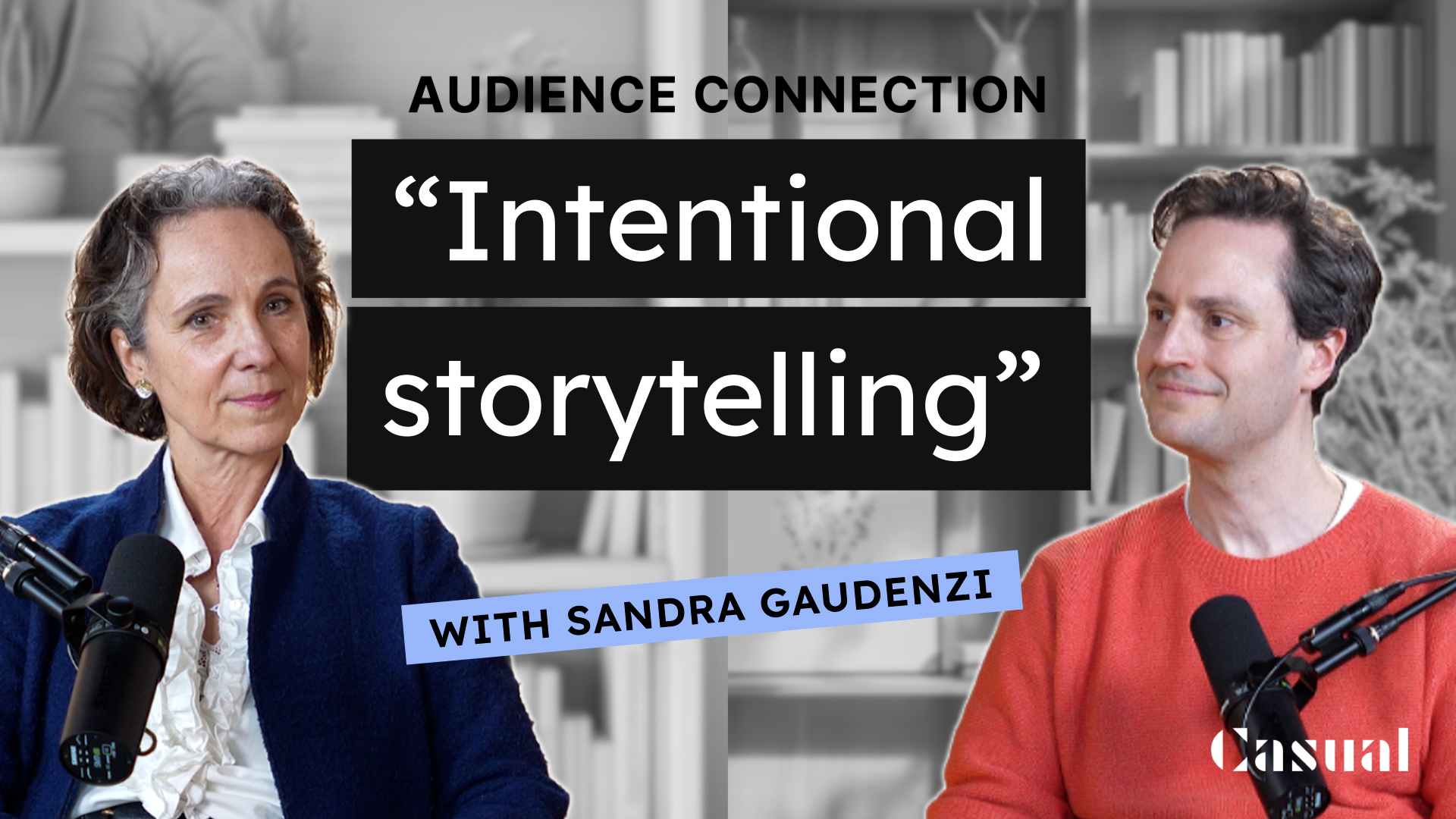
Sandra Gaudenzi on Intentional Storytelling | Part 2
Oliver Atkinson continues his conversation with Sandra Gaudenzi to ask a tougher question: once a story moves someone, how do you turn that moment into real change without slipping into manipulation?
Sandra reframes impact storytelling as intentional storytelling, mapping every layer from who makes the work and how the interface is designed to the conversations, communities, and campaigns that follow release. Her metaphors land hard: a single story is just one fish in an ocean of narrative change, and a brand chasing short-term persuasion is like a parent ending a supermarket tantrum through force, effective now, costly later. She also argues that behavior change needs repetition, belonging, and values that are lived consistently, not just performed in the ad.
For marketers, brand leaders, filmmakers, and strategists, this episode is a sharp guide to behavior change, long-term trust, and the kind of storytelling that shapes culture instead of merely chasing attention.
Learn more about Sandra:
🌐 Website: www.what-if.uk
💼 LinkedIn: https://www.linkedin.com/in/sandragaudenzi/
Key Takeaways:
- 05:18 - Intentional Storytelling Over Impact: Sandra reframes "impact" as intentionality, asking what your story is truly for and what change you want to create before you even begin.
- 10:22 - Design Is a Layer of Impact: How you design interaction - the platform, the interface, the emotional arc shapes how a story is received just as much as the story itself.
- 12:44 - One Story Is Just One Fish: Real narrative change happens when many stories move in the same direction over time.
- 18:32 - Brands Have a Storytelling Responsibility: Brands that use storytelling purely to drive sales are playing a short-term game.
- 22:01 - Short-Term vs. Long-Term Game: Like parenting, manipulation may work in the moment, but building trust through consistent, values-led storytelling is what creates lasting relationships with audiences.
Podcast Transcript
00:00:47:00 - 00:01:08:06
Lydia
Welcome back to the audience connection, guys. Today we're letting the audience choose their own journey. Not you guys listening specifically. You'll have to listen all the way through like usual. But, yeah, today's guest is someone who has spent her career exploring a really fundamental question. What if audiences didn't just watch stories, but actively participated in them?
00:01:08:07 - 00:01:42:03
Oliver
Yeah. Now we've worked in interactive talks ourselves and we've produced interactive work. I've worked in interactive theater. So this is a real subject that I really, really passionate about. Actually, you know, you've got interactive games as well. So to spread out into all areas of society. But Sandra has spent much of her career studying this, and she's really a pioneer of interactive documentary and immersive storytelling and exploring how digital media can transform audiences from passive viewers into active participants.
00:01:42:05 - 00:02:03:22
Oliver
And so her work, it really argues that stories don't just inform people, they actually shape how we understand the world and how we how we actually relate to each other. So when I when audiences are able to interact with a story or explore it or even contribute to it, that changes the relationship entirely.
00:02:04:00 - 00:02:33:09
Lydia
Right? Because we we all have our own perceived reality, right? And that's all shaped by our own experiences, how we grew up, our language, our culture and traditional storytelling tends to guide audiences down a single path, which is through the lens of, you know, the people making the story. And we know with true audience connection, if you're actually interacting with something that lodges into memory more, more deeply, and it resonates a bit more long term.
00:02:33:10 - 00:03:02:18
Oliver
Yeah, yeah. And this is packed with case studies. A fascinating case studies. And and Sandra asks what happens when you open that up. Right. So when audiences can explore, contribute or even help shape a narrative, what happens then? And we also dive into impact storytelling. So not just about telling a powerful story, but thinking about how stories then ripple out into the world and how that influences conversations, communities, and even social change.
00:03:02:18 - 00:03:16:16
Lydia
Well, a great conversation about how storytelling is evolving. So here is all these conversation with Sandra Gaudenzi.
00:03:16:18 - 00:03:26:04
Olly
Sandra, welcome to the Audience Connection podcast is absolutely fantastic to have you on. So I'd like to talk a little bit around impact storytelling as well. Right.
00:03:26:06 - 00:03:26:16
Sandra
Okay.
00:03:26:21 - 00:03:39:16
Olly
So some segue into the concluding bit. I think that's, you know, you've been working more on this field recently. If you could give us an introduction into impact storytelling and what that is as an idea.
00:03:39:16 - 00:04:27:11
Sandra
Yeah, that's that's an easy question, isn't it? I think from everything I said so far coming from documentary, trying to think, how do we use technology to effectively, create stories that matter? You can already see there's a thread that I, I overall believe that stories are transformative, that they have a power, and therefore, especially now in this time, probably are always but even more now we have too many stories, too much being sort of, led on us three stories and not enough impactful storytelling for a positive change.
00:04:27:11 - 00:04:49:00
Sandra
So I have this urge lately to think of impactful stories. An impact is a word that I don't particularly like, because first, it comes a little bit too much from the industry from my side, which is like, what does it mean to have an impact? Does it mean to change people? So then we go back into that logic of, I want you.
00:04:49:01 - 00:04:49:23
Olly
To do this, to.
00:04:49:23 - 00:05:18:04
Sandra
Do this. So I'm going to tell you like that so that you do that. That's not the way I would want to understand impact. And I, I would prefer to call it intentional storytelling. So what is my intention when I put a story into the world and my job is normally to teach at university to future storytellers, and I want them to be aware of their power, I just don't want them to be, egocentric people going, yeah, I have this idea and this is what I need to do.
00:05:18:04 - 00:05:37:22
Sandra
Or I have a client who just want that. I'll just do what they want. Life is life, and we all need to learn our living. And so there is the I don't want to put a judgment on that, but at least when you're young and at least when you move into the world at the beginning, you know, asking yourself, what am I really doing with this short amount of time I have in my life?
00:05:37:22 - 00:06:11:05
Sandra
And if my tool to be in this world is storytelling, what are my stories for? Where do they land? What is what am I trying to do and say with them? I think this is a question that we should at least ask ourselves. And so impact storytelling is a way of. Considering all this is, you know, is of thinking of the how a story land into the world and what impact and how we might change things around it.
00:06:11:07 - 00:06:32:17
Sandra
And what I have discovered recently, because, you know, for me, this is a fairly new field, is that I've probably spend 30 years of my life thinking of the impact of a story. Literally, just if my story is good is going to touch someone, and if it touches someone with their emotions, that's fine. This is enough. If I touch one heart, this is enough.
00:06:32:18 - 00:06:59:04
Sandra
This is why I think most of the people I hang out with, people in TV, in documentary, that's that impact for them. And what I realize is that that is a very small part of how a story lands in the world and creates change, because in the creation of this story, story has a lifespan, a lifespan that start the moment I decide to make this story.
00:06:59:06 - 00:07:17:16
Sandra
And when I decide to make a story, I need to think about what is this story about on my creative team. So now my interaction with this team is already a form of impact. Due to that story, who am I going to choose to tell this story? It's going to be the voices that normally or represented or not, you know, how accurate am I?
00:07:17:18 - 00:07:42:11
Sandra
You know? So so the team level, what I call the the the the process of the production, how am I going to work on this story is already creating a level of impact because I'm choosing people. I'm changing them through speaking about this story with them. Also, I'm probably going to have to, interview people. So the subject of the story are going to be impacted by this story.
00:07:42:13 - 00:08:17:08
Sandra
So this is already the while I produce, I'm impacting, you know, at a certain level. But at the same time, if I want this story to kind of have an effect, I could think of impact as the impact of story as the power of story, power of storytelling. Those are all the psychologist or the people who are thinking, what is the narrative arc that cognitively you know, brings us to have an emotion and because we are emotional, then we open our heart and then we want to have an action, for example.
00:08:17:08 - 00:08:58:05
Sandra
So that is another way of thinking of the impact of story, which is literally the power of the craft, of making a story that if I do it well, it might create more impact that if I don't do it well. But the story doesn't live in a vacuum. It lives in a medium. And this is why all this work that I've done with interactive storytelling for me was also about saying, okay, but when even if I am aware of how I work with my team and my subject, even if I'm aware of what my story is, if I now decide to do it in VR or on another platform, now there is another layer that
00:08:58:05 - 00:09:45:18
Sandra
will create more or less impact, which is the layer that belongs to that medium. So, for example, the way I'm going to design an interface, what I was telling you before about alma designing an interface that allows me to go up and down is impacting the way I'm going to receive that story. If I, if, for example, I create layers of interaction throughout my story where the user slowly opens up, for example, in writer's block by the end of writer's block, my cycling story, by the end of it, you're asked very, very personal questions about what is the secret you never said to anybody, for example.
00:09:45:20 - 00:09:59:06
Sandra
Now that is an interactive story that has an interactive design that is, I think, evocative in the sense that you start with easy task and you end up with questions which are more and more.
00:09:59:08 - 00:10:00:21
Olly
Run into the more personal.
00:10:00:21 - 00:10:22:15
Sandra
Yeah. So that is that is emotional design, that is interaction design that belongs to the platform. So one level of impact is not just the story. I'm going to do a story about people cycling in in the cities. That's one level. How am I going to work with my team and with my communities is another. But how am I designing it?
00:10:22:15 - 00:10:50:11
Sandra
Interaction design testing, that's another layer of impact. And then the moment the story hits the world, if we want the so called launch, the so-called distribution in cinema or in documentary, now we have another layer of impact because the story is going to hit an audience. But these audience now is hopefully opened somewhere. Cognitively, they're going to learn something, they're going to have emotions.
00:10:50:11 - 00:11:20:14
Sandra
So there's going to be transformed while they go through the story, what the experience, the story and then what. And then hopefully, maybe that is going to change something in their brain for the future, but very likely not, because the transformation that happens to you through a story is immediate, but doesn't last in time. So there is a whole other layer of impact, which is about social impact, about how do I create maybe activities, call to actions.
00:11:20:16 - 00:11:43:16
Sandra
Debates at the end of a film, a petition or a movement. So something that uses the power of a story to open you up, but then to move it into a space that is more a behavioral change is not just, oh, I understood something, but is rather right. No, we need to do something about that. But that needs to be orchestrated.
00:11:43:18 - 00:12:14:17
Sandra
So that needs impact producers. And that's a whole other layer than just creating the story at the beginning. It's another job. So that layer of impact is about social impact, but it needs to be strategized, financed, made happen by people who work in that field. And this is how the story starts now, moving from the single individual to communities and hopefully maybe to change this legislation or whatever.
00:12:14:17 - 00:12:44:14
Sandra
So that's a stretch of impact, which is much further than just the individual impact on the audience at the beginning. And then the last layer that you can think of is that I've done my story, maybe, and this has helped some people to change, but I'm just a drop in an ocean of other stories, you know, often, you know, there are a lot of, of, of waves of saying these sometimes people speak about the story being just a fish.
00:12:44:16 - 00:13:13:21
Sandra
And it's only when, you know, a whole stream of fish go into the same direction that you have what is called a narrative change. So the narrative change is a societal change in the way things are perceived. Patterns like, I don't know, Black Life Matters, for example, is not a single documentary or a single new story or a single interview or a news item that has created, you know, a sort of societal change.
00:13:13:23 - 00:13:39:22
Sandra
It is all of those things happening at the same time, moving. Yeah, that change the patterns in people brain because they start to think differently. They see, I mean, all our beliefs are a lot about just connecting in our brain. So the more we get used to see things differently, because this is what is all around us, the more we become part of that worldview sort of infuses on us.
00:13:40:00 - 00:13:56:07
Sandra
So narrative change is also a level of impact, but it's a very long term. It might take ten years, you know, 20 years, like the way we relate to tobacco and to smoking. Yeah. You know, if I was to take a cigaret now and say, okay, what should we talk about? You would think I'm completely bonkers.
00:13:56:08 - 00:13:59:20
Olly
I probably have cigarets as well. I used to be a like but yes. Yeah.
00:13:59:22 - 00:14:00:11
Sandra
All right.
00:14:00:14 - 00:14:02:11
Olly
Might be frowned upon by the podcasting studio, but.
00:14:02:16 - 00:14:30:19
Sandra
Not in the podcasting student. It was completely normal, you know, even 50 years ago. So that is a narrative change that doesn't belong to a single story, is the result of a lot of different type of stories throughout a long term. And so if you look at all these layers of impact, you kind of realize that these simplicity, you know, simplification of if I do a good story, this is going to be good enough because it's going to change someone.
00:14:30:19 - 00:15:10:17
Sandra
It's like, yeah, but that's a very little step compared to all those layers that if you knew about them and you were to start of taking them in consideration where you're creating your stories, then you could, for example, you know, be maybe more effective, but also at the same time stronger and more humble. Because if I know that I'm not going to change the world with my new documentary, but I might just, you know, push it in one way, I might want to do a research, know what else is around, because I might want to position myself in a space that at the moment has not been used by other stories, because this is how
00:15:10:20 - 00:15:17:09
Sandra
I, you know, I help the stream of fishes is not by doing exactly what already has happened.
00:15:17:12 - 00:15:19:22
Olly
It's building on the movie that's already going.
00:15:20:00 - 00:15:53:18
Sandra
On the movement. So I think being aware of these, what I call the impact, you know, mandala, which is like lots of different layers that together form a whole that gives us hope actually, because it also means, well, I can't change everything alone, but I am part of something. And so these, these, these way of thinking about how, you know, our stories can have an intentionality of change and going in a direction, providing that we take into account all those layers.
00:15:53:18 - 00:16:09:16
Sandra
And we are maybe a bit active about it. So when I form a team, I might want to think about what is this team really representing. And when I look for partners, maybe that also then is part of the impact, because those partners are going to help me to spread my story. So they need to be part of my story.
00:16:09:22 - 00:16:25:10
Sandra
So maybe they need to have also something to say about it. So now suddenly making stories becomes a much more complex juggle than just I have an idea. I need to find some money to do it, and then someone else would broadcasted and it's okay.
00:16:25:12 - 00:16:43:20
Olly
Yeah, yeah. You see, the film is is so powerful. Really. But it only does so much like you say, you can go and watch and you can feel moved by it. And that's, I think, reflecting back on what we're doing at casual is trying to focus on behavior change behavior science and, and how to actually change things. Once you've produced the film, what's the behavior change?
00:16:43:20 - 00:16:46:11
Olly
And it's it's really difficult to change behavior.
00:16:46:13 - 00:17:08:01
Sandra
It is. And it needs repetition or it needs, communities and needs belonging. So this is why activists actually have been doing that for. And we need to learn from them. They've been doing, I don't know, educational material. So watch the movie. But then we maybe discuss it. And then after discussing we kids have to, I don't know, write a blog about it.
00:17:08:01 - 00:17:20:10
Sandra
And so it's because they, you know, they enter into a new logic, into the story has open a space, but then you need to be active in that space so that there is a behavioral change.
00:17:20:12 - 00:17:41:05
Olly
And I love that idea about the narrative and the ocean of stories and building to that one point. And I think in the report there was a really nice, example of the arches was where they brought awareness around domestic abuse through the play, the, you know, people just listening to the story of it. But off the back of that actually had a change in society that.
00:17:41:07 - 00:18:09:03
Sandra
Yeah, I mean, that's a good example of how we all have a part to play in this, because, you know, when I think of, you know, storytelling for change and, you know, most I normally go into, oh, documentary news, you know, because those are activists and you normally don't think about the Archers or, you know, something. But but no, because that is a representation of, you know, it's part of public knowledge is part of what becomes normal or not normal.
00:18:09:05 - 00:18:32:07
Sandra
And therefore, you know, fictional stories are probably even more powerful because they're seen by more people. So we also have, I think, a responsibility to make sure that the way we script are, you know, sort of commercial, stories and going back to even the type of audience that I believe you probably have more for this podcast, which are brands.
00:18:32:09 - 00:18:56:02
Sandra
I mean, brands have a responsibility. Same thing. They have a role to play in to this. I mean, if they just use storytelling to, you know, sort of inflict a change, which is by more of my staff, they're just playing a single game and ignoring, you know, what we need as a community. And in the long term, I don't think that pays off in the short term.
00:18:56:02 - 00:19:26:17
Sandra
So I'm sure that the history of advertising tells us that it works. Yeah, but in the long term, it creates a society that maybe has its values a little bit too much in the owning and doing and not enough into the being and the connection and communication. So I think I want to hope and I want to believe that, you know, brands are of all types and forms and that they're all people who are really genuine.
00:19:26:19 - 00:19:53:09
Sandra
Of course, they care about their brand selling well, but that really believe that also that they represent they have values that needs to be represented. And so that they can use storytelling not just to do one ad, but that they can live as a role model, embedding and embodying and living and breathing those values. And then they will create a positive change providing that they do it like that.
00:19:53:11 - 00:20:00:23
Sandra
If they just do the ad saying those are real values, and then they actually do exactly the opposite, though back into the situation of.
00:20:01:01 - 00:20:12:17
Olly
The again, it's lack of trust. It's the same thing with I as well. We're entering into a world where there is no trust. And so the brands that live by their values are intentional around what they do. They are the ones that will probably stand out.
00:20:12:23 - 00:20:31:19
Sandra
Completely, I would say so. And and back to the parenting. I mean, not not that everybody needs to be a parent, but I think we've all all been kids. So we know that relationship of role model and who we are, you know, is, is often, I think, very useful when we think about how do I want to, you know, what is the game I'm doing?
00:20:31:19 - 00:20:51:07
Sandra
Am I doing the short term game or the long term game? You know, this idea of how I use storytelling is the equivalent of parents saying, you know, you shouldn't be lying, and then maybe they're lying at home. So between what they say and what they do, the kids pick up first that there is a tension and then that the reality, the world words in the other way.
00:20:51:12 - 00:21:06:23
Sandra
So this dissonance, my work in the short term, you know, it's like, it's like being, using authority as a, as a parent. I mean, you have small kids. I don't know if you've already done the tantrum, the tantrum case with.
00:21:07:00 - 00:21:08:09
Olly
Deep in the tantrum face.
00:21:08:10 - 00:21:35:02
Sandra
Okay. Well, let me tell you about the realization of my the first time I had to deal with the tantrum in the supermarket, you know, thinking, oh my God, this is so embarrassing. How do I deal with this kid completely out of control, you know? And I thought I had that half a second thinking, maybe I could just be the nasty parent who either slaps or screams or, you know, just be super authoritative and that's it.
00:21:35:02 - 00:22:01:23
Sandra
That's not on. And it will work. It does work. You know, it's not that authority doesn't work. But in the long term, what you create is a relationship of fear between you and your kids. Yeah. So the difficulty and I think this is difficult in general in life, for me, it was very clear in parenting, but I think it has a lot of relationship with how we do our stories and how brands should use their story.
00:22:01:23 - 00:22:32:04
Sandra
Is this idea of what is the game I'm playing? Am I playing the short term game? I want my kid to stop the screaming right now. So I need to, you know, sort of impose something or do I want to build the trust and plant seeds so that my kids never rise to this tantrum? Or maybe accept that there are time tantrums, but we can discuss about it, which is a relational way of thinking of how you still have an authority because it's not.
00:22:32:04 - 00:22:50:00
Sandra
The kids should do whatever they want, they need boundaries. But the thing is, how do you keep those boundaries or your responsibility as an adult? And I think brands is the same, you know, if they want only to have an immediate, you know, sort of gratification of a product being sought more by definition, they need to lie by definition.
00:22:50:01 - 00:23:05:02
Sandra
Yeah. And if they want to be authentic and I hate this word authentic because I think everybody's so everything in life. Right. What the hell does that mean. You know, what do you think authentic means for a brand? You know, tell me. I'm you're more of a species than me.
00:23:05:04 - 00:23:28:13
Olly
Well, I think it's really going back to what you were just saying around. I think if a brand's being authentic, they are. You're judged on your values when no one's looking. Really. And so I think if you are being authentic as a brand, you are making sure that it goes through your entire organization. It's not just to do with the sales, the shop window, you know, every single bit, you know, should be threaded through.
00:23:28:15 - 00:23:43:10
Olly
And I feel like if if from the top down, everyone is living those values, then I feel you're being authentic as a brand. So that's what authenticity just came to me. Thank you. I think it's bandied around a lot like you say, and I think it's put into content, especially you know, it's like this needs to feel authentic.
00:23:43:10 - 00:24:00:07
Olly
And by that I just mean you just. UGC probably. Yes, exactly. But that is not enough. You know, you really need to make sure that actually who are you talking to? What are they trying to say getting deeper into why they would want to say something about your brand and on camera and trying to just bring that out.
00:24:00:07 - 00:24:11:18
Olly
And I think that's what makes you a good director or a filmmaker is the ability to have that conversation, but pull that out of somebody without, you know, with their permission, obviously, and then being comfortable with it. Yeah. Yeah.
00:24:11:20 - 00:24:41:22
Sandra
So I think there is, bizarrely, a link between all those different layers, which is overall how to be responsible adults, whether we are a storyteller, whether we are a parent, whether we are a brand, and genuinely thinking more about the long term than the short term. More about the connections. I like to say that I hope people will start doing more stories, which are stories of care, of connection, of curiosity, of courage.
00:24:42:01 - 00:25:08:21
Sandra
I call them the forces because I think is what we need now. And so if you, you know, how do we embed those values and this way of understanding storytelling as a connection rather than I'm telling you what to buy or what to think or, you know, this oversimplification that we can see at the even political spheres right now about having you know, you know, amend that to me.
00:25:08:22 - 00:25:34:20
Sandra
Looks like, you know, effectively a sort of, a kid in the school either having a tantrum or bullying other people. It's actually representative of the way we are using storytelling for persuasion is that there is right and there is wrong. I'm right. So you're wrong. So I can do what I want to you. It's like, do we really want to believe that this is what all the values of our world.
00:25:34:21 - 00:25:39:00
Sandra
And if we don't we need to not speak like that.
00:25:39:02 - 00:26:07:23
Sandra
It works in the short terms. So because it really shows. Because it reassures people, because it speaks to their fear, because it manipulates their feeling of, you know, not being powerful enough. But it is a short term strategy. And that is the choice. I mean, I'm not saying that, you know, this type of storytelling and manipulation in storytelling and therefore also the counter effect of impacting storytelling because a negative impact of storytelling.
00:26:08:02 - 00:26:30:08
Sandra
I'm not saying that they don't exist. I'm just saying that our job is to be aware and as you know, as as much as we can of our power and use it to follow values that we hope our generation six generation apart might be proud of us, as opposed to just think about the short term.
00:26:30:10 - 00:26:36:01
Olly
Yeah, absolutely. I mean, like you say, it is, it is powerful in the short term if you kind of it works.
00:26:36:03 - 00:26:42:05
Sandra
It works like slapping your kid. You know, during the time in the supermarket. It's not that it doesn't work, it works.
00:26:42:10 - 00:26:44:20
Olly
And then people writing will drop off the cliff.
00:26:44:20 - 00:26:53:22
Sandra
What are the consequences in the long term is the question that I would like, you know, most people who are in communication to think about.
00:26:54:00 - 00:27:11:21
Olly
Yeah. I think Emem Rashid, who we have previously talked about the marketers oath. You know, we have a responsibility as a brand. We have you know, you are communicating to people you are that there's a lot of power and story. And so you know, that can be used badly. And and you know we've seen that it can still be very effective that way.
00:27:11:21 - 00:27:15:22
Olly
But we sort of need to check our moral responsibility.
00:27:16:00 - 00:27:17:13
Sandra
Totally.
00:27:17:14 - 00:27:19:02
Olly
Well, thank you very much for coming on.
00:27:19:03 - 00:27:19:19
Sandra
Thank you.
00:27:19:20 - 00:27:49:10
Olly
I really brilliant conversation. I've got what we always wrap up with one question at the end, and I'd be really interested to hear your response to this, because it's called the Audience of one. So it's really there's this idea that when you're writing a piece of content, you should think of one person to communicate that idea to and that sense as you're writing and or where you're creating and forms it's in a lot of, you know, all of our guests have different people from their the parents to their best friend who would critique in a certain way.
00:27:49:16 - 00:27:54:02
Olly
I'm fascinated what your response would be to that. Given our conversation, I.
00:27:54:02 - 00:28:32:08
Sandra
Think I'm going to disappoint you and tell you that I don't have a personal one. No, I don't I think, I genuinely don't, I think I really, I think of who am I talking to and with hopefully, and sometimes if it's a logic of, you know, how do I, I'm trying to look for words that are not impact, you know, how do I create a change in the person, a shift of in that person between, you know, through our conversation is a bit like, where do I want what do I want to add to the worldview of that person?
00:28:32:08 - 00:29:03:12
Sandra
And how can I, you know, so I think more of I nearly come out of myself, look at where are we? Most of us, it's not just the other one is where am I? What? What is it that I don't see? And so my audience is zooming out and looking at both me and the other and say, how can we meet in the middle so that we both change through these, story, through these, conversation, through these, whatever it is that I'm, even if I'm writing, I'm thinking like that.
00:29:03:12 - 00:29:20:06
Sandra
It's like, how do we meet in the middle so that we both have a space of of change? Because I think you never. It's never one way. Yeah. It's always at least two ways, if not more. So I think this is probably what fascinated me.
00:29:20:08 - 00:29:28:21
Olly
That it took me right back to that reference, the, the Power of ten, you know, the zooming out idea. And so, like, if anyone hasn't seen I think it's IBM. Isn't that the reference?
00:29:28:21 - 00:29:29:08
Sandra
Yes it.
00:29:29:08 - 00:29:44:19
Olly
Was. And so again, in that medium, article, which we'll put in the show notes, you know, Sandra references this zooming out of this old story where it keeps going out by the power of ten out into the universe and then goes back into somebody's skin and then into the molecules in that body.
00:29:44:20 - 00:30:14:04
Sandra
But I also think that by doing this exercise and I do this a lot in coaching, I also, you know, coach people either through their stories or life coaching, whatever. The moment you detach from the story you told yourself about who you are or what the world is, etc. the moment you detach from it, you suddenly see the possibilities, then it's your choice to decide to try another possibility or to experiment with the then you know that, then you really have a choice.
00:30:14:04 - 00:30:35:18
Sandra
But if not, you actually are in a linear path of which you have very little control. And and you often don't even know that you're in a linear path and that you could be someone else or do something else, or. So I think these exercise of zooming in and zooming out is something I do in general, both in my teaching for myself when I write.
00:30:35:18 - 00:30:37:21
Sandra
I mean, it's just a way of.
00:30:37:23 - 00:30:47:20
Olly
Yeah, of looking at getting a different perspective. Yeah, we want to, Fisher said. The you know, the life is a series of stories of which you choose from to live the good life. Right?
00:30:48:02 - 00:30:48:15
Sandra
Totally.
00:30:48:15 - 00:30:50:17
Olly
And so, yeah. Well, look, thank you very much.
00:30:50:17 - 00:30:51:11
Sandra
And pleasure.
00:30:51:13 - 00:30:54:03
Olly
Hopefully we can have you come on again in the future at some point.
00:30:54:03 - 00:30:57:06
Sandra
Thank you for having me.

Fix up quick smart.
Find out more about how Smart-Casual can help
improve your video content
