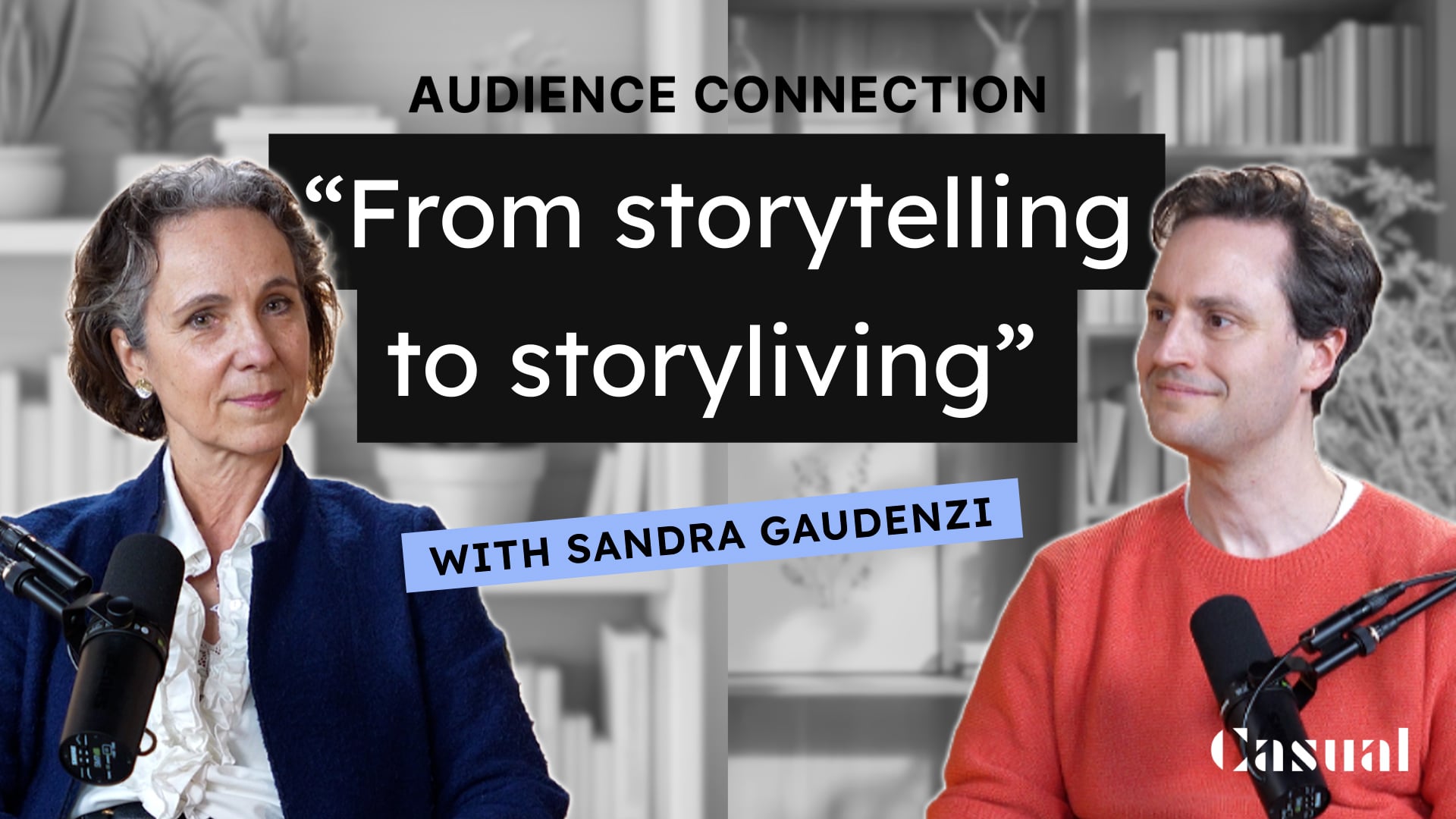
From Storytelling to Storyliving with Sandra Gaudenzi | Part 1
Oliver Atkinson sits down with interactive documentary pioneer Sandra Gaudenzi to explore why stories become more powerful when audiences stop being spectators and start becoming participants.
From the childhood moment a speck of dust made her realize perception is constructed, Sandra traces how language, culture, and media shape reality. She breaks down interactivity from branching paths to participatory spaces, then makes it tangible with a locative storytelling project that asks cyclists to record why they love a corner of London and leaves a “cloud of stories” for strangers to discover. She also shows how subtle interaction can deepen empathy, whether that means choosing when to look away in Alma or feeling another life inside Notes on Blindness.
In a world of passive scrolling and fractured attention, this episode gives marketers, filmmakers, experience designers, and communication leaders a practical lens on agency, embodiment, and why stories stick when people do more than watch.
Key Takeaways:
- 04:15 - The Construction of Reality: How a childhood experience with a "blob" of dust in her eye led Sandra to realize that reality is a complex, layered construct shaped by our own physical perceptions and cultural backgrounds.
- 11:16 - Agency vs. Control: Moving from traditional television production to interactive documentaries to give the audience "freedom and agency" within a story rather than just being passive observers.
- 22:45 - Modes of Interactivity: A breakdown of how we interact with digital media, ranging from the author-led Hypertext and the gaming-inspired Conversational mode to Participatory collaboration and body-led Experiential storytelling.
- 59:30 - The Power of "Otherness" in VR: Why Virtual Reality is most effective when it allows us to embody a different perspective
- 01:07:30 - AI and the Value of Process Time: A cautionary look at using AI for efficiency in storytelling, arguing that the "time it takes" to create and process stories is a fundamental human requirement that builds love, trust, and connection
Podcast Transcript
00:00:47:00 - 00:01:08:06
Lydia
Welcome back to the audience connection, guys. Today we're letting the audience choose their own journey. Not you guys listening specifically. You'll have to listen all the way through like usual. But, yeah, today's guest is someone who has spent her career exploring a really fundamental question. What if audiences didn't just watch stories, but actively participated in them?
00:01:08:07 - 00:01:42:03
Oliver
Yeah. Now we've worked in interactive talks ourselves and we've produced interactive work. I've worked in interactive theater. So this is a real subject that I really, really passionate about. Actually, you know, you've got interactive games as well. So to spread out into all areas of society. But Sandra has spent much of her career studying this, and she's really a pioneer of interactive documentary and immersive storytelling and exploring how digital media can transform audiences from passive viewers into active participants.
00:01:42:05 - 00:02:03:22
Oliver
And so her work, it really argues that stories don't just inform people, they actually shape how we understand the world and how we how we actually relate to each other. So when I when audiences are able to interact with a story or explore it or even contribute to it, that changes the relationship entirely.
00:02:04:00 - 00:02:33:09
Lydia
Right? Because we we all have our own perceived reality, right? And that's all shaped by our own experiences, how we grew up, our language, our culture and traditional storytelling tends to guide audiences down a single path, which is through the lens of, you know, the people making the story. And we know with true audience connection, if you're actually interacting with something that lodges into memory more, more deeply, and it resonates a bit more long term.
00:02:33:10 - 00:03:02:18
Oliver
Yeah, yeah. And this is packed with case studies. A fascinating case studies. And and Sandra asks what happens when you open that up. Right. So when audiences can explore, contribute or even help shape a narrative, what happens then? And we also dive into impact storytelling. So not just about telling a powerful story, but thinking about how stories then ripple out into the world and how that influences conversations, communities, and even social change.
00:03:02:18 - 00:03:16:16
Lydia
Well, a great conversation about how storytelling is evolving. So here is all these conversation with Sandra Gaudenzi.
00:03:16:18 - 00:03:43:13
Oliver
Sandra, welcome to the Audience Connection podcast is absolutely fantastic to have you on. And I'm really excited to talk about interactivity, how that plays out and impact storytelling as well. I'd love to dive in straightaway by talking to you a little bit around your journey into this field. And there was one specific bit from the research that you sent to me on your, your medium, article around a speck of dust on your eye.
00:03:43:13 - 00:03:51:05
Oliver
And I'd love to kind of recap on that and some of the references in there, because I thought that was a really lovely introduction into how you started thinking differently about the way you could produce a talk.
00:03:51:09 - 00:04:17:04
Sandra
Yeah. Thank you. Well, thank you for having me to start with. I think when we look back to our choices in life and why, you know, for me, interactivity ended up being something really important. We construct stories of where it comes from. So I have several ones, I think in the in the article that you referred to, there are two parallel stories.
00:04:17:06 - 00:04:42:09
Sandra
One is effectively like a, a physical, moment where I remember being really small, I don't know, the age I would imagine nine I don't know, actually, because I only see it from the inside. And I really remember effectively touching at the fact that our body perceives the world in a way that it can, but it doesn't mean that the world is like that.
00:04:42:09 - 00:05:17:14
Sandra
And and the way it happened to me was literally having a bit of dust going through my eye and realizing that I was seeing the world with this, this blob. And it looked like if the world had the blob, but then by just cleaning my eye, the world was clean again. And so it made me realize the end of my body, the beginning of the world as I see and questioning, oh, how does my head put all these together into creating what effectively is what I believe is a reality?
00:05:17:16 - 00:06:04:03
Sandra
And so I think, of course, at that age, I didn't have a philosophical explanation about constructivism. And, you know, and phenomenology of that was like, not existent to me, but kind of planted that doubt that things were maybe not as easy, as simple as grown ups were putting it. So I think that's part of my beginning or in my embodied journey into the idea of reality being complex, being layered, being, embodied, and the relationship between the mind and, perception and how storytelling actually bridges all those different bits that, if not, would be disconnected.
00:06:04:09 - 00:06:37:23
Sandra
So that's one part of why I think storytelling is fascinating. And I think the other story that is also, I believe in that article is more, related to my upbringing. I'm half French, half Italian, and I grew up in a bilingual family, so we would be eating, the evening and I would literally speak in French to my mom and then turn and continue to sentence in Italian to my father now being bilingual.
00:06:37:23 - 00:06:58:07
Sandra
And then having to move in in other countries and having to learn other languages, okay, as such is a skill. But I think what it does in your brain is that it makes you realize that. I think this is the example in the article A glass is a glass in English, it's a biscuit. In Italian, it's a they're in French.
00:06:58:12 - 00:07:28:12
Sandra
And when you're really small, those three things, those three sounds are three different things because it takes you time to understand that actually we have different words, languages to speak about the same thing. And so again, this is another way of feeling not even thinking about it, but feeling that everything that we, give a meaning to that meaning is a cultural construct.
00:07:28:12 - 00:08:04:17
Sandra
It's a language construct, which is about language. It's me, their cultural construct. When I have to even discuss what a glass does, that might be culture, what the glass doesn't exist or do other things. So this, this idea that everything is, dependent and situated into a very complex, system, which is a little bit physical, a little bit cultural, a little bit about how our brain works, a little bit about, you know, values and societal values and nature.
00:08:04:17 - 00:08:32:00
Sandra
And it's like, it's like if the, the, way through life is a constant storytelling to make sense of way too many things to which we need to give some sort of meaning just to be able to be together and even to speak to each other. And this is absolutely fine. The fact that, we will never grasp the entirety of our possibilities is okay, that's our living condition.
00:08:32:02 - 00:08:53:09
Sandra
But I think what fascinated me was this feeling of, okay, but at least we need to be aware of that. So if I'm aware that I'm speaking to you in English and through my language, what comes to you is something that you probably understand, hopefully, even if I have an accent. But that will be only part of what I'm trying to say.
00:08:53:10 - 00:09:16:14
Sandra
And it's okay. And yet I could probably speak differently as well. And so this idea that possibilities are always around us and that our job as human being is to, in one way, to the best of those possibilities, but also be humble enough not to believe that we are right, because I'm speaking English and I'm saying this is a glass and that's it.
00:09:16:14 - 00:10:00:06
Sandra
Well, not really. We can agree that this is what we're going to use as a way to be together now, but let's also agree that there are other possibilities. And that for me is also right now, in this moment, a really urgent call to understand diversity, complexity, different cultures and not, you know, as something positive and fundamental human as opposed to be in a sort of dichotomy which is good, but body, brain, you know, all those dualism that we carry through our culture, I think we need to take them with a pinch of salt because they are becoming extremely dangerous right now.
00:10:00:08 - 00:10:05:11
Sandra
And so I think being aware of these is the first step, and storytelling is a way of doing that.
00:10:05:13 - 00:10:12:11
Oliver
And did you you worked in documentaries and in storytelling for a long time prior to going more into the I docs field?
00:10:12:13 - 00:10:44:16
Sandra
Yes. So I think my my love for storytelling, you know, led me to television production. And I loved it to bits, actually, I did nearly ten years of television production. On the factual side of things, short documentaries. What I keep from there is, in those years is this, beauty to be able to encounter people and interview them, connect in the middle, as we're doing right now, suddenly opening your mind to the universe of someone else.
00:10:44:18 - 00:11:15:14
Sandra
So there's, you know, all these aspect of storytelling each other as a way to get in contact with a whole other world, a whole other way of living your life, all other set of values, interests, whatever. So I think that's the magic of that job. And then I had to go in an edit suite and spend very long hours to put all these humongous amount of beautiful things into a single story.
00:11:15:16 - 00:11:16:13
Oliver
00:11:16:15 - 00:11:42:22
Sandra
And for me, that was agony. And I don't think I knew then that the reason I was really agonizing was precisely because it felt like a reduction of reality to just say, well, this is what I've seen. What I people I spoke to, I spoke with them for three hours, but I ended up using only 22nd grabs because those were the one that fitted into the narrative arc that I had to create.
00:11:43:00 - 00:12:11:20
Sandra
So I started being aware that, you know, what we call a narrative arc, what we want to see in TV, the type of narrative that we're used to, which is introduction, complication. You know, a little bit of excitement. And then conclusion is a construct. And I had to put all the things I was discovering in this construction that actually was very pale regard, you know, in regard to reality.
00:12:11:22 - 00:12:33:06
Sandra
And it's interesting because when I was, you know, 25 years old, at that stage, I just could feel the pain. That's all I was in contact with. I thought, you know, I don't know how to do this. I don't want to have a final line, which is banal, like, thank you so much or whatever. You know, it's like, this is this is not what it was like.
00:12:33:06 - 00:12:56:21
Sandra
So I was only in contact with the pain. And it's only around the year 2000 when computers started arriving into television as an institution. So we started using computers to write script, but lately also to edit and then the web, which we think is part of the air that we breathe. But actually it's only about 26 year old, pretty much.
00:12:56:21 - 00:13:00:03
Sandra
I mean, as least as, as something that we use.
00:13:00:05 - 00:13:01:11
Oliver
It's early days, really, isn't it?
00:13:01:11 - 00:13:23:09
Sandra
You know, 25 years is nothing. You know, if you think about the history of cinema, it took them 50 years to just put the sound. So imagine what 25 years is. And I remember when we started editing with computers, where again, the process the media forces you to do things differently. So you don't need to go through all the tape.
00:13:23:09 - 00:13:43:16
Sandra
You can start to have different layers because you can see them on your computer. The software shapes the way you see and what you can do that you know, media have their affordances, they allow you to do certain things and they don't allow you to do others. And I had to click at that moment where I could see, oh, I'm editing differently and online.
00:13:43:22 - 00:14:10:00
Sandra
That was the beginning of website. I can go in a place, click there, go somewhere else. And that started to be for me, a language and a media that allowed for a larger way of speaking of reality. And so I actually left my job pretty much. Yeah, I was 30 years old. I left my job. And so what I get going to do anime, you know, what was then called multimedia.
00:14:10:02 - 00:14:10:19
Oliver
Right?
00:14:10:21 - 00:14:32:09
Sandra
Because I thought, I want to do documentary. I want to speak about the world, about what is important about. But I want to do it in such a way that people have an agency within it, but they're not just listening to me and believing me, because what I have to say is like, I'm speaking about the glass, but if you come from another world, that maybe is not what you need to know.
00:14:32:10 - 00:14:59:13
Sandra
So this idea of giving back a form of freedom, an agency to an audience and to be together in the story, as opposed to just be the controller of the story and putting my audience into an observer of my glands felt super exciting. And that's how I moved into the idea of what I then called interactive documentary, because that's what I was interested in to discover.
00:14:59:13 - 00:15:26:06
Sandra
Unfortunately, by the end of the year made that there were no jobs because because the potential was there, but the industry was not. And this is how I moved into academia. And basically because I kept studying the potential of the media, of the digital media as opposed to making and producing, because it never felt that it was really exactly at the point that it was interesting.
00:15:26:08 - 00:15:49:21
Oliver
Yeah. And it's it's something I've seen really like from my university days. I did, I think we spoke on our discovery. Cool. I did interdisciplinary performance, which had all those different elements, multimedia, all, you know, site specific components, all of that. And the course got shut down. And then even in, you know, from working on interactive content, casual and in various other places like the it's, it doesn't get adopted as easily as you might hope.
00:15:49:23 - 00:16:14:08
Oliver
Yeah. And it's always seen as a layer of cost or, you know, there's this there's always an excuse not to do, I thought and clients often sort of shy away from it. And that for me is quite, I always want to explore it because I think it's really interesting and like, almost like, you know, I did some interactive theater, but doing theater in the round, but inverted, you know, so you've kind of got these open possibilities around your production.
00:16:14:10 - 00:16:35:22
Sandra
But most of your experiences are all around at the moment, so it doesn't come as quickly as we think, and often it doesn't arrive in the way we think. But I would say that at the moment, location based entertainment lbe immersive experiences are suddenly a business proposition. And it took, I don't know, nearly 30 years and.
00:16:35:22 - 00:16:36:12
Oliver
A pandemic.
00:16:36:17 - 00:17:03:09
Sandra
And a pandemic for people to want to be back together. But it also took and I think we only see retrospectively when we look back. It all also took took, a lot of experimentation from theater companies. Blast theory, for example, who's done a lot of work, which was in between. They were coming from theater a bit and end up doing lots of things with digital media.
00:17:03:11 - 00:17:29:16
Sandra
Punchdrunk has have experimented for a very long time. And I think what they are, what they learn through time, then gets, you know, sort of ferried in to other spaces. So somehow I think when you are leaving, you feel that things are slow because they are slower than what you would want to. But then it's a bit like planting seeds and you never really know which one or the seeds are going to actually really grow.
00:17:29:16 - 00:17:38:10
Sandra
But eventually somewhere, things start growing. And yeah, maybe it just takes more time than what we think.
00:17:38:12 - 00:17:57:23
Oliver
Yeah. Because if you go back to the kind of very early days of storytelling everywhere around a fire, like everybody's interacting, communicating, telling each other, well, you're right, we've ended up in this society where it's very top down in terms of how we communicate. So we get to kind of explore that further. I'd love to talk around the different levels.
00:17:58:01 - 00:18:02:05
Oliver
So you've you've categorized it and right in terms of the levels of interactivity.
00:18:02:10 - 00:18:24:19
Sandra
I need to, you know, maybe have a little bit of an introduction to that because I as I often I am I live in academia, but I also have this, way of coming in and out of it because of the way my brain probably works. So I was doing a PhD that's probably 15 years ago and, if not a bit more.
00:18:24:21 - 00:18:55:00
Sandra
And I was fascinated into seeing the very early days of interactivity in documentary or in factual narrative online, mainly a little bit in gaming. And so, you know, you put your heart as an academic and you think, right, I need to understand the field. So I need to check what is around. And once I've checked that, there was a little bit of stuff on the web, some things which were just on your computer where you could click and just use hypertext, as we do on any web page.
00:18:55:00 - 00:19:14:17
Sandra
We just don't call them hypertext anymore. It's the blue stuff that you click and moves you somewhere else. But a lot of people write of hypertext around the year 2000 because it was a novelty. And so I think with an academic brain, you have to classify that's what you do. So I thought, how do I make sense?
00:19:14:19 - 00:19:46:15
Sandra
And I think classifying is always problematic because by definition, first you're imposing your own way of thinking because you only classify following your own logic. And secondly, becomes obsolete very quickly, especially in technology. So I think when I think of the way I classified, which I'm going to go into in a second, what I would retain is the intention and probably not the result, because I think the result is already obsolete.
00:19:46:17 - 00:20:15:23
Sandra
So let me explain this a little bit better. I thought, how do I classify? How do I make sense of all the ways we could tell stories which are factual stories, very large idea of what documentary is. So I see documentary as documenting the world and not documentary as, you know, only the film form. So that's already, you know, taking a little bit of liberty and which has been problematic sometimes.
00:20:15:23 - 00:20:42:11
Sandra
But anyway and then I thought, what is different in digital? You know, what is the fundamental things that we didn't have before? Because in the digital media we can use video, we can use audio. You know, we, we can sometimes have a bit of tactile, I mean, rather now than in the year 2000, etc.. So in a way it is multi-sensory and it's multimodal, so you can put it all together.
00:20:42:13 - 00:21:14:20
Sandra
But really, I mean, we could have done that in doing an installation, a video installation before where, you know, we would have a projection on a screen and then a little bit of smell somewhere. And, you know, so it's not that that is that is much easier with the digital media, but it's not unique. I think the bit that is unique is this idea of interacting with this story, and this is setting it aside from what you were referring to, that if we are all in on a group of people and we're doing oral storytelling, we keep interrupting each other.
00:21:14:20 - 00:21:36:10
Sandra
In a way, we are interacting with each other, of course, but we're doing it in real life. We're not doing it into a media and media story. So the moment the story has to sit in some form of media, whether that is a book, whether that is TV, whether that is radio, whether then it becomes kind of trapped into the form that the media can allow you to do.
00:21:36:12 - 00:22:02:02
Sandra
And in that sense, if you move from all these media, which are linear book, you can only go through flickering the pages from the beginning to the end, TV or video. You watch it from the I mean, you can stop it, of course, but it's meant to be seen as a linear story. And then suddenly arrives the computer and then the web and then the phone, the mobile phone and the iPad.
00:22:02:04 - 00:22:36:04
Sandra
And we skip through stuff so we interact with the content. And so certainly I thought this is the bit the relationship that we have with what it means to interact with the story is the bit that is completely new. So how do I classify that? Because clicking and moving to the next part of my webpage is I called it a hypertext mode is I'm using a logic of interaction, which is I click somewhere to go somewhere else, but that somewhere else has been preset for me by the author.
00:22:36:09 - 00:22:56:08
Sandra
Someone has put that content on the web page or, you know, on an interactive documentary or whatever. So that is, a logic from the author point of view. You have a series of points where you want your audience to go, and you also organize how they can get there. So I call that the hypertext.
00:22:56:10 - 00:22:58:01
Oliver
So it's kind of like a branching structure.
00:22:58:01 - 00:23:15:19
Sandra
We don't use structures or a classic. Yeah. Of that. You could do it without only branching. You could do, you could, you could have a main story. That's what a lot of people do. Like there's a main story. And then every so often if you have a look to how we read the news, we have a main story.
00:23:15:19 - 00:23:33:17
Sandra
That's our text. Each hypertext allows you to see the video, click here, the audio. But if then you come back and you continue to read the rest, you scroll your article. So that is like if you had to do a little picture of it is like a straight line with lots of dots of having a little siloed areas.
00:23:33:17 - 00:23:55:13
Sandra
And exactly. Yeah, you're moving around and you go, whoops, I want to peek at that. So you give a little bit of space to curiosity. But as an author you still retain the beginning, the middle and the end. You just give a bit of sightseeing to your audience. So that's an option of interactivity, a little bit restricted because you keep control of your story, but it's an option.
00:23:55:15 - 00:24:17:13
Sandra
And the other option that was already very present, since the beginning was more the option of video games, which already existed because gaming and computers have been around and they were very much relating on this idea of interaction. But often a game is a 3D space where with the mouse or now in VR with your with your physique you can move.
00:24:17:13 - 00:24:40:13
Sandra
But regardless of what is it that moves. But the idea is that you, you turn around and the world turns around you and gives you the option of opening the door or open. You know, I don't know, finding the clue. So that form of interaction is not feels to the user much more like you are going into a journey where you have the computer is reacting to you.
00:24:40:13 - 00:24:57:00
Sandra
It's more like a conversation between you and a space that you can now discover. So I've called that conversational, but effectively most games work like that more. Most of the 3D, 3D games and a lot of virtual reality stories work like that.
00:24:57:00 - 00:25:05:02
Oliver
So is that a sandbox then? Is that what that type of game you would call? Assignment. You've got an environment and you are going around and meeting characters in that environment.
00:25:05:04 - 00:25:18:21
Sandra
In the sandbox, you normally also have the algorithm also creates new stuff is a bit more generative. So I think that is yet another level of interactivity because there's a difference between.
00:25:18:23 - 00:25:38:06
Sandra
Moving through your flat because you're actually moving it through a video game is the same as moving in real life in your flat. And you know, what I see is what is there. It has been planted by someone, by the owner of the flat. And that would be different than in a lot of generative games. The story, the algorithm actually creates artifacts as we go.
00:25:38:07 - 00:25:51:23
Sandra
So that is a level of interactivity which I have classified like higher, like the author doesn't have full control. It's like a flat that kept having people moving things around the new lands all the time. You know, depending on.
00:25:51:23 - 00:25:53:04
Oliver
How my decisions.
00:25:53:04 - 00:26:16:01
Sandra
How your decisions. So that for me is like, you know, a higher level of interactivity because you know, you, you author, lose the control of you set the rules. Like if you if you think of a game like The Sims of the game set, I've used the same tricks, like everything done by O'Reilly, where you move through the history of the world and you start.
00:26:16:01 - 00:26:37:20
Sandra
You're not even a cell. And then you meet other cells, and you, you meet. So you create a bit like the pokemons. You create a new entity that was probably never designed by the author, but the author designed the rules in such a way that if a microorganism meets something else, can't remember the name of all those little things, you know, boom!
00:26:37:20 - 00:27:05:20
Sandra
It becomes a cell that now has a name and has a certain behavior in the world, and then this thing can move and basically going through this very, very, very long game, everything you, you go from very small scale of being to the universe and there isn't a real script. And the thing that I will see when I played are going to be different from yours, because we're not going to make same choices.
00:27:05:20 - 00:27:41:02
Sandra
And the algorithm also creates physical entities that I see and you don't see. So we literally the content is not predicted, but the rules is what you're the author will be sort of responsible for. And so that's the second type of interactivity. And then there's a third type which I called participatory, where I thought, well, the other thing that is really happening online now, even more with social media, but when I was doing that's why it's already a bit obsolete.
00:27:41:02 - 00:28:04:14
Sandra
This classification were a lesson on mobile phones. Is that we, you know, if we're on social media, you and me can actually create a story by collaborating. So this is a form of interactive storytelling. I mean, any form of speaking about things that are factual, this maybe is a form of documentary. It's like a sort of, and yet it's completely different than click here and go there.
00:28:04:16 - 00:28:30:01
Sandra
We are using the medium within a space that might be social media, but you could also create a space as an author for people to interact. For example, a project like Question Bridge, which was quite early on, was a project where the topic it was a question. It wasn't a project. The question was, what does it mean to be a black man today in America?
00:28:30:03 - 00:28:51:04
Sandra
And we're speaking about at least ten years ago. So it's a question. The project is a question, but the interface online and it was also an exhibition was a space where if you were a black man, you could come and ask you a question. How do you know when you're a man, for example, is the first question that I think I saw in that project.
00:28:51:05 - 00:29:19:13
Sandra
And anybody else that sees that question and is black and men, because it's for that, target audience can record and and give an answer. So now this becomes a space of conversation, but is completely participatory in the sense that the author has zero control. I mean, maybe there is a little bit of moderation, of course, but what I mean is, the only thing that the author was in control of, was the intention.
00:29:19:15 - 00:29:39:12
Sandra
I want to create a space to speak about blackness in the US, and maybe about masculinity as well. I also want to I'm going to decide I'm going to do an installation. Sometimes they did it in supermarkets as well, so that it could be more open to a diverse audience. And you will see it also on the web.
00:29:39:14 - 00:29:45:14
Sandra
So you control the media, the content moderation, a bit of.
00:29:45:14 - 00:29:57:05
Oliver
Madness. When does that line get you? You have to be quite careful. Surely if you're trying to kind of create this open environment and not steer the narrative in any way, you need to sort of set it up and and leave it alone. Right.
00:29:57:05 - 00:30:20:15
Sandra
But to a certain level, there is also the fact that you might be filtrate ING a little bit the content that you think is more interesting, you know, to make your project more appealing. But overall, the intention is to create a space of discussion is not I'm going to tell my story is not I think I'm going to do a documentary about blackness and, you know, and I'm going to interview the people I think are interesting.
00:30:20:15 - 00:30:46:13
Sandra
And then I'm going to create a story that starts, ladies and finishes like this. It's like, no, but the the reason for which those ways of using interactivity are for me, interesting is not it's of course, they help us to give a name to different type of interactive storytelling that are around, but more than anything is because they respond to, I think, an ethic of storytelling.
00:30:46:18 - 00:31:19:21
Sandra
You know, if the type of person ends up doing and creating participatory stories, online or not online, there are people who believe that the story doesn't belong to them, that their role is to foster dialog, that their role is to give a voice to people who normally don't have a voice, for example. So in that case, if that's your intention, then I think an interactive, participatory storytelling logic is ideal, you know, probably much better than a straight linear documentary.
00:31:19:23 - 00:31:41:05
Sandra
If, on the other hand, let's go to the the last, there was a fourth level of, mode of interactivity, which I called experiential, which I think now is a little bit obsolete. And this is because 15 years ago, VR wasn't, well, more than 15 years ago, nearly 20 years ago, VR was not really around, at least at the consumer level.
00:31:41:05 - 00:32:09:04
Sandra
Of course, VR has a very long history, actually, but not as a consumer product because it was too expensive to have the headsets. So what we did have 15 years ago was the beginning of, for example, we had mobile phones, and so people started doing stories that you that were geolocated. So, for example, I could go in the streets and just using audio, but my mobile phone would know where I was.
00:32:09:06 - 00:32:42:05
Sandra
And so, I could, for example, plant whole oral stories in a space. I give you an example, blast theory that I quoted before, which I think where, you know, a fantastic group there are UK based, by the way, did a project called Writer's Block and it was the idea is that you were a cyclist, you would literally they would give you a bicycle and a mobile phone and the mobile phone with a very rudimentary, sort of interface then, because it's a, it's an old project.
00:32:42:05 - 00:33:04:17
Sandra
I think it started in 2007. So yeah. For, you know, and it would give you just the interface had a voice, you would switch it on and the voice would say, welcome to Rider Sport. And then I think the first question was something like, well, we're going to stay together for a good hour, so why don't you find yourself a place in London you really like?
00:33:04:19 - 00:33:29:08
Sandra
And when you get there, stop there and come back to me. So that's a prompt. But what does it do to you? And this I call it experiential because this is about using the city as an interface. We're not in a computer game. I'm literally cycling. I'm literally not only cycling with my body, but with my head. I'm thinking, oh, I'm at the Barbican.
00:33:29:08 - 00:33:52:13
Sandra
What is the nearest place that I really like? So I'm now I have an active need to find a place. And I think I stopped at simple almost church or square that is not too too far. And now suddenly you stop and you go back to your interface and voice, say something like, oh, amazing, you found a place, tell me why you chose it.
00:33:52:15 - 00:34:15:11
Sandra
So now I am taking my phone to record my explanation of why I stopped here, and I'm planting my story of why this place means something to me, so I'm planting it. No one can see it. But if someone else comes into that area with within radius Borg, and with that interface, they will be able to listen to me.
00:34:15:15 - 00:34:16:06
Oliver
That's interesting.
00:34:16:06 - 00:34:41:05
Sandra
So I'm creating now I'm part of a cloud of stories about the city that other people can now interact with. But what I thought was even more intelligent in that project is as as I'm now explaining why I chose this place, I realized that I don't know because you know the places you like, you feel okay there. So you go there and then suddenly someone asks you, why did you choose it?
00:34:41:05 - 00:35:02:14
Sandra
And you feel, oh, all right, let me have a look. What is it here that I really like? And by doing these, you move into another level of you. Remember I was saying at the beginning, I'm very, you know, I'm passionate about understanding how we make sense of the world. So now I'm asked to make sense of my choices.
00:35:02:16 - 00:35:21:07
Sandra
And so you tell your stories and and now that I've told my story, I like, I don't know, I can't remember what I said. It was a very long time ago, but now that I finished recording, so the story is my story being planted into a cloud of stories and now the interface. Tell me. Thank you for your generosity.
00:35:21:07 - 00:35:52:05
Sandra
Would you want to listen to other stories, other people who have chosen the same place? And so I would probably have never wasted my time to listen to someone telling me why they like that place, but because I have chosen it, and because I've just made the effort to understand what drew me here, I'm now actually completely fascinated knowing why someone that I've never met in my life has recorded a story about maybe growing up there or having a grandmother living there.
00:35:52:07 - 00:36:16:15
Sandra
And so this type of storytelling, which I call experiential, it's like it's about using interactivity, I think at its larger and widest form and also probably the most akin to us being human beings, where the interactivity is led through a story and a device that will prompt me and allow me to record, to listen. But really, I'm interacting.
00:36:16:15 - 00:36:44:12
Sandra
And in relationship and connection with a the environment, which is already, I think, incredible to my way. It's an introspective way of thinking how do I relate to this environment? So to my way of understanding the environment and three to other people, to understanding that these environment is different for others. And so you can see how all those things put together does relate to my earlier story about the three glasses.
00:36:44:13 - 00:36:45:01
Oliver
Yes.
00:36:45:03 - 00:37:32:15
Sandra
Because it's the same thing. But just by using storytelling and a medium, which in this case was just a mobile phone. So locative storytelling now exists as a word. It didn't really exist then. So no one speaks about experiential storytelling because that was the invention of a PhD. But now, you know, a few years later, you hear definitions like we have moved from storytelling to story living, which is kind of similar, this idea that if you're bored, if the interface is to space or a VR space, for example, and your body is moving through it and you are a character of a story, then you're living the story as opposed to listening to it.
00:37:32:17 - 00:38:03:21
Sandra
Some people speak about story doing, which is. And if on top of that I do something during the story, then I also am an active character. So what is my doing? So I think we can find a thousand words to speak and define things. And to a certain level, they're not very important. But the format and the medium itself imposes on you, even if you have the best intentions, imposes on you limitations.
00:38:03:23 - 00:38:26:19
Sandra
And in a story that has to be linear, that those limitations do not allow you to give a real role and you know, to your audience effectively, apart from and this is doesn't mean that I don't like, films or documentary. I spent a lot of my time looking at them, so I have I know what the pleasure is to be led by someone into a story.
00:38:26:19 - 00:38:38:00
Sandra
I'm not saying that is not, but I just think that it's that there is more that we should explore. Also, other options is not either or is and there is more.
00:38:38:02 - 00:38:57:20
Oliver
So the reason I, I, I really love that the, the what's the locate is located storytelling which is. Yes. Because what I'm from my kind of pop psychology understanding is that what that's doing is connecting subconscious unconscious as you're going through the story. So it's taking you somewhere, and then all of a sudden you're having to post, rationalize and say, why am I?
00:38:57:20 - 00:39:26:10
Oliver
Yeah, I think that's really powerful. And I think, you know, the point around being led is obviously you're a deep thinker around this topic and you want to be you want to go into different areas and you have this sort of expansive view. Do you think that because I wonder whether people like being led because of the low effort and what we have at the moment is people are sort of disengaging even from story where they're sort of double screening.
00:39:26:10 - 00:39:39:17
Oliver
They're not really engaging with things properly at all, but is still going in right in some form or another. How do we turn people more into how do we enthuse people to do more of this sort of participatory viewing?
00:39:39:23 - 00:40:05:07
Sandra
I think it depends who are the people and what type of stories we're talking about. If you think about how social media is ever present, that's already your answer that people want to be involved. The problem is what are they involved with? You know, so I think a lot of people spend a fair amount of their, you know, of their day, posting, reacting.
00:40:05:07 - 00:40:33:10
Sandra
So that need of not just being led in theory is there. It's just that it's used within an environment which I think is leading people towards, you know, sort of content bubble and towards, you know, creating, you know, a what I'm trying to say is that social media could be used differently, could be used to open up to others, has been used to help in creating community.
00:40:33:10 - 00:40:58:18
Sandra
So it's not that is good or bad, but that because the intention of the corporate which are behind them is to actually trap to into a sort of scrolling, you know, then then it sort of doesn't really you think you're interacting, but you're not doing much more than I like, I don't like next, you know, providing data. So you're becoming a machine without an algorithm that is effectively, you know, using you.
00:40:58:20 - 00:41:37:13
Sandra
But this is not because the medium has such ease, but it's because it has been used to create a huge profit for very few companies. And, you know, if we if we wanted as a nation, if we wanted as people, if we were to wake up, we could probably, you know, reclaim, part of these of the agency to do the stuff that we really want to be do, maybe to be more in contact with our neighbors, maybe to do things together, maybe to, I don't know, have a reflexive leave, I don't know, I think there is, the human brain and the human nature is very complex.
00:41:37:13 - 00:42:10:12
Sandra
And of course, it's quite easy to tap into. Are, addictive side. So and the fact that this is how it's used is not the proof that the medium as such is, you know, good or bad, a medium is a tool. A tool is a tool. We do what we want with it, you know, and it's the same for, for the media and also so, so this so, so long answer to say, I think actually people do want to be part of and be active is just that.
00:42:10:12 - 00:42:38:10
Sandra
They are misled into how they can be active. So that's first part of the. But then the other thing is, I have young adult kids. And they never, ever switch on television. You know, they may go into Netflix and watch series and they, they do go to the cinema, but they are much more into they, they need to feel that they have control.
00:42:38:10 - 00:43:08:03
Sandra
On choosing something on YouTube, playing a game, you know. So I think these this need of not just being led has already moved a lot. You know, my generation compared to them, it's like, you know, there's a huge difference. The problem is that the space in which that interaction is possible I think is overall toxic. Not always. This is why I'm teaching, because I really hope to wake up my students to say, guys, the tool is here.
00:43:08:06 - 00:43:35:14
Sandra
Use it for something useful. You know, they control, you know, move with it. Don't be, you know, sort of absorbed by it. So I don't I think our job right now is to understand, to be aware of also of the beauty of the possibility and of the positive side of the story, as opposed to, you know, only be the victim of the negative side of what is happening in interactive media.
00:43:35:15 - 00:43:50:02
Oliver
Yeah, I think that's when you when you actually experience a really positive interactive piece that it does. It raises awareness or it can be really powerful in that sense. It would be good at this point to kind of talk about a few of the the case studies that you've worked on. You know, you referred to a few projects there.
00:43:50:02 - 00:44:05:18
Oliver
One, I want you to talk about, and you unfortunately can't see it anymore. But alma, this one about, domestic violence and the fact that you could scroll between her face as she's telling the story. So it's direct to the lens, wasn't it? The shot and she's talking up. But then you scroll down to see.
00:44:06:00 - 00:44:34:02
Sandra
Yes, the b roll. So alma was a project done by European French company who, I would say 15 years ago were really the leaders. I mean, France has always given quite a lot of money for any type of storytelling, including the digital one. So I would say that France was and still is now, more in VR, quite leading in Europe with a few other countries which are, you know, sustaining culture in a way.
00:44:34:04 - 00:45:18:06
Sandra
And so alma was bizarrely still, I think, a linear story. Because it was a long interview with, if I remember well, the woman from Guatemala who had been part of a gang and it was a long interview. So one interview at a half an hour, 40 minutes of one person speaking of her life. And there I remember that, Alexandra Brasher, who was the the guy behind UPI stills, was telling me the story was the interview was so powerful because she goes through the most incredible atrocities of gang culture and how you're led to kill people, and it becomes normal because if not, you don't survive.
00:45:18:06 - 00:45:22:23
Sandra
And I mean things that you go, you stay, and you listen to resting.
00:45:22:23 - 00:45:23:06
Oliver
Yeah.
00:45:23:06 - 00:45:47:11
Sandra
It was like, whoa, very powerful. So there was no point in using interactivity to move out of the story. You know, cognitively, you would just only want to know what's happened next. So the way they had decided to use the beginning of interactivity was not to interact with the story by clicking and going somewhere else, but to interact with the, the video.
00:45:47:11 - 00:46:07:01
Sandra
Did you know this was a web piece and you could actually also done for the iPad? That was mainly because the iPad was a novelty then. And so you had this face speaking to you and you could listen to you. So and what the idea was, interactivity doesn't need to be just about content. It can just be how do I watch?
00:46:07:03 - 00:46:33:21
Sandra
How do I show my presence in this story? So in this case, the idea is you could either watch her speaking to you or sometimes the stories were really so hard to listen to that you know, your your natural inkling would have been to sort of move out, you know, not look. And the equivalent of that was to move with your finger and then you would see a second, sort of video stream.
00:46:33:21 - 00:47:00:13
Sandra
So the audio stream was the same, but you could decide whether you're watching her or you were watching an animation of things. She was talking about. So it was more bearable. And I think, though not that many pieces were doing these right now, I think, it was an interesting experimentation because it was about understanding that, again, this idea of how do I show up in a story can be very subtle.
00:47:00:15 - 00:47:28:18
Sandra
There. It was very subtle. Another piece which I think was called, a Place on Hold or something like that was a piece where, for example, you would listen again to, women who had been raped during war. Again, very strong story. But in order to listen to their stories, you had to press this is all computer stuff because it's ten years ago.
00:47:28:18 - 00:47:55:04
Sandra
At least you had to press the space. Spacebar, the spacebar. And at the beginning. That's very annoying. You know, it's very annoying to have to press space to listen to something. And then after a while, you understand that this movement is a way of showing into the story, because you have to make the effort to hold the space.
00:47:55:04 - 00:48:16:11
Sandra
And the piece is called the space we hold. And you hold the spaceship down in order to listen to someone who has not been listened to for I don't know how many years, because of the war history of her country and so I think I don't know if those are winning strategies. How many of us really want to do these?
00:48:16:13 - 00:48:51:15
Sandra
But for sure they are important because there were an experimentation on how do we interact, maybe with a mouse, with maybe with our body, maybe with our silence. Sometimes by speaking, for example, a piece that was called My Mother's Lingo, which was very beautiful Aboriginal piece from Australia, was about a disappearing language, and it was a straight story with animation, very beautiful, about a girl saying that her grandmother used to speak to her with this language and that now we don't have it anymore.
00:48:51:21 - 00:49:13:16
Sandra
And so every so often she would say a key word in that language. And what you had to do to continue the story was to repeat that word. So in order to know the story of a language that disappears, you need to be part of the pattern of speaking that language and making the effort to hear it. Because a language is only.
00:49:13:18 - 00:49:15:06
Oliver
Alive if you keep speaking, it keeps.
00:49:15:07 - 00:49:20:10
Sandra
Making it. So I think those were symbolic ways of using, I would say what.
00:49:20:10 - 00:49:36:13
Oliver
I like about that, though, is that it's quite an easy ramp on to doing something interactive, right? Like, you know, there's this there's this sort of like step towards how do you how do you get to this? And like curating a project, I guess it's fairly easy to sort of set that up as well as an if you want to go to that.
00:49:36:14 - 00:49:53:20
Sandra
Level, it's probably not the most mainstream things to do, but I think it's where I think maybe with with VR pieces or XR or, you know, extended reality, this is now becoming even easier because you can easily do something where you know, you're in a world, and because this is a microphone anyway, you can speak.
00:49:53:21 - 00:50:01:00
Oliver
And just to clarify, VR, obviously virtual reality, extended reality, that's a mix of AR and VR. Or is that what what do you mean by extended VR?
00:50:01:00 - 00:50:27:06
Sandra
Right. So, you know, if that's why the world of definitions is is a touchy business. And I tend to try to be quite agnostic, but effectively, I mean, my way of explaining these is that we had VR, which was virtual reality needed headsets. Even in VR you have two different two big families. One is a cinematic look, which is a 360 VR.
00:50:27:08 - 00:50:45:18
Sandra
So those are cameras who are recording 360. So when you look at it, it looks like the real world is looks like a film all around you, but it's a form of VR. And then you have CGI. So computer generated, sort of imagery. So this is the VR that looks more like a computer game and then a few hybrid in between.
00:50:45:18 - 00:51:14:07
Sandra
So you're moving into a space that clearly is not recorded by a camera, let's say. Then there is an in-between, but let's move on. So we had VR, and then on the side of that there was another thing. There was augmented reality, which was more I can see through those where headsets, I can see through the headsets, the world as it is, but there is a layer and so you can add one layer.
00:51:14:09 - 00:51:40:12
Sandra
But I see, I still see through. So I extend I over impose if you want an image on what I see. And that didn't pick up because no one really wanted to buy the headset. Although he's coming back now because we're speaking of mixed reality, which effectively is now we have mixed reality headset that allow you to, through a camera, see the world, and then you can also switch off and become all VR.
00:51:40:13 - 00:52:03:17
Sandra
Right. So now this difference between AR and VR is a bit merging okay. Yeah. Mixed reality. But the thing is technology goes super fast. So we, you know, we finish one word definition and we're ready for the next, you know, we're ready to the next one. And and AR augmented reality also ended up being something that you can do on your phone.
00:52:03:19 - 00:52:12:14
Sandra
Even just if you think about using, the filters on, on social media, you know.
00:52:12:15 - 00:52:13:23
Oliver
And then, Pokemon Go was a.
00:52:13:23 - 00:52:15:01
Sandra
Huge Pokemon Go.
00:52:15:01 - 00:52:16:20
Oliver
We got everyone was doing this in the streets.
00:52:16:20 - 00:52:41:07
Sandra
Yeah, absolutely. So what started to happen is that you had all this technology which were somehow immersive, but were using different headsets, different medium. And then we started speaking about doing, immersive exhibitions where so physical space, but merging a bit of, maybe sound and then sometimes you, you have, you know, the 360 images, but they're on the wall.
00:52:41:07 - 00:53:08:07
Sandra
You don't need to have them on your headsets, which are the Van Gogh exhibition, or those which are now called, you know, location based entertainment. So this became a family that was like pretty much immersive technologies was using images technologies, but the result were completely different from one to the other. And so that's how these wording of expanded reality emerged as a way to put all together.
00:53:08:09 - 00:53:11:18
Sandra
But the problem with these is that therefore it doesn't really mean.
00:53:11:23 - 00:53:13:16
Oliver
It's a catch all, isn't it? Because yeah.
00:53:13:18 - 00:53:47:08
Sandra
Like, you know, so some people speak about immersive, technologies, other about immersive storytelling, other about immersive, experiences, other speak about extended realities. You know, it's going to change in a couple of years anyway. So let's not get too attached to that. But what it means is that clearly there is now a trend or a need to move out of the flat screen and to have longer experiences where by, for example, the recorded experiences do not call stories.
00:53:47:10 - 00:54:16:03
Sandra
They're called experiences because I think we, we have a need to have our bodies involved with again. So this is the key word or at the moment are very much embodiment, embodied storytelling, sense of presence. Like if we had rediscovered that being here, you and me today is all about sense of presence, feeling immersed, connection. So it's like, how can we use technology to go back into what we know makes us human somehow?
00:54:16:05 - 00:54:23:20
Sandra
I think this is an interesting turning point because it speaks of a need, a need of connection again, completely.
00:54:23:20 - 00:54:41:21
Oliver
I mean, just reflecting on, you know, this is the second podcast I've done in person. Most of them are done remotely that, you know, Orlando would in this one. And it is a far more powerful experience generally just having that conversation. But I do think you, mentioned this before, but I feel like VR is a barrier to that connection.
00:54:41:23 - 00:55:03:08
Oliver
And so I just people don't like putting something on their heads, really. And I think it will it will take some time before the technology catches up, really, once we can put something very light on our heads and still be together and experience those environments, I think that's when it will will really be very, very powerful. I mean, I don't know what your opinion is on that.
00:55:03:09 - 00:55:24:14
Sandra
Yes, I agree, I mean, for sure, ten years ago when the first headsets came up and they were decently priced, I remember the sort of that's it. This is a new revolution. This is, you know, drop everything as we've ever done before. You know, you're going to be Uber rich. Yeah. Ten years later. Not that many people have bought their headsets.
00:55:24:14 - 00:55:49:16
Sandra
And mainly because why would you want to be alone? You know, in isolated in a world where we actually are craving for connection. These being said, I think what we've learned in those ten years of doing headsets, sort of storytelling is now useful to create other type of stories, which are more maybe, you know, multiple people in a room.
00:55:49:18 - 00:56:19:02
Sandra
So I think all of these about creating a language of interaction in space and understanding how we can also play. I think there's one thing with VR that I still find fascinating, and I'm not a fan of VR, just to let you know. So for years I've been in writing and doing intervention, pretty much, you know, saying, let's, let's remember that our life is about being immersed.
00:56:19:02 - 00:56:47:17
Sandra
So VR has not invented very much. So again, what is it that we can do with VR that goes beyond just the fact of being immersed, which are such, you know, we can also just be immersed in a fantastic story that is an oral story. So for me, that was, you know, hyperbolic exaggeration of the technology. But there is one thing where I think VR really works well, and it's, counterintuitive in a way, because it's about not being yourself.
00:56:47:21 - 00:57:01:01
Sandra
The first one that made me realize this was not on blindness. Oh, yeah. Which is an awful fact. One of the very first VR project that started moving around, coming out from a was a companion to a documentary.
00:57:01:03 - 00:57:03:15
Oliver
Yeah, it was a 1980s documentary. It was. And it was quite long.
00:57:03:15 - 00:57:11:15
Sandra
No, no, no, no, the documentary is But let me remember. I don't remember the date exactly, but I it probably is.
00:57:11:17 - 00:57:13:06
Oliver
Oh, maybe he recorded his tapes in the.
00:57:13:10 - 00:57:42:21
Sandra
Recorder to say, you know, John Hall, if I remember. Well, you know, he's a man who went, who lost his sight. But gradually and in the 80s, and he recorded a sort of diary, with a with a tape on tapes, very, very exotic, you know, these old medium and, you know, sort of 30 years later, those tapes were discovered and they decided to do a whole documentary about these, you know, about himself and losing sight.
00:57:42:23 - 00:58:13:19
Sandra
And, also a VR experience was done by Arnaud Collin, French company again. And so what is interesting about that piece in VR is it doesn't make if you think about it, doesn't make a lot of sense to use VR, which is mainly a visual. Sort of the strength of your is that you can turn all around and do it feels like if you're in another world because you know, the system arranges itself so that it feels like the world has moved when I move my head.
00:58:13:21 - 00:58:52:09
Sandra
So it is a very visual, viscerally visual, medium. And suddenly we're using it to speak about losing sight. So that's already a bit weird. And I thought that this and it's a linear story, there's very little, interactivity. There are six chapters, but the thing is, because you're in a headset and you're completely inside these other reality, so you're not distracted, you you can really reconvene your physical sense of presence within a story.
00:58:52:09 - 00:59:12:12
Sandra
So you're, you know, that's quite powerful. At least for me, it was maybe one of the first time in my life where I thought, oh, what would it be to lose sight? And now you're in a journey where, okay, the images are also a very beautiful, and very esthetic, sort of,
00:59:12:14 - 00:59:13:23
Oliver
They kind of come out of the darkness.
00:59:14:00 - 00:59:17:02
Sandra
Don't come out of the darkness. You have like, like career lights.
00:59:17:02 - 00:59:18:02
Oliver
When you hear the audio.
00:59:18:05 - 00:59:41:23
Sandra
You audio. So it's a dance between what you're hearing and what you see or not see or about to see. And the voice of John Howard. And so what he does, and I think for me that's very exciting in VR, is it can give you the opportunity to not be yourself and to perceive what it might be. You never become the other, you know, at no point I become John Hole.
00:59:41:23 - 01:00:20:01
Sandra
That was a creative interpretation of what it might be to not see. But I can spend half an hour in a space where I'm now suddenly more aware that sight is a gift, and also because the story leads me to the end, to understand that someone can lose sight and still feel very alive and very connected. You know, I can move through my own fear of losing sight and arrive in a space where, together with the story, I think, oh yes, it's one sense, but life.
01:00:20:01 - 01:00:31:20
Sandra
It's okay, it's okay. Yeah. And there are other project and I think these is better done in VR because you are, quite viscerally engraved inside the story.
01:00:31:20 - 01:00:33:05
Oliver
Yeah. It shuts off your other senses.
01:00:33:05 - 01:00:34:06
Sandra
Shuts everything out.
01:00:34:06 - 01:00:41:21
Oliver
And when you start on Notes on Blindness, it's just pitch black. Yes. You are like and then they stop hearing, you know, and that that's very powerful.
01:00:41:23 - 01:00:59:02
Sandra
And I think this connection with the not me or the, the, the other is something that VR does very well, even for example, in connection with nature. So projects that Marshmallow Laser Feast, which is another UK,
01:00:59:04 - 01:01:00:00
Oliver
Great name.
01:01:00:02 - 01:01:28:15
Sandra
The incredible name. Yeah, they do the most stunningly beautiful VR project where, for example, one of their project is called in the Eyes of the animal and you're in a forest and, you know, I know what the forest looks like as a human. But then I put my headset and I become a other animal so I might become, I can't remember a snake, maybe a bat.
01:01:28:17 - 01:01:44:11
Sandra
And the space that we share is the same, but the space then now looks different and feels different. And I will never be a bat in my life. Maybe in some form of future life. Maybe.
01:01:44:12 - 01:01:46:18
Oliver
So when you're going for reincarnation is about.
01:01:46:18 - 01:02:15:08
Sandra
I don't know about reincarnation, but what I know is that for a glimpse of the second, I thought, wow, we share a world. The world is not mine is not as I see it, you know. Yet back to the same narrative. But being able to to see, to feel it, to to embody that otherness again, I think is a very positive message.
01:02:15:10 - 01:02:40:03
Sandra
Because people come out of that experience going, oh, we're all connected. They did another project which was called we are, an ocean of air, and then you become, you become air, you end up, you go through your lungs, you know, you breathe out so you can see yourself becoming breath. Breath enters into the tree.
01:02:40:08 - 01:03:12:02
Sandra
The tree, you know, sucks, you know, CO2 and becomes. And so you have this sort of fluid journey through life and life not being me, seeing the tree there, but me being connected with the tree through the movement of air and CO2. And and so these type of projects, which I think can pretty much only work in VR because I am really diving into the tree, I become er, like I have this feeling of.
01:03:12:04 - 01:03:12:21
Oliver
Yeah, yeah.
01:03:12:21 - 01:03:36:10
Sandra
And then I come back to me being a mortal human and I go, I really need to be careful about, you know, in retirement. Yeah. You know, how can I keep thinking me, them, me, the animals, me, the tree. I must be a wee. And I know because I've experienced it. I think that I think is still super powerful.
01:03:36:14 - 01:04:13:15
Oliver
Yeah, yeah, yeah. I think getting closer to any way we can get closer to that is, is really important. And I think one, one thing I'd also like to kind of touch on is the, the some more like how we can use, you know, AI is obviously dominating generative AI. We're going to approach it now. But if you think about like if I take you back to things like, we talked about papers, please like game or Stanley Parable was another one that came up to my, my mind where it narrates your journey as you go and then change the narration changes as you change your, your actions.
01:04:13:17 - 01:04:25:20
Oliver
Do you think there's a world where generative AI could be used in documentaries, or the way we tell a story to start generating things as the user is using it? Do you think that technically we could go that way with with AI?
01:04:25:22 - 01:04:50:00
Sandra
Oh, there's no doubt we could. And there's no doubt the technology can do that. And, I know of I mean, I can very easily generate stories, and we could, use them, use it in so many different, environments. And it could be a generative AI, and there's no doubt it can. The doubt is to we want that.
01:04:50:01 - 01:04:59:03
Sandra
And what I always think about is you remember when do you have kids. Yeah I think yeah. You have kids very small.
01:04:59:03 - 01:05:00:14
Oliver
Yeah. Two and four.
01:05:00:16 - 01:05:29:03
Sandra
Excellent. Best age to understand what I'm about to say. That's the coffee. I remember when Alexa came out and people were bribing about the fact that it was amazing because you could call Alexa, which effectively is an AI, sort of language recognition system, and ask Alexa to tell a bad story to your to your kids. I mean, in the era of efficiency, this is amazing.
01:05:29:03 - 01:06:01:02
Sandra
I could put my kids to bed, have Alexa telling them a story, and do my washing up. And this how efficient is this? This is one narrative, okay? We want to think about short term efficiency and doing more and more AI is going to generate all the stories that we want and is going to help us. But if we start thinking about the consequences of it, I think we start suddenly to find it much less interesting.
01:06:01:04 - 01:06:07:13
Sandra
Because if you do have kids and if you do read them bad stories or invent them, don't know what's your.
01:06:07:14 - 01:06:14:02
Oliver
Situation, they just think that they need. Yeah, I have to do loads of stories, but both inventing them and and then reading them.
01:06:14:02 - 01:06:36:23
Sandra
Exactly. Then in that case, you will know that the point is not the story that you say. I mean, that's you can actually tell the same story a thousand times. They still like it as much as, you know, the first one. So the question is not the story. The beauty of the bedtime story is that first you're there for them one your time.
01:06:37:01 - 01:07:02:16
Sandra
Second is the pleasure. And we can all remember that pleasure of slowly going to sleep because there's a voice that is reassuring, a story that we kind of know. And it's that pleasure of being loved and being loved. Abide by love into sleep and sleeping is scary when you're little, because that's black hole. We don't really know if we're coming out of it.
01:07:02:16 - 01:07:21:23
Sandra
Yeah, yeah. So the whole point of storytelling, a kid to sleep is not that much to do. I mean, the stories do count, because if you think in cumulation of all the stories you will tell them, when there are little, you will have create a sort of world view of what is dangerous, what is not, what they could do, what they cannot do.
01:07:21:23 - 01:07:48:03
Sandra
So overall it is important. But the most important thing is that you are there for them and that inventing that story night after night is an act of love and what they feel is the love. The story is just an instrument for that love. So do we want Alexa to love by our kids? I really, really don't want that.
01:07:48:03 - 01:07:55:22
Sandra
And maybe the world is going to go in that direction, but I think it's a world that actually is missing out on a lot of things.
01:07:56:00 - 01:08:11:12
Oliver
But I think I think you're right, though, because by doing thing, I'm not sure it will because that's exactly what's lacking with AI content. And I keep saying this to people, it's like, when did you last feel the hairs on your neck stand up from anything? I and I've never had it myself yet.
01:08:11:12 - 01:08:24:21
Sandra
But but then maybe it's not just not good enough yet, but maybe if you think how you know, the technology has evolved in three years, you can imagine, I mean more, five years more, and probably you can tell all the stories you want.
01:08:24:21 - 01:08:43:09
Oliver
Sure. But then, like you said about the the idea with the kids going to bed, that's the trust element of this, isn't it? Exactly. It's you need to know that people are that is care and trust and the attention. Attention is we can grab attention really easily now. And there's loads of algorithms and things to grab everyone's attention.
01:08:43:09 - 01:08:48:04
Oliver
But if we don't trust what's being said, then what's the point? Really?
01:08:48:09 - 01:09:38:06
Sandra
Totally. And I think it goes deeper than that. It also is that, the understanding, I mean, that we are a body will made by flesh. We live through time, we get old. Time is part of how we process things, and we need to process. If we start to go in a war with AI thinking that AI is the best because it gains us time, then we end up always being not good enough, not fast enough, and eventually not trusting that the time it takes us to, I don't know, write an email, write an article, tell a story, understand the book, read the book.
01:09:38:08 - 01:10:02:16
Sandra
Supposed to ask AI to give me the summary of the book. It's not lost time. It's process time. And we are. That's what we are. We are animals who needs to process through our body. And if we are not in love with that anymore, if we start to see it as a waste of time, as a inefficiency, as, you know, we are kind of going to be doomed.
01:10:02:16 - 01:10:04:12
Oliver
Because the requirements really is the.
01:10:04:14 - 01:10:11:18
Sandra
Requirement. So we need to be very careful about, you know, how we use AI. And I think that actually is yeah, quite scary.
01:10:11:20 - 01:10:12:21
Oliver
Well, look, thank you very much.
01:10:13:03 - 01:10:13:18
Sandra
Pleasure.
01:10:13:18 - 01:10:16:07
Oliver
Hopefully we can have you on, on again in the future at some point.
01:10:16:07 - 01:10:19:09
Sandra
Thank you for having me.
01:10:19:11 - 01:10:28:00
Oliver
If this episode sparks something, curiosity, a new way of thinking or something you're going to take back to the team, we'd love to hear about it.
01:10:28:01 - 01:10:35:16
Lydia
Absolutely. Make sure you're subscribed, leave us a rating and drop us a comment. Tell us what stuck and what you want us to explore next. We want to know.
01:10:35:18 - 01:10:43:15
Oliver
This is the audience connection sponsored by Casual, the video partner for Global brands trying to build trust with their audiences. We'll see you next time.

Fix up quick smart.
Find out more about how Smart-Casual can help
improve your video content
