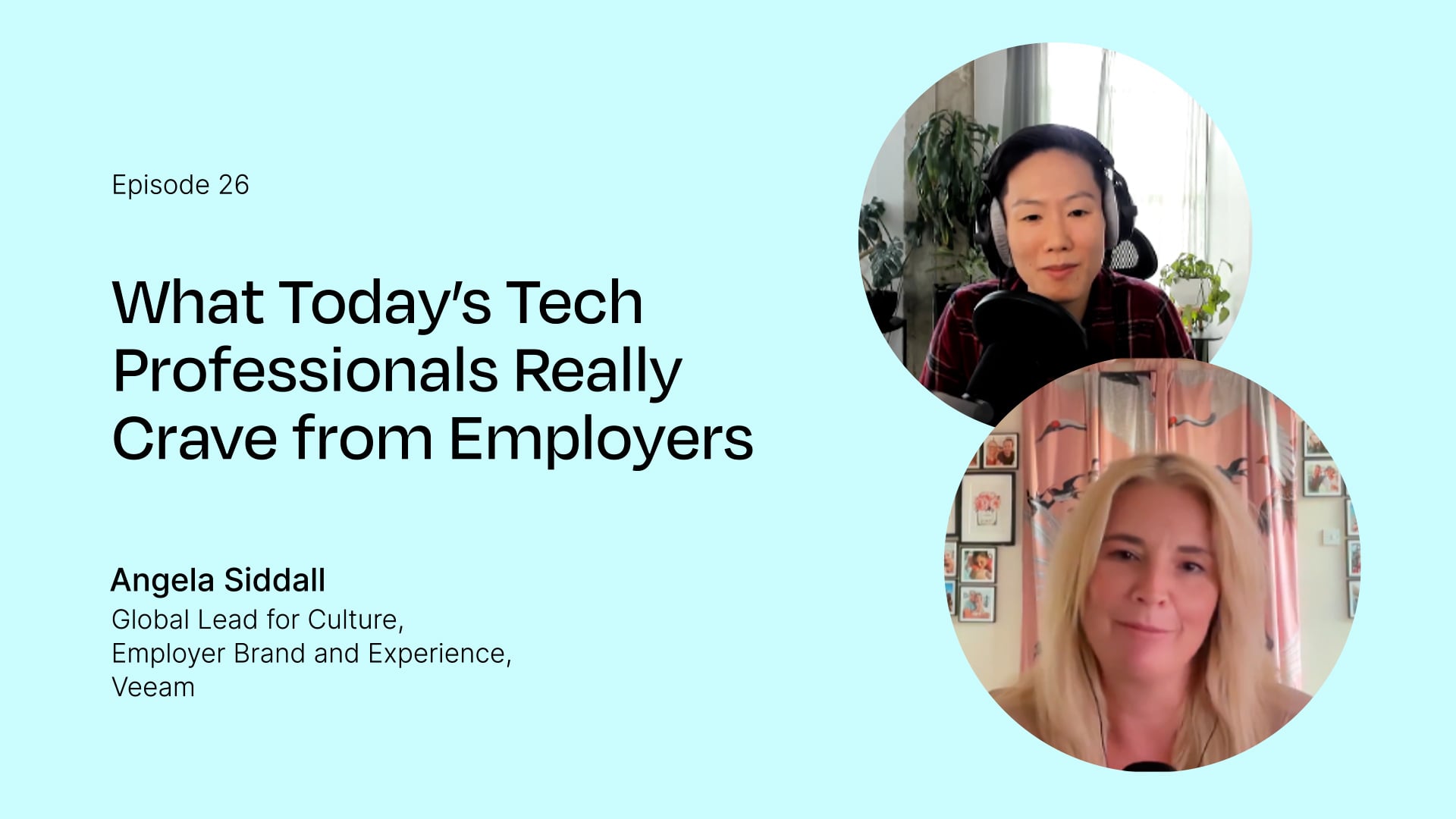
What Today’s Tech Professionals Really Crave from Employers — with Angela Siddall
Lydia Chan sits down with Angela Siddall, Global Lead for Culture, Employer Brand and Experience at Veeam, to explore what tech professionals really want from employers today. Drawing from over 20 years of global experience, Angela shares her perspective on what drives technical talent, revealing that impact, cutting-edge technology, continuous learning, and autonomy matter more than traditional corporate perks. She emphasizes the importance of authentic storytelling and explains her view on why tech-to-tech communication often resonates more effectively than polished corporate messaging.
Discover the unconventional engagement strategies Angela has seen work for remote tech teams, including surprising examples where arcade games and virtual reality replaced traditional town halls. Learn why she believes crowdsourcing ideas directly from tech talent leads to better results than any corporate playbook could provide. Angela also shares her multi-pronged content approach for keeping different audiences engaged, from junior talent hungry for detailed guidance to senior executives who demand strategic insights delivered in seconds.
Angela offers bold predictions about how AI will reshape the talent landscape in just one to two years, not three to five. Find out why she thinks building diverse skill sets matters more than deep specialization, what the shift toward project-based work really means for employers, and how brands can demonstrate the authentic purpose that top technical talent craves in an increasingly uncertain future.
Key Takeaways:
- 07:17 - Impact, Innovation & Autonomy: Tech talent is driven by making meaningful impact, working with cutting-edge technology, continuous learning opportunities, and the freedom to work without prescriptive management
- 15:05 - Tech-to-Tech Storytelling Works Best: Employee advocacy and allowing technical professionals to speak directly to peers through detailed, authentic content resonates more effectively than polished corporate messaging
- 18:58 - Crowdsourcing Engagement Ideas: Reaching out to tech talent to co-create events led to unconventional but highly successful gatherings featuring arcade games, VR experiences, and board games alongside strategic business updates
- 24:16 - Multi-Pronged Content is Non-Negotiable: Creating diverse, digestible content across multiple formats and touchpoints is essential because tech professionals consume information differently—some prefer quick 10-minute overviews while others digest three hours at once
- 30:20 - Tailor by Career Stage: Junior talent needs detailed guidance on corporate basics and hunger for comprehensive information, while senior executives require concise, strategic white-glove content focused on long-term business impact
Podcast Transcript
00:00:00:00 - 00:00:10:07
Olly Atkinson
Welcome to the audience connection. This is the podcast where we focus on how businesses can create content that builds more genuine connections with their audience.
00:00:10:09 - 00:00:18:11
Lydia Chan
Each episode, we dive into the art and science of storytelling, speaking with the sharpest minds in brand marketing and creative storytelling.
00:00:18:16 - 00:00:24:05
Olly Atkinson
Our guests share their strategies, insights and creative choices that made their audiences care.
00:00:24:07 - 00:00:30:17
Lydia Chan
Brought to you by casual, the video partner for global brands with offices in the U.S., EMEA and APAC.
00:00:30:22 - 00:00:37:04
Olly Atkinson
Casual leverages the art and science behind creating impactful stories to drive business results for their clients.
00:00:37:06 - 00:00:39:09
Lydia Chan
We’re your hosts. I'm Lydia chan.
00:00:39:09 - 00:00:42:20
Olly Atkinson
And I'm Olly Atkinson. This is the audience connection.
00:00:42:22 - 00:01:04:15
Olly Atkinson
Hey everyone, welcome back to the Audience Connection. Today's episode is all about one of the hottest topics in business right now. Finding and keeping great tech talent. And joining Lydia for this one is an industry veteran who's been doing this for over 20 years. Angela Siddall is currently a global people leader at Veeam.
00:01:04:17 - 00:01:30:13
Lydia Chan
I mean, it was so great to reconnect with Angela. She's got such a unique global perspective. I actually worked with Angela when I was first starting in this field. You know, she was at an agency, and, you know, I was creating content for casual, so we were creating really impactful employer branding campaigns. And I think she's always just had this knack for really understanding what motivates talent.
00:01:30:15 - 00:01:49:02
Olly Atkinson
And that's, that's amazing to, to reconnect with a client like that for, for a podcast like this, because it's obviously a dynamic there. And this one digs into how to attract top engineers and developers, to the rise of employee advocacy and how gaming and community can help build loyalty inside organizations.
00:01:49:04 - 00:02:17:03
Lydia Chan
Absolutely. Angela shares, you know, some practical examples, like how, being uses virtual and in-person events to connect people around shared challenges. And and also just what brands can do to keep things authentic when talking to a very widespread global audience. She also gives us one surprising fact about how new hires consume learning development content that I did not expect.
00:02:17:05 - 00:02:35:01
Olly Atkinson
Interesting okay. It's a great conversation. They'll give you tons of ideas for how to connect with talent in smarter, more human ways. All right let's get into it. Here's Lydia with Angela. Settle.
00:02:35:03 - 00:02:37:17
Lydia Chan
Angela, welcome to the audience connected.
00:02:37:19 - 00:02:41:15
Angela Siddall
Thank you so much for having me. I'm excited to be here and have this conversation.
00:02:41:20 - 00:03:09:10
Lydia Chan
Same here. Well, today we're talking about talent. But specifically talent, in the tech space, right? Yeah. But certainly I think some of the themes will apply universally to any talent pool. So, I'm really eager to dive into that conversation about sort of the evolving challenges, right, of connecting with talent in general. But before we jump in, Angela, just tell us a little bit about, you know, you and your background.
00:03:09:12 - 00:03:29:14
Angela Siddall
I have been in the talent and people space. And the marketing space for probably most of my career. So we're looking at, 20 plus years now. It's, it's a hard truth, said Matt. But it's the truth. I've, I could call myself a bit of a global person because I'm from South Africa, living in the UK.
00:03:29:18 - 00:03:48:23
Angela Siddall
And over the last, I would say 15 years of my career, I've very much been in global roles. So I'm always really intrigued about what different people wants around the world, different audiences, what they're interested in, what makes them tick, what makes them want to come to a company, what makes them want to stay in a company.
00:03:49:01 - 00:04:00:11
Angela Siddall
And so I've probably spent a big portion of my career trying to understand that a little bit more. And, yeah, I live I live just outside of the UK. Can you hear my dog barking?
00:04:00:12 - 00:04:08:02
Lydia Chan
I could, but, if any of you joining, that's, watching. Okay. You got a puppy background?
00:04:08:04 - 00:04:23:18
Angela Siddall
That's puppy. My pup. I didn't know if I could hear it through the headphones, but, Yeah, this is part of the crazy family life of remote working and living at home. They might be a child that pops in or a husband or a dog. So that's also part of who I am. The family. So I hope you don't mind.
00:04:23:20 - 00:04:48:09
Lydia Chan
Perfect. No. Perfect. Angela. And, I think that's why it's it's it's so great to have you on this show, right. Because of that global lens and that global expertise. Because nowadays, yeah, it's almost, the SA default, right, that you will have global talent that, you know, talent comes from everywhere. And with the pandemic, people work very remotely now.
00:04:48:09 - 00:05:13:21
Lydia Chan
Right? So you know, it's not about looking at the local markets anymore. It's about, you know, opening at up to wherever, right, depending on experience and, you know, skills that we're looking for. So what we like to do on the show, to kind of tee things off is, is really defining the audience. Right? And I know that that can, that can have it's highly segmented, right, in your space.
00:05:13:21 - 00:05:24:14
Lydia Chan
But I would love to kind of take a stab at it. Right. So how would you, I guess, define the the kind of tech audience that, you know, companies are trying to speak to.
00:05:24:16 - 00:05:51:01
Angela Siddall
Yeah. So for us, it's, you know, you said it perfectly earlier is first and foremost, we are after tech talent from across the world. So, when we define who are we talking to? It's, talent that are from the engineering space. Software developers, Q&A professionals, system engineers. Sometimes people are it or it supports cyber security compliance.
00:05:51:03 - 00:06:12:05
Angela Siddall
So we've got kind of a really, really big mix of tech talent that we're trying to attract for our company. And we've also got a really big set of footprints. So if you look across, you know, almost 6000 employees that we've got, a big portion of that is tech talent and it's across 30 countries. So that is a little bit about who we talking to.
00:06:12:05 - 00:06:35:19
Angela Siddall
And also the generational differences that we have. We've got people that are sort of really early in career, right through to some of the most professional based, cutting edge professionals in this space that have been doing this for many years. So it's a very broad audience. It's lots of nuances depending on who you're talking to. But generally when we say tech talent, that's that's what it means for us.
00:06:35:20 - 00:06:57:16
Lydia Chan
Yeah. So I guess let's, maybe try to define some of those groups. Right. And perhaps like our top three, if you will, in regards to maybe priority or just like volume of talent. Right. Or what motivates them. Like what what do they care about, and how should they be spoken to in order to connect with them?
00:06:57:21 - 00:07:17:09
Angela Siddall
Yeah, it's a great, great question. And I mean, we've done lots and lots of homework in the space and we've tried many things, but what I would say is probably a few of the threads that go throughout all of these audiences is the first and foremost is this is a group of people that want to make an impact with the work that they do.
00:07:17:13 - 00:07:38:08
Angela Siddall
They want to be incredibly challenged. They're very motivated by building stuff and ideas and solutions that are cutting edge. Something that's interesting and that's going to differentiate and be a little bit of a career game changer. So firstly, we always talk to this audience about the impact that they can come and make and how are they going to be able to do that.
00:07:38:10 - 00:07:59:16
Angela Siddall
This audience cares about, all the latest tech. So any time there's new, stuff that's coming out, I mean, I is the buzzword of everything that we are talking about at the moment. And so what does this mean for, not only just how they can, you know, use and leverage the right technology for the work that they do, but ultimately just how they exist.
00:07:59:16 - 00:08:22:08
Angela Siddall
So it means that how we operational ourselves at work and everything, we have to be thinking about this across across everything, because there'll be nothing more annoying to a lot of this tech talent to come and work in old, clunky systems or have archaic ways of doing things. So impact is important. Working on some of the most latest tech is super, super important.
00:08:22:10 - 00:08:39:17
Angela Siddall
This is an audience who also likes to feel that they can continuously grow. And what I mean by that is, because of the new things that are happening in the tech world all the time, it's how can I get the latest certifications, how can I get knowledge about this particular type of tech that's cutting edge and coming out?
00:08:39:17 - 00:09:07:19
Angela Siddall
And so I think this is a very hungry audience that wants to continuously be bettering themselves and learning, and it would be a mess. I know you said three, but let me give you a fourth one as well. This audience is also super, super keen to feel, that they can be autonomous to do their job. They don't want to feel in any way that, they'll get in prescriptive command of what they need to do in a step by tests.
00:09:07:21 - 00:09:21:04
Angela Siddall
Like task. It kind of takes away from the challenge. And it's also to be innovative and creative, which a lot of them want to do to make the right impact. You need to allow them a little bit of flexibility and space and breathing room to be able to do that.
00:09:21:05 - 00:09:49:01
Lydia Chan
Yeah. No, no, absolutely. And, you know, at we at a casual, you know, we do a lot of work and recruitment and like culture, storytelling space. Right. Yeah. And what I've kind of seen as, as maybe a trend in the type of, of stories that we're telling. We're telling purpose driven stories. Yeah. Right. And we're telling stories about culture and, you know, ambition.
00:09:49:06 - 00:09:54:00
Lydia Chan
Right? It's, and, you know, Angela, you and I worked together like we did.
00:09:54:00 - 00:09:56:03
Angela Siddall
Like, do we go way back.
00:09:56:05 - 00:10:23:07
Lydia Chan
To being ourselves a little bit, but, I think back then it was more maybe almost on the surface, right where you're talking about benefits and like, you know, I think opportunities of growth. But it was it was more of listing those things versus being able to truly go go deep with the audience and actually tell that that deeper story.
00:10:23:09 - 00:10:50:15
Angela Siddall
Yeah. And just building on that, I think you said something that has to be authentic with this audience as well. You know, when you're telling that story about what you're going to do and the impact that you're going to come and make and and the purpose behind that is a beautiful connection for this audience, but also being very, very clear and authentic around what it is that we're saying and is a truthful, because this audience also is is very quick to call out if something's promised and something's not true.
00:10:50:17 - 00:11:03:04
Angela Siddall
So, you know, it can be aspirational. That's okay too. But as long as it's as long as it's true and this, whatever it is that we're saying to them are trying to connect them with is actually the lived reality when they get there is important.
00:11:03:06 - 00:11:20:15
Lydia Chan
For sure. So I guess, you know, with that, right. What, what I'd like the biggest shifts that that you're seeing though, and, and tech talent now, you know, now versus maybe, well, even three years ago. Right. Because I feel like things are changing so quickly.
00:11:20:17 - 00:11:40:13
Angela Siddall
It's changing so quickly. I mean, if I look back over even just six years of of being at Veeam, where I am now, as you know, we've gone through a pandemic, we've gone through a few wars, we've gone through political shifts, we've gone through economy, unrest. We've opened up in new locations and new hubs that we've never been into.
00:11:40:15 - 00:12:04:16
Angela Siddall
And I think you can segmented only from the micro of, you know, what a people's needs that comes from the macro trends and themes that we've seen out there. So, for example, you know, the pandemic totally shift. You mentioned this earlier, the pandemic totally shift the way that the that's, the autonomy of how people like to work and the flexibility of being able to work from home and have that sort of space.
00:12:04:16 - 00:12:25:15
Angela Siddall
So that is one trend that we have seen and it's stayed since, you know, since the pandemics happened. And in fact, now it's really, really difficult to attract talents and ask them to come into the office. And we don't expect that with all of our tech talent for that exact reason. You know, that's become a big shift that we've seen over, over the last few years.
00:12:25:17 - 00:12:44:20
Angela Siddall
I think, with, you know, the, the way AI is going, that is also going to be another big shift. And, you know, again, I'm probably fortune telling a little bit here, and this is my own personal view, but I think it's going to change the power dynamic a little bit with tech talent. Because tech talent, it's been competitive.
00:12:44:20 - 00:13:14:00
Angela Siddall
It's been demand. And I think that will continue to stay the case for, you know, certain areas of tech talent. But what we're also going to find as AI is going to start to kind of come in in a few areas and start to demand a different profile. So I think, you know, with, with these sorts of trends going on and then the trend of, okay, if, if I don't necessarily know the security of the job and the work that I'm going to be doing in the future, how can I build the right skill sets?
00:13:14:02 - 00:13:31:20
Angela Siddall
And almost it's thinking about it like a set of tool, tool belts, you know, like toolkits of, okay, let me just try and expand my knowledge here, here, here. Because the more dots that I can connect, the more skill sets that I have and the and the breadth and the width of those skill sets is going to set me up for the right future.
00:13:31:22 - 00:13:51:10
Angela Siddall
So I think, you know, again, it's, it's it's where people want to work. It's how they want to work. It's the demand of the employer versus the employee that I think is shifting. It's the technology that they expect to work on. And how are they supposed to navigate sort of the the new as well as, you know, gaining expertise in certain fields.
00:13:51:12 - 00:13:56:13
Angela Siddall
Those are some of the things that I've seen that I've kind of really started to shift over the last few years.
00:13:56:15 - 00:14:19:11
Lydia Chan
Yeah. Now for for sure. And I guess from, you know, you talk about things in our toolbelt, right. What are the best, like storytelling approaches in our tool belts that we, we can use to really, again, connect with these folks, and with all these challenges that, that are whether ahead of us are in front of us right now.
00:14:19:13 - 00:14:46:20
Angela Siddall
Yeah, it's a great question. And I think one that we found that has started to work quite a lot is to actually sort of turn it back to that, that employee advocacy type of storytelling and the reason I say that is because, this audience wants to not always just have that big picture view, but sometimes they want to go a little bit granular and be able to almost talk tech to tech and understand what that means and the real reality.
00:14:46:20 - 00:15:05:07
Angela Siddall
And sometimes we've even looked at some of the content, and I don't profess to be a tech person at all, but you look at some of the content you like, surely. Is that really going to land with the audience? It seems too technical, it's too detailed, it's too involved, and it's been written or produced or a video by a tech person for a tech person.
00:15:05:07 - 00:15:31:20
Angela Siddall
And actually what we found is it's that sort of, you know, speaking to a like minded person in that environment that's actually starting to really help. So, you know, what I would say again, is it goes back to the authenticity of and that storytelling from the first person's point of view, which is this is really going to resonate with the audience, because let me tell you a little bit deeper than a little bit more of that tech stuff you might want to know.
00:15:31:22 - 00:15:51:09
Angela Siddall
And I think sometimes the layman way that we would do that might, might not resonate with this audience because they want to go deep and they want some of that information in detail. You know what we've also found, you know, whether it's, you know, videos, but also things that evoke a little bit of a game ification, elements, you know, the virtual reality world of what we can do in that space.
00:15:51:09 - 00:16:11:21
Angela Siddall
That's also a space that I've seen really resonate with this audience problem solving. It's anything that leans into that. This is going to be a challenge. I want to make an impact. This is where I connect. Those are the sorts of messaging I would lean into, but something that really kind of evokes that and shares that, I think is, is the opportunity for us in that space.
00:16:11:23 - 00:16:36:05
Lydia Chan
Yeah. Yeah. No for sure. Like, I think a lot of the tech clients that, I've, I've worked with, there's a lot of like hackathons and. Yes. Yeah, just, just a lot of events that, obviously touch on many things. I, it touches on that, desire to, to be innovative, right, to do something autonomously that the gaming aspect of it and then of course community.
00:16:36:07 - 00:16:55:02
Lydia Chan
Right. Because I think at the end of the day, we're all we're all seeking community, right? Whether it's at work, outside of work. And if, if we become so autonomous that there is no community, then it's almost like, why stay at this organization? Absolutely.
00:16:55:04 - 00:17:11:12
Angela Siddall
And community takes such a different you know, I've, I've seen it take such a different form even for us at Veeam, which has been so interesting as we've had sort of get togethers where we try and engage tech talent together and we put them in different forums, and sometimes even the more surprising things that you wouldn't expect people to do.
00:17:11:12 - 00:17:36:19
Angela Siddall
It's almost like independent behavior, but they do it together. So whether people are gaming together or whether, you know, you have a party and you have an arcade thing with just next to each other, and people are gaming right next to each other and virtual reality moments and again, to your point, there's still a community and all of that, even though it's not the the more traditional way we might look at it is people get together and they sort of looking at each other and they're having those sorts of it's similar interest.
00:17:36:19 - 00:17:58:08
Angela Siddall
It's you know, similar passion projects, being able to solve problems together. We have games nights where you sort of see this big competition emerge between people playing board games, even, you know, this is not all online stuff, and it's that sort of community that I see really unfolding with this group. And once the loyalty is there and the community has built, I couldn't agree with you more.
00:17:58:08 - 00:18:06:02
Angela Siddall
It's something that really, really resonates. And it's been a huge, engagement strategy for us to make sure we build that.
00:18:06:04 - 00:18:29:16
Lydia Chan
Yeah. Not and I love those specific examples. Right. And I would love to I guess maybe here, if you can share just a little bit more on on these like tactful projects, right where, where it's like quite specific that, you know, maybe, again, our listeners can say, hey, like, I love that example. Right? I'm going to try to implement something similar.
00:18:29:16 - 00:18:38:08
Lydia Chan
Are there any like, standout projects that come to mind that, you know, again, are just very much these concepts in practice?
00:18:38:10 - 00:18:58:13
Angela Siddall
Yeah, I mean, what we do is we also try and reach back out to the audience for them to tell us what ideas are going to work. So, for example, you know, we might have a, a big town hall moment where we want to share our strategy with the entire business. And we think, okay, we want to make sure that we've got everybody involved.
00:18:58:13 - 00:19:23:21
Angela Siddall
Not always. You've got the sales talent, the support function that are there, and they doing it sort of in a more traditional way with the tech talent. You can't do it the same way. So for example, we we reached out to them and said, okay, we want to bring this to life for you. We do need you as a business area to understand where we're going as a business, and the broader strategy about how is it that we want to bring this to life for you and that specific example?
00:19:23:23 - 00:19:42:19
Angela Siddall
You know, I mean, I was actually in Prague, that's one of our, big R&D hubs. I was in Prague for that year, and it was the most unusual for me just because of my background type of get together. But it really did include things like, you know, we had sort of a whole area set up as virtual reality.
00:19:42:19 - 00:20:09:07
Angela Siddall
We had arcade games across the entire floor. We had a, an area where people could, do puzzles and board games together. And that's a really unusual sort of, you know, for me, coming from my background that I had had, I thought it was quite an unusual set up. But what I did absolutely find is that this audience was super, super engaged, they were there to listen to the to the broader piece and then them taking it and kind of making it their own.
00:20:09:07 - 00:20:33:16
Angela Siddall
But the whole point with that was it crowdsource those ideas. And those were not ideas that we would have just automatically gone and said, oh, that's going to work. So I think, you know, really tapping into this audience and finding influencers within this audience and getting them to help you solution ize what it is that we want to do, what's going to be the right solution to whether it's attract this audience, engage this audience?
00:20:33:18 - 00:20:46:01
Angela Siddall
I found them to be super smart, super valuable, and we've taken a lot of pilot risks thinking, is this going to work? Because it might be a bit untrue, you know, a bit less traditional. And it's been fantastic and it has worked.
00:20:46:03 - 00:21:18:18
Lydia Chan
Yeah, that's really great. And I, I feel like a theme that is emerging, is, is a lot of kind of in-person, you know, activities. Right. Or just sort of in-person, events again, functions, game gaming type, sort of activities. Do you see that as, as something that people should like double down on? When they have, such a remote workforce?
00:21:18:18 - 00:21:45:09
Angela Siddall
Yeah, yeah. Personal opinion. Absolutely. Yes. Because for me, I think we have so much time online. We spend so much time without human connection that I think any moments of time where we can get people together to spend time together. To your point, doing something that they enjoy from a community. And it's not the traditional ways. But yes, that's my I'm totally, totally behind that as a strategy.
00:21:45:11 - 00:22:03:01
Angela Siddall
I think the challenge is, is how scalable are these things and how much do these things cost businesses? But I do think also, I mean, when we went through the pandemic, for example, I mean, then the world shut down and we had absolutely no way to be able to do it, and we had to be inventive around things that we could do online.
00:22:03:03 - 00:22:25:07
Angela Siddall
So again, that's when a lot of our, you know, we sort of started these gaming competitions and we would do them as an online forum and people would sign up and then play against each other. There were things like, we did a whole sort of week dedicated to, balance. Work life balance is another topic that really is important for this audience.
00:22:25:09 - 00:22:41:00
Angela Siddall
And it was about sort of saying, you know, you could work 24 hours a day, you're locked up in your house at the moment. But we're actually also noticing it's not good for you and it's not good for how you do it. So how can we sort of help you manage this a little bit better and give you some ideas of other things that you can be doing?
00:22:41:02 - 00:23:00:21
Angela Siddall
So there are online solutions. I'm not saying that they not and they are scalable solutions. But but genuinely I think that it needs to be the right balance. I think you can't lean too much into one that's just too expensive for businesses, but I think leaning too much into thinking online is going to fix everything, build that community, build that loyalty.
00:23:00:23 - 00:23:07:01
Angela Siddall
I, I'm not bought into that. I think we need to be a bit more aggressive on that in personal moments as well.
00:23:07:03 - 00:23:56:02
Lydia Chan
Yeah, for sure. And I do like the online examples. Right. Because, you know, like like you said, the in-person, activities is not as scalable, right, as it is quite expensive. So you know what with the majority of the time being virtual, right? What are some things that, and, you know, you just mentioned some, but what are some other maybe content driven things, that, you know, like HR or, or an employer brand, culture sort of department can really implement to continue to connect with folks, you know, before going into these larger gatherings, in-person gatherings.
00:23:56:03 - 00:24:16:17
Angela Siddall
Yeah. I think it has to be a bit more, balanced. I mean, you know, we are looking at a whole bunch of things in our space, where those moments that are online, how can we make them really matter? And how can we choose the right ones for the right moment? So for example, we've just re hold or we're holding at the moment our whole onboarding approach.
00:24:16:20 - 00:24:45:16
Angela Siddall
And so, you know, you've got a new, group of talent, tech talent or any talent that's arriving our business and what we are sort of grappling with at the moment is how do we create super usable, digestible content that can be experienced at scale in real time, in the moments. And then what you do is you allow huge amounts of flexibility around how much information people can consume at any given moment.
00:24:45:16 - 00:25:08:05
Angela Siddall
So if somebody likes to have a quick ten minute overview of something and then go for a walk or have a breather, then that might be a preference. Other people like to just sit and, you know, go through three hours of content set at the same time. So we're trying to be very thoughtful about the experience that we're giving our talent and thinking about the right touchpoints and the right channels and the right mechanisms at the right moments.
00:25:08:05 - 00:25:33:20
Angela Siddall
So, you know, sometimes that is the perfect time for film or the perfect time for video. Sometimes it's the perfect forum for gamification approach of how to of how to look at learning materials. Sometimes it's how do we create a, community of people that can have a coffee randomly with somebody at the right moments and try and actually have a human touchpoints in the midst of all of that.
00:25:33:20 - 00:25:56:06
Angela Siddall
And so we are actually looking at a very multi-pronged approach, because I think if you just go down one avenue and you go hard on that and you forget some of the other different styles and learning materials that people might want to consume. I think with video you have the huge opportunity to add a bit of personality, sometimes a little bit of human playfulness, which we have at theme.
00:25:56:07 - 00:26:22:01
Angela Siddall
So that's really important for us. And then also the more formal learning modules that that you might need to have a different moment. So it's a bit of a mix. It's, it's I don't want to say it's a one size fits all, but we are looking at it from pretty much across every employee. Touchpoints. So from how we hiring people to how we attracting them in the first place, what we know that people use different channels, we know that people like different length of content.
00:26:22:03 - 00:26:42:08
Angela Siddall
And so it's put a lot of pressure on us. And with the way I's going is you just have to have very rich content. And a lot of it's because it needs to be able to reach the audience based on what they're actually searching for. So you have to be quite multi-pronged about it. You can't just, you know, do a website anymore and be like, okay, that's everything you need to know about V nine and it's not going to work anymore.
00:26:42:10 - 00:27:01:19
Lydia Chan
Yeah, here's the website. Here's, you know, the three slots that. Oh, right. We want to put a video in this slot. We have a video on that slot. I mean, that's how it was done, right? But I really yeah, I really like what you said about this multi-pronged approach and utilizing the different tools that we have as, as content creators.
00:27:01:23 - 00:27:25:22
Lydia Chan
Right. As like, engagement officers, right. To really connect with people. Because like you said, you know, sometimes the audience wants to watch a video, right? But, you know, like speaking for myself, I like to listen to podcasts. Right? Or I like to listen to conversations, as well. And of course, you know, I love watching videos too, right?
00:27:25:22 - 00:27:52:16
Lydia Chan
It's kind of my space. So, and then the gamification aspect of it and then taking people out of that, having those moments of, hey, now's time to have a virtual coffee. So then you can connect with someone, exact about your experience, etc.. Right. So I think, you know, folks no longer can really look at, something so isolated or in one approach, rather like you need to bring.
00:27:52:20 - 00:28:08:02
Lydia Chan
How do all these things fit together right into one, you know, onboarding experience or even one culture experience. Right. I think, you know, you can utilize this concept throughout, like, like you said, the recruitment process, the onboarding process and the retention process.
00:28:08:04 - 00:28:27:01
Angela Siddall
Totally agreed. And the thing is, you put it in front of different audiences. And as much as I say tech talent and these are some of the trends that we see, is that they still humans who are individual with their own way of consuming information as well. So I think, you know, adding a lens of thinking that there's going to be a one size fits all and it's going to be a perfect approach.
00:28:27:01 - 00:28:45:12
Angela Siddall
It just doesn't exist. So what we have to try and do is be thoughtful around how people like to consume. Can we see any trends? Can we pilot stuff? And we also, you know what I love about where I work, as we do get the opportunity to play a lot with these sorts of things, and we get to try things and we talk about pilots all the time.
00:28:45:12 - 00:29:03:18
Angela Siddall
So it's like, let's try it, let's see how it's consumed. And you always going to have the two tail ends of that was the best thing I've ever experienced too. That was terrible. I didn't like it at all. And then you have this this bell curve in the middle. So again, you're never going to please everyone, but we do start to pick up a lot of data.
00:29:03:18 - 00:29:25:05
Angela Siddall
What's worked, what hasn't, what's been the the sort of the consumption rates of these different materials. And then we try and sort of pick up on those trends and be a little bit more focused, where we can. But, you know, having a linear approach, as I said, I just, I just think is is not going to kind of make it's not it's not going to resonate and connect with all the different audiences we want to talk to.
00:29:25:07 - 00:29:54:23
Lydia Chan
Yeah, for sure. And I want to touch on, the it's not one size fits all right. It's not a linear approach. Specifically when it comes to say, like executive talent, right? Versus maybe your middle kind of management versus the kind of new joiners associate level. I would love to pick your brain around what, you see has worked within those three groups.
00:29:56:01 - 00:30:20:16
Angela Siddall
Yeah. So, you know again just just putting a lens on this most recently is we were looking at sort of the most junior talent or people that were coming into our work for us, and they hadn't had work experience before and don't take for granted some of the information and how scary it is to come in from whatever environment you've been in and come into a workplace for the first time.
00:30:20:18 - 00:30:50:12
Angela Siddall
Even things that might sound so obvious to people are not obvious to this group. So things like, let's set up a quick meeting, invite that is something, and it might seem obvious and we giggle. And we also are like, what's like when you go back you got a really, really deconstruct, simplify. And it's not because this audience is an incredibly smart we know that they are in fact they smarter and millions of other ways that we're not smart, but they are brand new.
00:30:50:12 - 00:31:07:11
Angela Siddall
They don't understand. They've never been given a how to 101 guide on how to show up in a in a corporate environments. And so for us, we've had to not only do we would expect to deconstruct what do we do as a company. What are you what is your role going to be? What do we expect from you day to day?
00:31:07:11 - 00:31:28:04
Angela Siddall
We would absolutely expect all of those things because of course, you know, they they somebody just joined our company. But what we wouldn't have expected was some of the, the basic what we would say is basic corporate living or corporate world how to dress, how to show up in a meeting, you know. Yes, we want you to be voice vocal and have your opinion and share your opinion.
00:31:28:04 - 00:31:53:14
Angela Siddall
But there's also a way to do that in the right forum and the right moment to do those sorts of things. So that I found really interesting with the more junior audience of finding that balance, but also, you know, not treating them as if they are inferior with knowledge that they can share. Because if you give them big, meaty, interesting projects and tasks, I've seen better results from this audience because they know how to research.
00:31:53:14 - 00:32:19:17
Angela Siddall
They know how to scratch the surface and look for information. They know how to package it up. They've got a lot of skill set. They will lean on technology to really, really support them on that journey. So for me, that audience is just it's it's a beautiful audience to look at. But it's, it's it's one to look under the hood with, and do it kind of phase by phase and, and help them a lot throughout that, that transition and building that bridge for them from that moment.
00:32:19:19 - 00:32:46:06
Angela Siddall
To, to the corporate moment, the more senior audience is I found, a little we tend to treat them a bit more like a concierge. So it's a little bit more of that white glove service and keeping information super short, super succinct. They don't want to go into huge amounts of detail. You've got to be able to come out of the weeds and give them the big picture.
00:32:46:08 - 00:33:23:06
Angela Siddall
You know, they don't want to know some of the, the nth degree of all the details that sit behind stuff. So when we're talking to that audience, it's very much like, it's different messaging. They'll want to know things like where the business is going, the five year strategy. You know, the what what is it that my expertise and role can come in and really make an impact on very, very different sort of, more long term view and it requires a little bit more, nuanced hand-holding depending on the skill set you're actually bringing in, because somebody wants to come in and know that they're really needed, they're useful and that they've
00:33:23:06 - 00:33:42:08
Angela Siddall
got a real mission statement ahead. And then the broader audience, as you asked, I'd say, is kind of a it can be a little bit of a mix of both. But I think with that audience often, you know, you've got different nuances of, are you coming in to be a people manager or are you coming in to be an individual contributor who's an expert in your field?
00:33:42:09 - 00:33:59:22
Angela Siddall
Again, you're going to have slightly different nuances of what you need. And so we also need to be able to, you know, talk to that audience in a way of this is the type of, this is the type of information you'll need. This is the personalization part. This is where you have to join the cohort.
00:33:59:22 - 00:34:10:08
Angela Siddall
You're going to be joining the team who's delivering on this. So just kind of again, that's it's a probably a bit more of a broad audience and a tougher one to answer as a general statement, because it depends on the role.
00:34:10:10 - 00:34:40:22
Lydia Chan
Yeah. Now, I think that's that's really interesting. Well, specifically with the, more senior level audience. Right. Like they while they're, they're, time poor. Right. So they, they want content to be curated, actually. Right. And, you know, you have to, really think about, you know, how do I deliver this in a succinct way, but also, again, in a way where almost every second counts, right?
00:34:40:23 - 00:35:02:03
Lydia Chan
So I think that that's what that's what quite interesting to me because, you know, sometimes you have to look at it that way versus looking at, again, like when you're looking at maybe, new joiner talent. Right. Like maybe that's where stories can breathe a little bit more. Right. Or agree. You know, content can breathe a little bit more.
00:35:02:05 - 00:35:12:15
Lydia Chan
Because they maybe they're more just hungry for, content. That is, it's just like, really helpful to them. Right? And that they can really digest.
00:35:12:17 - 00:35:34:00
Angela Siddall
Yeah. And they actually are they're hungry for a lot of content as well. So I love that that phrase you just used, which is let it breathe because, you know, just even a recent example, as we had a junior person joined the business and then they asked for a little bit of time with me, and we were doing a bit of a mentoring session, and, she turned around and said, oh, I've got this really great idea for, you know, onboarding and content.
00:35:34:00 - 00:35:53:02
Angela Siddall
And I think that we really need to, you know, give more information to this audience. And I'd been so focused on the the more senior audience who it was trying to get things as crisp and succinct as possible. And you had this audience that's crying out for the detail. Give me more information. I want to know all the ins and outs of what you're talking about here.
00:35:53:02 - 00:36:14:04
Angela Siddall
So, I think it's a really, really good way of explaining it is content that can breathe, content that can get a bit more into the nitty gritty of things. And because they're learning and they're hungry to learn and often they've come from environments where that's what they've been doing full time is learning, spending time studying of whatever, whether it's school, whether it's college, university.
00:36:14:06 - 00:36:27:13
Angela Siddall
And so for them to sort of just consume big chunks of information, do research. This is a sweet spot. And so it's a perfect moment to sort of, tap into into their psyche at that's at that stage.
00:36:27:15 - 00:36:56:07
Lydia Chan
Yeah. Love that. Well, Angela, as we sort of wrap things up. Right. I want to talk about, I guess, that the future of, of connecting with global talent. Right. So, you know, where do you see, talent engagement sort of headed in and because. Yeah. And again, the world is changing. So rapidly. Right. My question as written here is 3 to 5 years, but I almost want to say like 1 to 2 years.
00:36:56:09 - 00:37:13:05
Angela Siddall
Yeah. It used to be 3 to 5. Now everything's 1 to 2. I think some of them I've mentioned a little bit, but just to sort of what I think are going to be the big things to, to look at in the trends that we're going to see is, you know, as I mentioned around this, this hunger for skills based learning.
00:37:13:10 - 00:37:42:11
Angela Siddall
So adding more things to, to tool belts and making sure that we are constantly producing materials so that this audience can learn, on the fly, quick, short, digestible content that they can keep learning. I think the world is definitely going to lean more into. You know, we've spoken about this talent marketplace type of concept. So, people being able to say, I have this skill, I can work on this particular project for this particular amount of time.
00:37:42:11 - 00:38:03:00
Angela Siddall
I think that's going to start to evolve, and I think it will start to evolve quite a lot with the tech talents. You won't necessarily always be, bought into this long term view, but more like short, quick, sharp projects, very agile. Being able to kind of quickly work on those, I think are some of the things that I, that I think are going to really start to come out.
00:38:03:02 - 00:38:33:00
Angela Siddall
And I also think, I think the brand as the thing that you mentioned earlier around making sure that people really connect with the companies that have got something that, again, is going to help them make an impact is going to be super important. So the brands that all saint sake, the brands that are clear on the purpose and the direction and giving that sort of that, that you know, that North Star for people to really feel like they can get behind and then it's giving them a bit of meaning of where they want to contribute to the world, because they do want to make an impact.
00:38:33:00 - 00:38:56:20
Angela Siddall
This audience. And I think being able to sort of really crisply be able to say that this is this is where we're going and this is something you can be part of, I think is going to continue to be a trend. So, yeah, I think the world of AI really, really is going to start to shake everything up as we know it's I think if you and I did meet in a year's time or in two years time, I think would be probably be quite surprised of things we didn't even fathom.
00:38:56:20 - 00:39:12:06
Angela Siddall
We're going to be in, in, in place, I think, I think that environment is going to make it a once two year story, and I don't think it's going to be a five year story. And I think it's going to, surprise us. I think in some ways it's going to be fantastic. It's going to change people's lifestyles and lives.
00:39:12:06 - 00:39:29:01
Angela Siddall
But I think, on the other hand, it's also going to it's going to shake up. Being one dimensional with your skill set is not going to be relevant anymore. And I think we're going to have to, people are going to have to reinvent themselves a little bit more, which is kind of cool and exciting, but very scary at the same time.
00:39:29:03 - 00:39:37:01
Lydia Chan
Absolutely agree. Well, Angela. Yeah, maybe in, two years time, we'll, we'll do this again and, see how much has changed.
00:39:37:03 - 00:39:41:00
Angela Siddall
It would be my pleasure. I'd love to talk about it.
00:39:41:02 - 00:39:59:02
Lydia Chan
Well, Angela, thank you so much for, for joining the show. This is a great conversation. Thanks for tuning in to the Audience Connection podcast. If you enjoyed today's episode, don't forget to subscribe and leave us a review. If you'd like to connect with me about how I can help you tell better stories and connect better with your audiences.
00:39:59:08 - 00:40:18:00
Lydia Chan
Drop me a note Lydia at Casual films.com. We'll be back with more episodes soon. See you next time.

Fix up quick smart.
Find out more about how Smart-Casual can help
improve your video content
