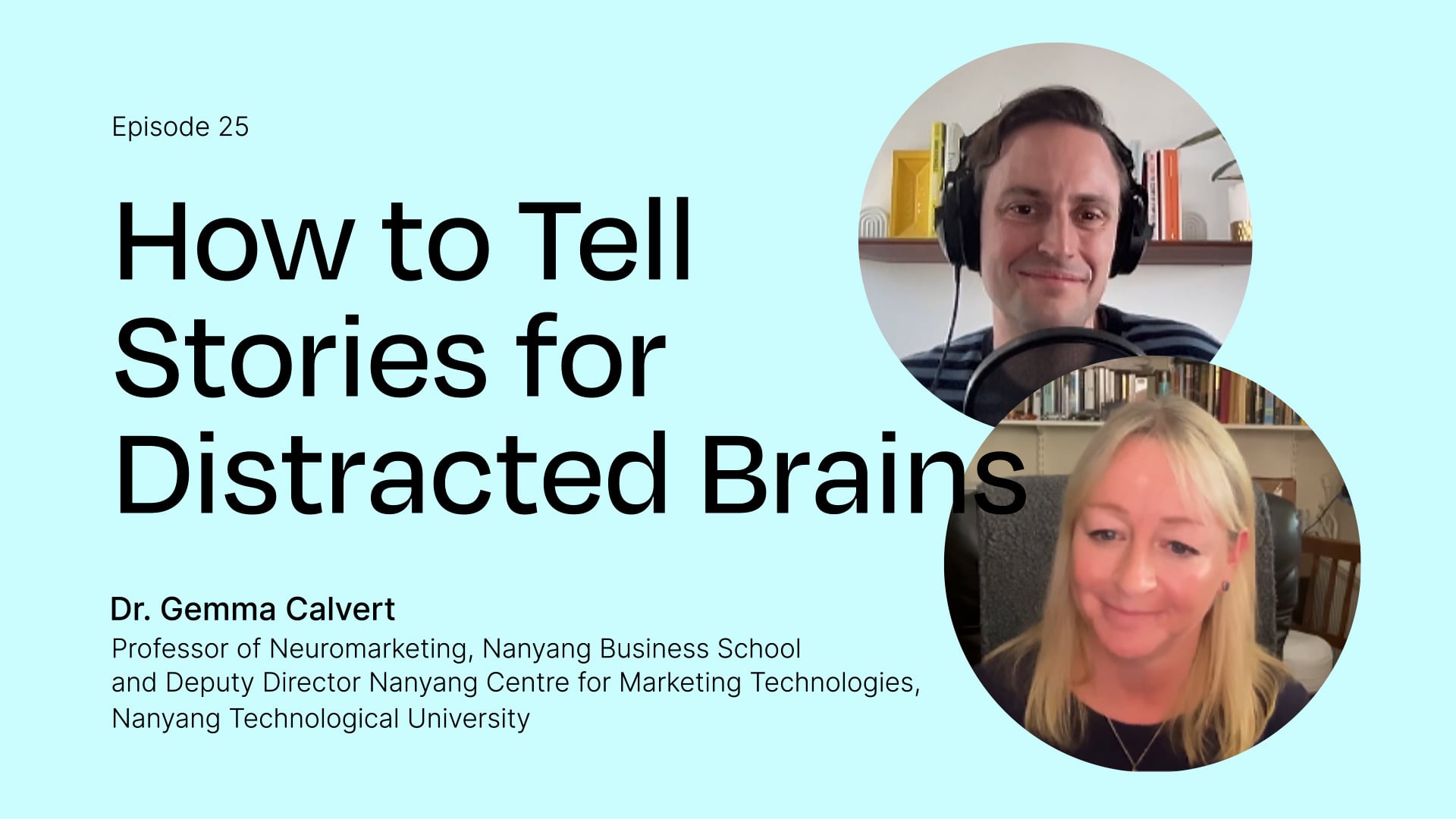
How to Tell Stories for Distracted Brains with Dr. Gemma Calvert
Oliver Atkinson sits down with Dr. Gemma Calvert, Professor of Consumer Neuroscience, Nanyang Technological University and Co-Founder of Split Second Research, to decode how always-on dopamine loops, “digital amnesia,” and story structure shape attention, memory, and action, so your content sticks and drives behaviour.
Calvert maps three rewired systems, attention, memory, emotional regulation, and shows how constant interruptions (and our own self-interruptions) splinter focus, why the “Google effect” shifts recall from the head to the handset, and how teens speak more candidly to an AI interviewer than to adults. Her hooks playbook starts with movement, novelty, and ambiguity, think chimeric images that stop the brain, then earns permission for longer stories that embed in long-term memory. And her best metaphor? The shift isn’t reversible, the train has left the station, but brands can fit seatbelts: design for responsible scrolls, cue reminders, and build human, two-way relationships.
In a world where feeds deliver micro-rewards all day and single exposures rarely encode, long-form isn’t dead, it partners with snackable teasers to deepen immersion. Marketers, creatives, and leaders will leave with neuromarketing tools (eye-tracking, facial decoding, implicit tests) and a practical framework to architect recall ethically.
Key Takeaways:
- 03:37 - The Brain Rewiring Discovery: Ten years ago, Professor Calvert noticed attention spans declining in students and discovered brain imaging studies showing teens' brains releasing dopamine from social media likes—the first evidence that digital content was fundamentally changing how our brains process information and emotional regulation
- 06:23 - Three Critical Brain Changes: Digital exposure is rewiring attention (making it surface-level rather than deep), memory (creating "digital amnesia" where older generations now have better recall than youth), and emotional regulation through constant dopamine hits throughout the day
- 11:58 - The Train Has Left the Station: These cognitive changes aren't reversible, but we can make the "ride more comfortable" by teaching responsible digital habits—similar to learning alcohol moderation rather than attempting prohibition, as the frontal cortex can impose control over addictive behaviors
- 21:39 - Gen Z's Hidden Crisis Revealed by AI: When students were interviewed by AI instead of adults, they spoke candidly in their own language about feeling depressed, addicted, anxious, and unable to focus—showing they're acutely aware of social media's negative impact but trapped in a vicious cycle
- 44:22 - Why Long-Form Audio Creates Deeper Connection: Unlike video that demands your eyes, audio (podcasts/radio) creates unique presence and escapism while multitasking—allowing audiences to slip into story worlds during daily activities, making immersive long-form content more valuable than short clips for building lasting engagement
Podcast Transcript
Oliver (02:34)
Hi, everyone, and welcome back to the Audience Connection. Today I'm joined by Professor Gemma Calvert, a pioneer in the field of neuromarketing and one of the world's leading experts on how the brain responds to brands, advertising and digital media. She's a professor of marketing at Nanyang Business School in Singapore, co founder of Split Second Research and has spent over 20 years helping global companies understand what really drives audience attention, emotion and memory. Her work has been at the forefront of revealing how constant digital exposure is reshaping our minds and has advised some of the world's biggest brands on how they communicate in a way that actually sticks. Gemma, welcome to the show. I'm so excited to discuss all of this with you.
Gemma Calvert (03:17)
Thank you very much for inviting me.
Oliver (03:20)
So, before we dive into the science, I'd love to start with when you first noticed something had shifted in the way people were engaging with content, was there a moment in your research where it clicked and you suddenly thought, hang on a minute, this isn't just a change in our attention, this is actually our brains being rewired?
Gemma Calvert (03:37)
I think probably about 10 years ago I began noticing the attention span of students on courses wavering somewhat. And I also have a young daughter, she's 19 now, but at the time she's nine years old. And she and her friends started to discuss attention and whether they were spending too much time on digital devices and so forth. You know, the really the conversation was all about screen time and whether it was okay to spend hours and hours playing Minecraft, Monkey island and various old games like that. And I started to have a discussion with my graduate students who indicated that they were having a little bit of difficulty focusing, you know, on content. And these were just slight indicators at the time.
Gemma Calvert (04:49)
Obviously over time it started to become more evident and I started seeing in the literature a few really intriguing brain imaging studies about social media and how teens brains would have a clear release of dopamine when they see or hear their posts obtaining likes and cues. And that was probably the first indication we had that digital content was beginning to change the way that the brain process information and how we could regulate our emotions maybe impact on memory and attention. And since then we've found that actually that's very much the case. And there's been more research coming out, including some of our own data discussing with teens themselves how they are experiencing the digital world and the impact of that on both cognition and their social interactions.
Oliver (06:03)
And we've all, I mean I felt that dopamine hit when I'm on my phone and it happens, you know, even more so when you're tired, really you have that sort of draw to that. And I guess what are the biggest cognitive shifts that are happening with digital exposure. What's, what's actually happening in the brain?
Gemma Calvert (06:23)
Okay, so there are three main areas, attention, memory and emotional regulation that we are picking up on in terms of the brain rewiring in response to the digital landscape that we are exposed to. Now, of course, attention is fairly evident. We are bombarded by cues and pings and we are constantly being interrupted. And that is having an impact on the ability to focus and concentrate for a long period of time. Also, endogenously we are trying to concentrate, say for example, on writing some content or writing an essay. And your thoughts naturally turn to the mobile device next to you just to check and to see if there's anything new that's come in. It's rewarding in itself. So there's attention being distracted both externally and internally. And we're seeing that is actually preventing people from concentrating.
Gemma Calvert (07:32)
We see that attention has become much more surface based and not deep, but spread across multiple modalities as well. So it's changing as opposed to. Is this a value laden shift? It is what it is. And perhaps we are adapting to the digital environment and looking back and saying, well now, you know, nowadays nobody can concentrate, nobody attends properly, you know, they're struggling in classes and so forth and they want to fast forward me times two, you know, which is fine. But it is, it's not necessarily a bad thing. It just is a thing. Right. It's an adaptation and it's a change to a new environment. So that's what we're seeing with attention. So attention systems are weakening. When you look at memory. I don't know if you're familiar with the term digital amnesia.
Oliver (08:40)
I feel like I know what that feels like, but yes.
Gemma Calvert (08:42)
Yeah, so it's kind of the Google effect. We know that we have information at our fingertips and there's so much of it that there is a kind of implicit question as to whether we actually need to retain information because it's so extensive. So what we're seeing is that for the first time in history, actually older generations have better memory than young kids. And maybe that's okay because your digital device is effectively acting as a memory storage facility. It's a third hemisphere, if you like. And so this has very real implications for education and also for the communications industry because it means that rather than expecting people to listen deeply and engage with your content unless it's contextually appropriate.
Gemma Calvert (09:40)
And there's some tips that we can talk about later, but it's more about cueing them and constantly cueing As a reminder, we now have to remind the audience or the listeners you can't just expect them to recall the information in the same way as in the past, just from a few exposures.
Oliver (10:02)
So effectively we've kind of become better at filtering the, through the noise and extracting elements, but then we forget about it quite quickly as well. Is that right? So the brain has sort of become a better. I mean, when I come, when you come back to like, it's, it's okay that we've gone this direction. I always think about Google Maps and how we all talk about, oh, I used to be able to navigate my way around a city and now I can't navigate anywhere. And there is a sense of loss there. Do you think it is really that we just are adapting to and the brain isn't. We are not losing anything from our brain or it's just restructuring because it does feel like there is a sense of loss to these skills, like going deep on a subject or understanding something.
Gemma Calvert (10:40)
Perhaps for you, but perhaps not for the digital natives who don't know any different. Right. So, I mean, as far as they're concerned, going forward, AI is going to outperform them every time on tasks of memory. We simply don't have the organic storage to compete. So we need to think about some other facilities where we might win out, like creativity and thinking out of the box, thinking in ways which AI perhaps doesn't, looking more at how to communicate on an emotional basis and a human emotional basis. So there are some other skills being learned, whilst past skills perhaps are being weakened to some extent because of the aids that we have now through AI.
Oliver (11:37)
So I know, I think I know the answer to this, but it's not, this isn't reversible. And I say that. I know I sound. After you've just given that answer, I know I sound like quite a dinosaur asking that, but is this the new baseline that we're going from or should we be looking at kind of reversing some of this in our head or trying to put your phone down a bit more and trying to engage more deeply on or something?
Gemma Calvert (11:58)
Gosh, I'll try and make analogy here. My view about this is that the train has already left the station and to some extent it's not coming back. But we can make the ride more comfortable and safer by using safety belts in the same way. Our interaction with social media is out of control in many circumstances. A lot of teens reporting inability to stop doom scrolling, wasting hours of their time and they can't get out. It's a little bit like gambling and it has a neural basis which is similar. Training people to scroll responsibly. Right. Isn't a bad thing. Right. So in the sort of same vein, I think you're right. Things aren't really going to be reversible as such, but they can be made more effective or better controlled so that we are in control of what we do.
Gemma Calvert (13:06)
I mean it's like introducing alcohol. A whole bunch of kids, you know, when, when they hit 16 and expecting them to, you know, behave responsibly.
Oliver (13:16)
And they're not your. One glass and thanks very much. Have a great night. Are you?
Gemma Calvert (13:20)
No. We have to learn how to do that. Right. So literally the brain has stop mechanisms which is the frontal cortex imposing control over the situation. And this is where addictions come in. Right. You lose that control and this then becomes, you know, you're hurtling out of control. And so similarly, I think where extensive doom scrolling and social media use is dysfunctional, we do have checks and balances that we can put in place to help younger generations and actually older of us. Right. To take a measured approach to the amount of time that we spend doing a single task like that. Like I said, it's the same with any vice.
Oliver (14:18)
Yeah. And I suppose if it's changing how we interact with content and there's a responsibility from the tech companies, but all brands really on how they communicate. How, how should we be changing the way we communicate if our audience is now their brains are rewired and it's very short term, how does that change things?
Gemma Calvert (14:42)
Well, I think for the first time in history we are looking at a scenario where dopamine release is happening at an unprecedented rate all through the day. So there isn't such a thing as boredom anymore. You're getting pinged and liked and very excited. Somebody's seen what you posted or liked it. You've got a peer evaluation. It's all releasing dopamine.
Oliver (15:12)
Isn't that a worry? If you said that creativity is one of the things that we're. Boredom often is what creates something creative. And by actually going for a walk or doing something and sitting around and just thinking about something, isn't that again, maybe we're just changing the way we work.
Gemma Calvert (15:30)
I think that's very important. I think you do need to have some balances. I think this is perhaps underlying the growth of meditation, which in the old days used to be called boredom perhaps, but now channeled and targeted you can't even have that. But I think. Sorry, I forgot. What was the question A bit about.
Lydia (15:49)
Kind of, you know, when we talk about the way the brain's changed and the way we've got this peer review and everything's moving quite fast, whereas actually being bored, which no longer exists, was a driver for creativity.
Gemma Calvert (16:01)
Okay.
Oliver (16:02)
So yeah, I guess the question is how, what do we do instead of sitting around scratching our chins.
Gemma Calvert (16:07)
Yeah. So I think one has to look at this realistically and understand how younger generations absorb and understand information. And it's small little snacks, they haven't got a big attention span anymore. They like a lot of variety and anything which is emotionally engaging will act as a hook. Now memes tiktoks short content like that is very hooky. But if you want to engage on a deeper level, which is when memory encoding starts kicking in more effectively, then your best approach is storytelling. And a little bit like this podcast, you want to leave the listener wanting more. And it's about a relationship. And a relationship isn't something which is just one sided and it isn't something which is just a one off.
Gemma Calvert (17:08)
So it's about having thinking about what is the relationship between you and me, for example, you know, we've been chatting and going back and forth and having discussions and over time we will create a bond. And I think this is where the communications industry needs to understand that it is a two way conversation. It is about building a human relationship as opposed to talking to an AI, which yes, it can mimic human emotions and it can mimic human speech and it can generate human content if you like, but there's something inherently implicit that we can detect that's not quite right, that's not quite real, that's lacking human.
Oliver (17:57)
Touch and we don't value it then. Right. Like if as soon as you realize that there's no human element there, it drops in your estimation immediately you want to engage with it less.
Gemma Calvert (18:10)
Yes, exactly. And we're not picking up all of those multitude of non vocal cues. Right. The way non verbal interactions happen, our brain automatically picks up a huge amount of information about your state of mind, your mood, your intention, my intention to you, and vice versa. And that isn't developed yet, I think by AI Yet.
Oliver (18:38)
Yeah, yes. It's not quite in a body yet, is it? So once that happens, maybe so interestingly, when we had our discovery call, we've talked around how AI is actually being really used effectively with Gen Z and you talked about a study with Listen Labs where you were interviewing a Large number of students in Singapore and they were talking to AI. Can you talk a little bit around that study and why that was so effective?
Gemma Calvert (19:06)
Yeah. So what we found was that kids are very used to talking on their laptops, talking to AI. And Ellison Labs developed an AI interviewer platform. Interviewing platform. It is the interviewer and it's generative. And so contrary to what we see with a face to face interaction, particularly between an adult and a mid to late teen, they're not going to necessarily reveal their true feelings about things because they may think, I wonder what she's expecting to hear. I wonder what is socially acceptable for me to say they will adjust their language so that it sounds more proper.
Gemma Calvert (20:02)
And you know what we found when they were talking about the impact of social media usage on their own day to day lives, including how they interact with others, their social circles, how they attend at school, the impact of social media on their cognition, their attention, their ability to concentrate and so forth. But they were doing this very much to the AI, just talking in their own language. Right. So they were not sort of fluffing it up or making it proper. So you see natural language in its reality, there isn't a person in front of them. They're just, it's like talking to a mirror and you're talking casually, colloquially, without stopping to think. And this is something which you feel when we're doing this podcast, right. I'm minding myself what I want to say maybe a few seconds before I say it.
Gemma Calvert (21:11)
When you watch these kids talking to the AI interviewer, they're just chatting away. It doesn't matter if they're umming and ahhing and you know, speaking in a way that they think is cool or using vernacular that, you know, it's every day for them, but it's not something they would share with us. Using phrases that they use between each other at the different age groups, which adults may be totally unfamiliar with.
Oliver (21:38)
No idea what they're saying, you don't.
Gemma Calvert (21:39)
Know what to say, you know, and that was just, it's so effective. And what came out was a real overarching sense of concern of awareness. They are not oblivious to the fact that their own interaction with these social media platforms and doom scrolling and TikTok short content video is not having any impact. They feel it, they feel it, they can express it and the lots of different aspects. Some of them are actually becoming depressed, some of them are concerned about their addictive behavior, it's impacting on their social lives.
Gemma Calvert (22:25)
They feel that they can't focus in class and they're switching between trying to listen to the lecturer or the teacher and then on their phone and then getting guilty about that and then trying to stop it and by putting the phone away and then, but it's still, that causes in itself anxiety, which stops you concentrating again. So it's a sort of vicious cycle. And this is real, you know, if they were all sitting back and going, yeah, it's, everything's fine, well, so be it. Let them go ahead and this is their world and this is their environment and they will adapt to it as humans always do. But the extent of negative feedback that we picked up from the study is concerning.
Gemma Calvert (23:21)
And that's when we sort of start to think, this calls for a discussion with the tech companies, with the communications industry, with the brands, that somebody needs to take some kind of responsible action.
Oliver (23:36)
Has there been much engagement from tech companies, brands? What, has there been a change after you've been delivering this research?
Gemma Calvert (23:44)
Well, watch this space because we've just issued the press release and we're talking to people now. So it's really hot off the press.
Oliver (23:53)
Okay, great. Well, yeah, we'll add some links when we've got them available into the show notes so people can follow that up. So just thinking about like if recall's fading faster than before and you talked about storytelling being a really powerful way to get that recall and that memorability. How do we construct our messaging? Do we focus on short form to open up the gates and then use long form to go deeper? Are we using a dopamine architecture of sorts? Are we creating storytelling by design now where we're understanding? We spoke to Paul Zak a few weeks ago around immersion and you know, it seems to be there's going to be a real change in how we produce work and how the understanding of oxytocin and dopamine. Do you see that there being a significant shift in the way we communicate?
Gemma Calvert (24:46)
I think it's important to understand that we have so much information now about how the brain works and how we absorb information, how we learn, how we recall content, that it would be naive not to use all of that knowledge to construct communications that are attention grabbing, that go into long term memory and that actually results in action in a positive way, in the way that you ideally design things. So it seems to me that most brands and also the big market research companies have a department or division of neuromarketing or neuroscience and business built internally to their companies and they're using this information to gain a competitive edge. And why wouldn't you? We have opened Pandora's box and so we need to deal with whatever comes out. Yeah. And deal with what comes out and actually use that in an intelligent way.
Gemma Calvert (26:02)
There's no excuse, I think, anymore for just burying your head in the sand and going, oh, it's all hopeless. We can't get their attention. They don't remember anything. They're not doing what we want. We don't know how to engage with them. We do. We have a huge repository now of neuroscience knowledge about how the human brain works.
Oliver (26:25)
And I think you touched on that earlier in the kind of meme culture and the sort of clickbait side of things, just kind of focusing that more on the corporate side. How do we create short form that really catches people's attention but doesn't make them feel slightly cheated or feel cheap?
Gemma Calvert (26:43)
From what we understand about the brain processes information in a hierarchical fashion or allocates attention in a hierarchical fashion. First kinds of things it will stop will be things like movement, of course, because that might signify something coming up to eat you from behind. You know, in evolutionary terms. Then after that it's things like novelty and ambiguity, chimeric figures which are a blend of different kind of creatures or something which is unexpected or something which trips you up will stop the brain in its tracks. And we like doing little puzzles. So it's both shocking and also rewarding at the same time. So these are what I would, I suppose you could call hooks to actually attract attention. And then once you've attracted attention, that leaves the door open to have a discussion or conversation about something which is highly relevant and emotionally engaging.
Gemma Calvert (27:49)
So these kind of visceral reactions that you can elicit, I think are important for capturing consumers attention. And then you then have the permission to engage further.
Oliver (28:07)
And I think I saw something where you were talking about the people get worried about neuroscience in marketing and consumer psychology because they're worried they're going to be manipulated. And you've said that's not the case. Right. We, we have free will still. We still have, you know, an ability to turn away or decide not to go for something. Could you explain that a little further?
Gemma Calvert (28:32)
Well, the easiest way to sort of explain this is that the subconscious brain acts as a gatekeeper against manipulation. That all comes down in my understanding and from where I'm coming to the release of dopamine. So for example, if I tried to use neuroscience to sell you a new jam and I'd tell you that my New jam is much more effective than anybody's. Much more tasty. It's whatever. I could fool you into buying it once, but if the experience is not as good as your current one, there will be less expression of dopamine, it will be less rewarding, and therefore you're less likely to do it again. You will revert back to the norm.
Gemma Calvert (29:22)
So in a sense, it's very difficult to sort of press a buy button that overrides the brain's ability, which is, I think it's pretty smart, right, to step back and make a more informed decision. We do things sometimes with sort of snap judgment, you know, kind of impulse purchase, but we are totally capable of then reflecting on that impulse purchase and realize, well, that was a bloody stupid thing to do.
Oliver (29:56)
Yeah, why did I buy those car mats and the services?
Gemma Calvert (29:59)
Everybody listening to this? Yep. They will have clothes in their wardrobe or stuff on their shelves and they look at and go, what was I thinking? Never worn, never used. Every student that I teach, I ask them to identify one of those things and everybody has something.
Oliver (30:21)
Yeah. I mean, I can look around this room and see lots of things, but it's. Yeah, I think it's important that people realize that because there can be this fear around engaging with it. Otherwise, is there a risk that we, if we overuse this quick hit methodology, is there a. Is there a risk that we will numb audiences further and we'll reduce. Rewire the brain again and it will all become very surface? Is that, is that a risk?
Gemma Calvert (30:50)
It's possible. We can't. It's not difficult to sort of read the future. We do habituate. You're right. But, you know, at the end of the day, there is a universe out there of novel things, and that's what the human brain is capable of, creating new experiences. And I think as long as that creativity pushes ahead and remains, then there is a plethora of alternative new ways of engaging and entertaining and building.
Oliver (31:31)
So say if you were sat with a CMO or CEO right now and they were trying to take the first step, I guess, in terms of using, you know, engaging that younger audience or a Gen Z audience, what would you say? The first step, what we try to do is provide obviously actionable insights and useful tools from the. Off the back of the podcast. So is there anything you would say, like in. In terms of your first few steps to constructing something that's really sticky? What would you suggest?
Gemma Calvert (32:02)
I think one has to first understand what the challenge is. And by so doing, you will naturally be Able to figure out what kind of tools we have at our disposal that can shed some light onto where the barriers might be. So it might be don't understand why people are not engaging on your website or on your billboards. And this is something which eye tracking can resolve. We can potentially identify what people are expecting to see where. And you haven't designed it in such a way. And that's very informative in itself. It may be that what you think people think about your brand isn't what they hold in their heads. And we have tools using System 1, subconscious reaction time tests which can reveal what exactly they do have in their heads.
Gemma Calvert (33:03)
What is, you know, like what comes to mind, what does this brand mean to consumers and in different segments. So you know, it may be when you work in a brand for so long, you know, sometimes it's difficult to see out or to see from the consumer's perspective. You have one sort of assessment of what you think your brand stands for, but it may not actually resonate with consumers in the same way. There are a whole bunch of other tools that we can use now to understand consumers emotional responses, even when they're able to articulate that directly themselves. And this is the beauty of neuromarketing. It's that you don't have to rely on introspection and verbal feedback from consumers because sometimes we just don't know.
Gemma Calvert (33:58)
I can't even tell you what I had for dinner last night, let alone why I shop for a particular brand. I guess it's just what I do every week. It's 80% of the time, you know, we buy the same brands, we cook the same meals. We're creatures of habit and the brain doesn't like change. We have this vast supercomputer on board which is our subconscious brain often which we don't have introspection into. And we confabulate. We don't even know we're fooling ourselves when we give what we think is answer which may have no bearing on the real reasons for why you behave the way you do.
Oliver (34:40)
I mean, going back to what you were saying about the brands kind of ending up in this echo chamber and trying to get under the skin of that like you talk from a consumer's perspective and with our clients we're often dealing with recruitment challenges or thought leadership, that kind of thing. But the same applies, right? You can still. It's changing behavior, so it's still the same. You talk about eye tracking. Could you apply that to video? And I'm interested So is the eye tracking nfmri, what are the other ways? I'm interested in the tools that you're using to understand this because it's almost like a dark art and so it'd be great to understand how you're doing these things.
Gemma Calvert (35:19)
I think FMRI was actually the outset of neuromarketing, but it's very rarely used now. It's a bit like taking a hammer to crack a nut, right. It's more about using FMRI to make predictions about population level behavior in the future and what drives us. So it's more providing insight into how things work, how human memory works, how human attention is grabbed, as opposed to will this new product or brand extension work? Sure, it's possible to use it for that, but it's prohibitively expensive and cumbersome. And so we have, yeah, so we have a whole bunch of more commoditizable tools that can do the same thing. So we talked a little bit about eye tracking that tells us what people are actually attending to when they can't articulate that themselves.
Gemma Calvert (36:17)
We have facial emotion decoding so we can read people's emotional state from their faces, which gives you a partial indication of how they're feeling.
Oliver (36:28)
How's that identified? Well, how do you understand the different expressions on the face and how do you link that to an emotion?
Gemma Calvert (36:35)
Well, that involves a big task at the outset, having to collect lots of different expressions from lots and lots of different people. And you have an algorithm which learns and teaches itself eventually that this is a smile, this is a smirk, this is disgust. And you know, there is a sort of predicated on sort of universal set of emotions which are, there are about seven of them also sort of greed, but there's a lot of nuance as well. And so when you're looking at the moving face, changing expressions, the algorithm is basically giving you goodness of fit against a huge repository of emotional expressions that is learned across lots and lots of different faces.
Gemma Calvert (37:27)
And when you group average that you get rid of some of the individual variability so that you can determine, well, this trailer for a horror movie is doing exactly what we wanted to do. You know that it's causing surprise, it's causing concern, it's causing shock and fear. So that's something which we can elicit with facial emotion decoding. And as I've said, we've got reaction time tasks which are typically known as sort of System 1, which is referring to the subconscious way of getting at your gut instinct, your implicit response to different types of communications or to new Ideas or prototypes, and that's quite widely used. It's a very easy tool to do. It can be used on a digital device as well. And it kind of reveals your own subconscious.
Gemma Calvert (38:27)
So sometimes we don't know, you know, what's the best photo that I have that I should put on my social media page, for example. If you can't make a decision, you can use these tools to help you understand. Well, you know what, your implicit reaction is this.
Oliver (38:49)
That's fascinating. And so it sounds quite accessible as well. It doesn't sound like cost prohibited. You don't need a huge budget to go and use these.
Gemma Calvert (38:57)
Not anymore. Not anymore. No, no. And I actually. And what's very interesting is many of these companies have education licenses. So I can now offer all the undergraduate and graduate students that I teach now in doing their group projects, they're able to collect their own data and then analyze it, you know, using these platforms, which is great. And, you know, there's nothing better than being able to, you know, capture eye tracking data and then, you know, try and interpret that. And you feel in you, it's, wow, it's really happening. I am literally doing this neuromarketing. I'm able to capture people's subconscious reactions to, you know, a major drinks company's new shift to, you know, a new product. It's very easy to do. It's not prohibitively expensive at all.
Gemma Calvert (39:50)
And I think you're going to see a whole generation now of students coming out of the marketing sector with degrees with the capability to understand how to actually apply these tools.
Oliver (40:06)
Yeah, fascinating. I think I saw one of your other podcasts you were talking as well about, like, when the new way the mind has developed, when you take a photo, it doesn't. It doesn't go into your memory. Is that right? Well, there's the difference between when you take a photo and when you. You don't, and whether you remember that environment. You talk a little bit about that.
Gemma Calvert (40:27)
Yeah, sure. So that was a research study published by some colleagues. Counterintuitively, they found that if they asked people to go around a museum, an art gallery, and remember the things that they liked, because they were going to ask them after they came out of the museum. They were going to ask them which particular structures, sculptures, you know, paintings and so forth did you particularly like. And they were able to answer pretty effectively. And the second group, they said, okay, so when you see something you particularly like, just take your mobile phone and take a snapshot of it and then we're going to ask you anyway which ones you particularly liked, and for you to discuss why you like them.
Gemma Calvert (41:18)
And what they found was actually taking a photo of these items weakened your ability to actually recall which items in the gallery and museum you actually particularly liked. And so from a psychology point of view, I was sort of. I thought this was rather strange because I thought if you're taking a photo, maybe you're interacting. We know that interaction helps information go into long term memory, but for some reason this type of interaction results in the reverse effect in a sense that presumably you think, well, no point in remembering this because I can just scroll through my photos later.
Oliver (42:04)
Right. Which is why our photo albums are just reams and reams of tons of photos. It's kind of our new memory bank in a way.
Gemma Calvert (42:11)
Exactly. Which is why it's so traumatizing when.
Oliver (42:15)
When you lose your phone and you.
Gemma Calvert (42:17)
Lose your phone and. Or you don't back up and you lose two years worth of photos.
Oliver (42:23)
Right.
Gemma Calvert (42:23)
It's.
Oliver (42:23)
Yeah, I, I really understand that because I nearly lost all of our wedding photos and there was a extreme anxiety around that time. But I've managed to find them. So I wanted to kind of touch again on storytelling, long form storytelling. Do you think long form content is valuable? Because short form is dominating.
Gemma Calvert (42:45)
We can't cater to all tastes all the time. And I think some people prefer short content, some people prefer longer content, some people prefer combination of both. I know I find myself strolling down Facebook or whatever and sort of aimlessly and I lose track of how many minutes I've been doing this. It is very much like a slot machine. You're just sort of like mindless scrolling. But I also really enjoy listening to science fiction and horror podcasts and the longer they are, the better it is. I don't want 15 minutes. I can listen to this whilst you.
Oliver (43:30)
Want to build that tension.
Gemma Calvert (43:31)
Yeah, like cooking or something like that. And I like to binge listen because I feel that if I have to wait two weeks until the next episode, I can't remember the characters very well, or I can't remember. I can't recall all the elements. And I'm sort of annoyed, you know, And I want that conversation to keep going. I want to be able to slip into that world when I want to and I want to be able to do. And there's lots of times during a day when I'm doing something with my hands, like cooking or gardening or doing something like that, where I'm taking a break and I want to slip back into this fantasy environment. Now short content can't do that for me. And doom scrolling takes my hands up, right. I can't do anything.
Gemma Calvert (44:22)
So I mean, I think this is one early days we realized the power of radio that you feel like you're in the room in a way that watching daytime TV feels like this sort of guilty feeling of I should be doing something, but I can't take my eyes off. And if I can't take my eyes off, I can't do something else simultaneously. And there's a sort of sense of presence about radio, which I think, you know, is captured by the auditory modality. And I think podcasts do the same thing. You can be driving in your car, you can't watch tv, we shouldn't be, you know, you can be on your bike, you can be at the gym, you can be cooking or whatever else. And you can listen to sound. And sound is special in that respect.
Gemma Calvert (45:10)
And you don't want just short clips of sound. You want a story, you want to embed yourself, you want to be in this fantasy world. It's, you know, what's the word I'm trying to look for escapism. Sometimes we just really need a little bit of escapism. And for that you need a story. You need to immerse yourself into this world with these characters. You need to, you know, like the characters or at least empathize or find them fascinating or interesting in some way. You know, bland doesn't cut it right. You need that kind of Marmite effect. You either love him or you hate him.
Oliver (45:50)
Is that different for fiction and nonfiction? Because I find that with long form, sort of non fiction, I actually quite like having a podcast on when I'm doing something. And I will, I mean interestingly on attention. I will kind of like tune in and tune out, but I'm fine with that. I kind of like, oh, I'm suddenly. My brain suddenly clicks in like, oh, I'm really enjoying it. Oh, that's interesting, that bit. And then go off and think about something else while I'm listening. Can you explain why that's so appealing? Because it feels like that's almost like a broken, non focused way of listening to something.
Gemma Calvert (46:20)
I think what we've seen is that storytelling is more effective in terms of stimulating and engaging the brain and you get sort of empathetic reaction does than just simply cold fast facts. And I think when you listen to not all documentaries or podcasts, which are nonfiction, are very exciting, not all of them. You have to work Hard. It doesn't just happen. You have to think about what kind of content am I putting out there that people haven't heard, that it's a little bit edgy, that it's interesting because it's novel and because you can, you know, you can create a dialogue in a. In a way you can start. Because people start sort of, you know, listening to this, and then they'll go away and stop listening for a bit and reflect on it and think, oh, that's really interesting.
Gemma Calvert (47:11)
You know, I wonder how that would apply in my career or in this particular context that I'm working out this kind of challenge or this kind of problem. How does that impact, you know, what does it say about me? What should I do about this? Is there something I can change, you know, my behavior so. So as to adapt to this new information? And. And then I'll go back and listen to a little bit more and go, oh, this is great. You know, I'm kind of. This is not boring.
Oliver (47:40)
Yeah.
Gemma Calvert (47:40)
Because I'm. I'm getting to have some me time when I can reflect on this. And therein lies the kind of. Is it meditation or reflection?
Oliver (47:51)
Oh, and the conversation, I suppose. Yeah. That's going on between you and your audience. Yeah. In terms of, like, long form roi, we know, obviously we're often dealing with business leaders who want KPI and understanding an ROI on how things are performing. Do you think that's harder to judge, or are there ways we could judge the ROI or the performance on longer form content? Obviously with short form content, you've got a bit more there because it's shorter and you can see the engagement a bit more clearly. How could we measure long form more accurately? Is there a way, using neuroscience, we could measure it?
Gemma Calvert (48:27)
I think it's so contextually based and every sort of scenario may be different. I'm not convinced there is a bona fide way of doing this. Now, Paul Zak has shown that stories have a certain structure, and the ones that are most effective follow this kind of structure. But within that structure, there's a universe of options and possibilities, which is why I don't think neuroscience frameworks stifle creativity. And if they did, in terms of the agency creatives, they'd be pretty annoyed with people like us. But, you know, so, so we work alongside them because what we can do is in the whole universe of possibilities, we can provide some directional pointers, you know, and some, Some, you know, like a. Yeah, I guess like a framework.
Gemma Calvert (49:32)
These are the Things which work best for this brand in this context, with this particular segment or with this need. But how you choose to express it is the creativity, you know, like exactly is up to you. And there's an endless list of possibilities.
Oliver (49:53)
Yeah, well, I think from our side, I think we've seen there's a hesitance to engage in long form because it's costly, because it takes a long time to produce and it needs a large investment at times as well. And I think especially with AI emerging, there is a rush to just use automation and generative AI to create content. And my concern I guess is that CMOs or leaders are going to chase that short form work. It will very quickly be seen as not effective, I guess. So that is kind of reassuring in.
Gemma Calvert (50:34)
A way because you know, we will habituate to that. And then in come the long, in come backs the long form content. Right.
Oliver (50:42)
So it's cyclical then it's going to keep going round essentially.
Gemma Calvert (50:47)
I guess that's correct because we are always chasing the next new thing. Always. I mean, you know, genetically we are programmed to seek safety and then novelty.
Oliver (50:58)
Yeah.
Gemma Calvert (50:58)
So that seeking of novelty is so that we adapt and we are one of the most adaptive species on the planet.
Oliver (51:06)
I wondered if we could wrap up with our audience of one question. So we asked this question at the end of every episode and that is who is your audience of one? So when you're writing a piece of content, when you're creating something for your students, who's that person in your head that you would create the content for? Who do you picture and how you, how are you trying to connect with them and how does it change what you do?
Gemma Calvert (51:34)
Usually myself, because I have a rather unique background that isn't based in science and so I have to think about appealing to somebody like me, particularly in my younger, I guess younger me. Right. Who didn't do science at A levels, went to do history of art initially for a university, worked in marketing, advertising and only later came back and decided to do a degree in psychology and then my PhD in neuroscience. And so I think about the young version of me who doesn't know diddly shit and how am I going to put this in such a way as to be understandable by a lay audience and entertaining because I was always a little bit one that sat at the back of the class and I didn't need a digital device to.
Oliver (52:39)
No. To have that.
Gemma Calvert (52:40)
Yeah.
Oliver (52:40)
Wandering attention. Yeah. And I suppose what everything you know about self report and the unconscious and does that change how you work as well. Do you see that feeding into the way you create content yourself?
Gemma Calvert (52:56)
I very much craft stuff to be entertaining. For me, teaching, you know, live is like being a comedian. You know, it's a standup show and I have to work hard to make them laugh, to be engaged. You know, it's my, my slides are very visual, I'm very ad lib, I don't have a script. I never know what's going to come out of my mouth from one, you know, one lesson to the next. And that leaves anticipation. They don't either, you know, and it's that unexpected element, this anticipation which I think keeps people engaged and keeps them listening, you know, and I'm building interactivity as much as I can and trying to get people to engage and think for themselves, ask questions, ask difficult questions, maybe questions I can't, I don't know the answer to. And then, you know, let's discuss this.
Gemma Calvert (54:05)
What could be the answer to that? So I think it's, you know, I'm always somebody who I would rather be giving the lecture than have to sit there and listen.
Oliver (54:14)
Yeah. And that's novelty, isn't it? You're using novelty to go in different directions.
Gemma Calvert (54:19)
Yeah, well, I'm entertaining, right? Yeah, that's great.
Oliver (54:23)
Great. Well, thank you very much for coming on. It's been really insightful and wonderful chatting to you. As I said, it'd be really interesting to understand this emerging hot off the press research and how brands are reacting to your work. So please do let us know and we'll add it into the show notes and yeah, hopefully we can have you on the show a little further down the line and see how that's all starting to play out in the real world.
Gemma Calvert (54:47)
Great, Fantastic.
Oliver (54:48)
Thanks very much, Gemma.
Gemma Calvert (54:50)
Thank you.
Oliver (54:53)
Well, thank you so much to Gemma. And that is it for this episode of the Audience Connection. For me, the big takeaway is that it's attention isn't gone, it's just changed. And micro rewards can grab people in the moment, but it's narrative and long form storytelling that build memory and meaning over time. If you enjoyed this conversation, please make sure to follow the show, share it with a colleague and let us know what's the last piece of content that really held your attention. Thanks for listening and we'll see you next time.

Fix up quick smart.
Find out more about how Smart-Casual can help
improve your video content
