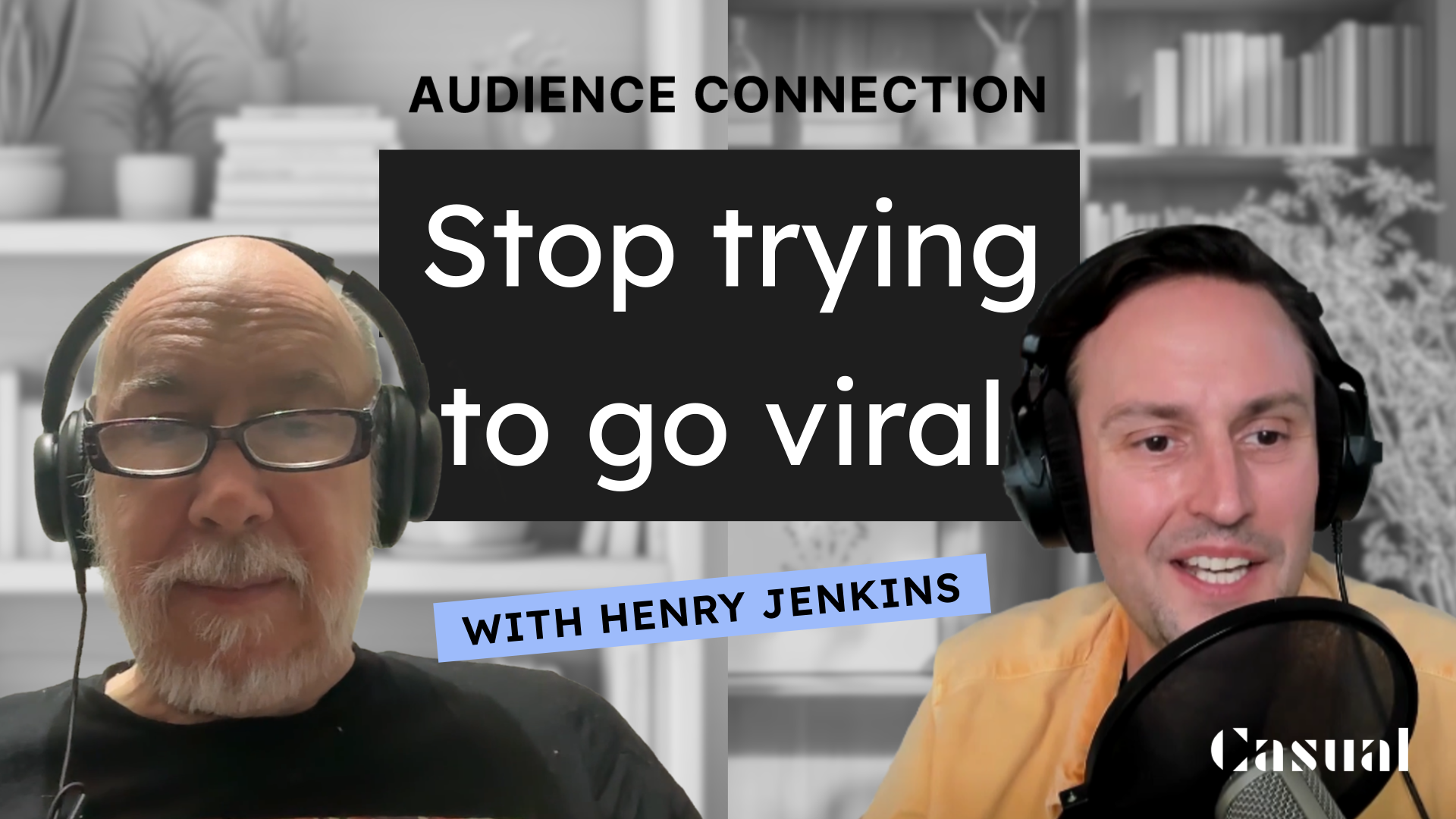
Stop Trying to Go Viral. It's a Smallpox Blanket with Henry Jenkins
What if the biggest mistake brands make isn’t failing to go viral, but believing they could control it in the first place?
Oliver Atkinson sits down with Henry Jenkins, Provost Professor of Communication, Journalism, Cinematic Arts and Education at the University of Southern California, to explore why “going viral” is the wrong goal, and what fandom actually asks of a brand. Jenkins made fandom a serious subject with his 1992 book Textual Poachers, and he argues the word viral describes a level of control brands lost decades ago.
The conversation is thick with examples. Jenkins unpacks why Lotso, a minor Toy Story villain, is everywhere in China while unknown in the US, and what that reveals about fandom being built by fans, not brands. He draws the sharp line between a loyal customer (his toilet paper) and a fan (his Lego), and explains the “moral economy” of trust that makes audiences feel entitled to content when brands withhold it. He praises Remington’s playful “how does Superman shave?” campaign and Lego’s Braille instructions, born from a blind fan’s grassroots fix, then dissects where A24 went wrong issuing takedowns to the very Backrooms community that fed its biggest hit. Survivor’s broken promise to fans gets the same treatment.
With fans able to abandon a brand “within hours” in the social media age, this episode is for marketers, creatives, leaders and internal comms teams. The takeaway: stop shouting at the cocktail party. As Jenkins puts it, “companies don’t create fans, they court them.”
Podcast Transcript
Oliver: This is Audience Connection, the podcast where we go into what content actually connects and why it sticks. Sponsored by Casual, where behavioural science meets storytelling to build trust with your audiences. And here are your hosts. I'm Ollie.
Lydia: And I'm Lydia Chan. Hello and welcome back to Audience Connection. We've got a really fun one today, because this is something I think every agency has received, and lots of clients have said over the course of my career at Casual. Certainly the words, "we want it to go viral."
Oliver: Now, my guest today thinks that sentence is a problem. Henry Jenkins has been studying fans for 35 years, and he'll tell you that "viral" describes a level of control that no brand has actually had for decades.
Lydia: Well, I've heard "going viral" less and less, which is nice.
Oliver: That's true. Definitely heard it many, many times over the years. And what I like about the way Henry thinks about it is that he looks at content as spreadable. Content moves because it's useful to people, passing it on, sharing it with friends, sharing it with community. Not necessarily useful to the brand that made the content. So one really interesting example he highlights is a razor company asking how Superman shaves.
Lydia: Oh yeah, I love that one. I've thought about it constantly since. Like, does he? Because he'd break the razor. He's the Man of Steel. How does he shave? With Kryptonite?
Oliver: Just to take his whole face off, because he's too strong. Yeah, who knows? Well, we get into what separates a loyal customer from a fan, and why Peloton is actually a media company, not really an exercise bike company. And what happened when Survivor promised fans a say and then didn't mean it. And the last bit, which I'm really excited about, is A24 sending takedowns to the very community that came up with Backrooms, which was a big hit for them. So that's a really interesting thing to unpack with Henry on this one.
Lydia: Yeah, absolutely. And there are practical threads for everyone in the episode. So for anyone building something inside an organisation, there's a lot about what it takes to turn colleagues into a collective, including a Lego story that changed how the company actually works.
Oliver: Yeah, there are tons of good stories in this episode. And a line that really stood out for me was, companies don't create fans, they court them. So something to bear in mind. But let's hear it from the man himself. Here is Henry Jenkins.
[THE BEAR NOBODY IN AMERICA KNOWS]
Oliver: Hello and welcome back to Audience Connection. My guest today is the person who made fandom a serious subject. Henry Jenkins is Provost Professor of Communication, Journalism, Cinematic Arts and Education at the University of Southern California, and before that he ran MIT's Comparative Media Studies program for over a decade. Back in 1992, his book Textual Poachers looked at the women writing Star Trek fan fiction, and argued something that sounded quite radical at the time: that fans aren't the passive end of the media chain. They're actually the most active, creative and connected part of any audience. Now it's about 30-odd years and 20-odd books later, and that idea is still running through everything from Marvel to K-pop to a film that's just come out by A24 and become its biggest hit. So we're going to dive into that later. But he's now writing a 15-book series called Frames of Fandom with Robert, four of which are now out. So, Henry, welcome to Audience Connection. It's great to have you here.
Henry: Delighted to be here.
Oliver: Brilliant. Well, let's dive straight in. When we initially spoke, you talked about a bear, and I'd love to start there. You told me about Lotso, the villain from Toy Story 3. Almost nobody in America remembers Lotso, but apparently he's huge in China. Can you take us through that story? Because I think it's a nice way of understanding meaning and where that sits.
Henry: Sure. I was going to Shanghai for a summer to teach a course on Western fandom studies to Chinese students. And I think I started seeing Lotso when I got off the plane at the airport. He is everywhere in China. And I thought, that's really curious, because you could go to any Disney store in the US and it's very unlikely you're going to see this bear, who is a villain in the third film and a series of sequels. Yes, the Toy Story movies have made lots of money, as they did this summer, but he's not well known.
So I started trying to dig into why that was, and spoke to some Disney executives who said the characters who do well in China are cute and mischievous. So they're Chip and Dale. They're the characters from Zootopia. There's Stitch from Lilo and Stitch. These characters speak to the way Chinese fans see themselves and their place in the world. But one of my grad students, who is Chinese, interviewed a bunch of fans, and many of them did not even know the film this character was from. They were drawn to the visuals of this character only, which they then fleshed out, and not from an American perspective.
It sounds quite strange. We think of fandom as built around characters we know in depth. But in fact, Molly, the lead figure from Pop Mart, the biggest entrepreneurial success out of China in recent years, has no media behind her at all. Molly dolls are selling like crazy. So she is a brand without meaning, a character without story. And something similar is true of Disney's own LinaBell, who is a pink fox character designed based on that archetype of cute and mischievous, who fans will line up for hours to get their pictures taken with, despite having no existence in Disney media whatsoever.
So that tells us some things about how fandom operates. How much of fandom is created by the fans themselves, either individually, in terms of people creating personal stories, or collectively, in terms of communities online constructing fan fiction and fan art around particular characters. And it tells us how much local culture, national cultures, reshape what fandom means in different countries around the world. To be a Disney fan in China is not the same thing as to be a Disney fan in the United States.
Oliver: And you've been studying fandom for 35 years or so. I think where our audience is working in internal comms or employer brand, they might think "fans" means Comic-Con, something very consumer-focused. What have they got wrong if they're thinking in that way?
Henry: Well, there's no question that fandom is a kind of creative consumption. The word consumption is inadequate, because it implies that we are using something up. In fact, I would say it's more helpful to think of fans as appreciating in the double sense: that they like you, I appreciate you, but also in the sense that they increase your value. We appreciate the value of a brand. So that's the first thing I'd say. When we think about fans as consumers, of course fandom is a phenomenon of mass media, mass cultural production. But it is also a phenomenon of localisation, customisation, personalisation, socialisation.
Now, we make a distinction in our books. We start with a definition of fans that is all-inclusive. It's any passionate relationship we have with some cultural object or practice. So you could be a fan of Star Trek, but you could also be a fan of Major League Baseball. You could be a fan of a brand, Lego. You could be a fan of a chef, Gordon Ramsay. You could be a fan of almost anything.
Now, there's a continuum. When lots of people say "fans," they don't mean anything other than "I liked it." Social media will go even further and say that one like makes one a fan, and I think that's absurd. That's too inclusive, the way the industry talks about it. But we go down a continuum toward greater and greater involvement. I look up information online. I read posts by other fans. I post something on a discussion forum. I go to a fan convention. I begin writing fan fiction, or whatnot. And as we go down that line, what becomes more important is the relationship of fans to other fans, as a kind of chosen family or community. And that's what we're calling fandom. So fandom is defined around the social. Fanship is defined around the individual's relationship with whatever the fan object is.
Now, within that space, I would say fans are the most creative, connected, critical, active segment of your audience. They're where the action takes place. If you please your fans, you can sustain your media or brand over a long period of time. If you alienate your fans, you're dead within hours, it seems, in the modern social media age.
[LOYAL CUSTOMERS BUY. FANS BELONG.]
Oliver: Yeah. We've talked before on this show about loyalty, and how far a loyal fan will go to defend you. Once you've created that loyalty, it's quite hard to break. But once you've lost it, once you've broken the trust, it's very, very hard to gain back. Have you seen that?
Henry: Yeah. I think trust is the key word there. I have to trust you, as a creator, as a brand, as a company, to deliver to me what I want. We have a social contract, a set of reasonable expectations of what this is going to look like. In fandom studies we call that the moral economy. Underlying any set of trade, there has to be trust. The moral economy is the shared social assumptions by which we both judge any given transaction. If I rip you off, if I put your content online and pirate it, I've broken a moral contract on one side. But if you withhold from me stuff that I could reasonably expect to see, if you make me wait nine months in the current age and cut me off from global conversations around your content, I may very well feel entitled to access it regardless. And that's what feeds the current trend toward piracy. The research shows the most pirated shows are those that are serialised, that are cult shows that people need to have a regular flow of information and content around, and where the company has somehow built a system that blocks us from having access to content we've become dependent upon in order to participate in increasingly globalised cultural exchanges.
Oliver: And what's the difference between a loyal customer and a fan, really? You've got people who will repeatedly go back. Is it that you feel a sense of belonging? Is it drifting into that tribal feel of needing to belong in the group?
Henry: Well, yeah. Let's take Charmin toilet paper. I buy Charmin every week. I need paper. I'll probably buy the same brand just out of habit. I'm a loyal customer, but I'm not a fan. I'm just not that into my toilet paper, despite commercials of people who like to squeeze the Charmin. Seriously, that's not a product I have an emotional connection to. It's not something I'm socially connected to. It's not something I frame my identity around. It's not something I make a lot of meaning with. All of those things would be true of a fan. So I could be a fan of Lego. I could be a proud owner of a particular automobile. Those are relationships we form. But there are plenty of products that are almost commodities, where we don't think about our relation to the brand in that way.
[VIRAL IS A FANTASY OF CONTROL]
Oliver: Often, when things get shared around the community, you get this term thrown around a lot: going viral. A lot of our clients have come to us over the years and said, "produce us a video, and I want it to go viral," as a sort of opening statement. You've got a bit of an allergy to that, haven't you? Can you talk us through why you're against it?
Henry: I mean, the word viral literally makes me go sick. Part of it is because it's a smallpox-infected-blanket theory of how media circulates. We infect something, unbeknownst to the user. We give it away to them, they take it back to the village, and infect all their friends and family. That's really what we're saying with viral. Your analogy suggests we can calculate precisely how to design something that is viral, and make something that will go viral. And it's a level of control that doesn't really function in reality, particularly not in relation to a group like fandom, which has a very strong degree of agency.
I would say companies don't create fans, they court them. Fandom has a long history going back hundreds of years. Within that community, say, of science fiction fans, a new show emerges, and it may be more or less successful in courting those fans. When I go to a corporation, they'll say, "we're worried about losing control," as if they have control. That, in fact, is the wrong way to think about it. You lost control decades ago. The people I study can do whatever they want. If you want to get back in the game, the way you do it is not to think about viral, but to think about spreadable. What is going to allow your content to spread through this community? It spreads because it's of value to the community, not because it's valuable to you. You're giving them a resource they can use to have the conversations they want to have with their friends.
So if there's added value in passing that content along, if it's part of a transmedia franchise, if it's unique content you've sent to them, if it's topical content they really want to engage with, if it's a creative advertising campaign that captures people's imagination and becomes a meme people use, that's valuable content we choose to spread. But we're not spreading it because you somehow infected it and infected us, and we have no idea why we're doing it. If you think about all the content that comes through your mailbox this morning, only a small percentage of it are you going to pass on to anyone. Mostly, I spend my morning waking up, zap, zap, zap, throwing that stuff out. There's a handful of things I read. There's one thing I send to a student saying, this is relevant to your research. That's the way we process it. So if the goal is viral, at a moment when we have more control over the flow of information than ever before, odds are you're one of those I zap. You're lucky if you're one of the ones I read. And it's highly unlikely, with that attitude, you're going to be the one I pass along.
[DON'T SHOUT AT THE COCKTAIL PARTY]
Oliver: Going back to the idea of trust, there's quite a high risk of getting it wrong. That's why I can see a brand pulling back and not trying to be part of that conversation, because to get it wrong could be almost fatal to the brand. So how should a brand navigate that? How should any team that wants to start communicating on that level begin?
Henry: Well, the writer Grant McCracken talks about having a chief cultural officer in your C-suite, someone whose job is to really understand the cultural dynamics going on around you. I went to Sand Hill Road some years back, spoke to a high-ranking VC, and asked him about this. He said, when we're choosing to invest in a tech company, we look for three things. We look for the person who understands the technology and what it can do. We look for the business person who understands how you make money, what the business plan is. And we look for the cultural person who understands the impact it's going to have in the culture, and why your consumer base would care that this product is being made available. And he said of those three, that last one is the hardest.
So you need someone who monitors culture. You could outsource it. There are lots of fandom experts out there now, so we're doing a better and better job of training them. The Frames of Fandom books are designed to give a crash course in fandom studies for anyone working in industry who wants to read up and learn the current state of the research. But it does take knowledge of culture and how culture works. My first advice is, above all, do no harm. Don't damage. If you have to step back, that's better than damaging your fan community. But being informed and engaging in a meaningful way is better still.
Oliver: Yeah. And there's the idea of mere exposure, isn't there? Start small, input in these different ways, rather than coming in with a big "we've completely repositioned ourselves and everything's different now." Just trying to slowly integrate into the conversation by being there.
Henry: Yeah. Think of yourself as going to a cocktail party. If you arrive and start shouting at the top of your voice, "look at me, I'm here now, I'll tell you what to think," people are going to avoid you like the plague. If you come in, you listen a bit, you understand the conversation, you make a meaningful contribution. You're not trying to take over the existing conversation, you're trying to be part of it. That's a very different attitude. But brands so often do the first and not the second.
Oliver: Yeah, I've been to a few cocktail parties with people like that. It's this idea that brands feel they're the hero. "This is what we've got, this is what we've got to offer, I'm here, I'm here."
Henry: And we don't need you that much. We're having a good discussion without you. Nice of you to show up a little late to the party. We're happy to see you sometimes, but you've got to behave well. We have our own norms and values and traditions and topics and social relations. And if you violate them, we're not going to think very highly of you.
[HOW SUPERMAN SHAVES: BRANDS THAT FEED THE FANDOM]
Oliver: So let's talk about brands that are getting it right, and then we'll dive into the ones getting it wrong. You talked about a couple of examples when we first spoke, around the Hunger Games makeup misfire. Can you take us through that?
Henry: Yeah. So CoverGirl tried once to court fans of Hunger Games at the peak of its popularity. They attached themselves to the content, which is something I might have advised them to do. But they attached themselves to the colours of the Capitol. Now, if you know Hunger Games, it's a very political story. It's about the districts and the ways they're oppressed by the Capitol. The Capitol is portrayed as decadent, frivolous, inhumane. So why you would attach yourself to the Capitol is a strange choice. It's because it's the sexy one. You don't want to be the colours of the district. You want to be the colours of the mining industry, or the foresters, or the bakers, or whatever. That's not going to be exactly fun, because the whole point of the story is that there are groups whose lives are pretty grim and grey. So I don't think it's a good franchise for CoverGirl in particular to become part of.
But we can imagine other relationships. Superheroes have been thriving for some time, and we choose examples of several brands that have found their way in. One is Mr. Clean. As one of the Superman movies came out, they decided to turn Mr. Clean into a superhero with his own origin story, whose mission is to battle dirt. That's an extension of the Mr. Clean mythology that goes back to the 40s and 50s, but reframed to speak to the superhero generation. It's a bit of a playful parody of the Superman story, but not one that's aggressively anti-Superman. So that one spread.
Remington, the razor company, asked, how does Superman shave? This is a debate people have had in the fan world for a long time. If Superman's the Man of Steel, you're going to need, of course, he gets pretty clean cut, so how does he shave? They got banter from favourites, celebrities, scientists, to speculate on that, and then encouraged fans to make their own videos speculating about how Superman shaves. And it was a great tie-in to their product. Then they did another one around Marvel, where they partnered with Stark Industries. This is a totally fictional partnership, but they're partnering with one of the big companies represented within the world. They produced razors for each of the Avengers. So the Hulk razor grows to eight times its original size, and they're all laser cuts and super powers attached to the razor. It's just playful, but it circulates very widely while carrying the razor company's branding. I got so many copies of that when it first came out, because it's something fans loved and wanted to say, "you'll never believe what this company is doing." So it's tied to the meaning. It's playfully engaging with the content. It recognises the traditions of the fan community itself. It invites our participation and gives us a resource we want to share with someone else.
Oliver: Yeah, you'll feed it. You're feeding the idea rather than taking it. You're adding something to it.
Henry: And let me say, if you do that respectfully and incrementally, it can be very powerful.
Oliver: I've got to know, what was the razor for Superman?
Henry: There's no definitive answer for that. It's a debate that can just continue and continue. That's evergreen content.
Oliver: Yeah. I was thinking some kind of thin blade of Kryptonite to shave.
Henry: No.
Oliver: Okay. So I wondered how your book Fandom as Consumer Collective touches on Peloton as a brand that created this community. It's an exercise bike, but they've ended up in a completely different stratosphere in terms of their community. How have they built that out? Quite an interesting case study for a brand becoming a collective.
Henry: I have to be clear that I am not a Peloton user myself. You can't see much of my body here, but I'm not exactly in great shape. My co-author Rob loves to exercise. He uses Peloton religiously, and he shares his experiences with it. He says Peloton has become a media company in a lot of ways, because the online classes, the particular coaches who run workshops, become celebrities in their own right. They form intense personal relations with individual riders, and they may encourage someone whose name pops up on their screen. They may say things directly to them. And they partner with media around releases. I remember reading about The Long Walk, the Stephen King movie that came out last year. They cut a deal so that a certain number of Peloton users won the ability to watch The Long Walk while riding their Peloton.
Oliver: Oh, wow.
Henry: And The Long Walk is about people being forced to walk, and if you stop at any point, you get shot. It's a horror film, but it's about long-distance travel. So the idea of settling in for two hours to watch this intense movie.
Oliver: That sounds pretty immersive, as a Peloton user.
Henry: So those are the kinds of partnerships they're doing on a regular basis. Partnering with entertainment companies, turning exercise into entertainment, generating their own celebrities, and personalising that interface with their users. All strategies which make Peloton a very fan-friendly company.
Oliver: And if you think about the way Peloton could have positioned themselves, they could have talked about the tech and the features and the benefits. But instead, they're encouraging probably people in my position: a 44-year-old dad, a couple of kids, not very fit, wanting to get back to trying to get fit, but with no time. And all of a sudden that community starts to feel quite attractive. You've got a bunch of people you can work out with and form bonds with. When you get a call-out while doing the exercise, it's almost like an embodied version of getting a Facebook like. There's probably a release of dopamine when somebody gives you that.
Henry: Well, I grew up in the generation that watched Romper Room on television. Romper Room had a magic mirror, and on birthdays they would call out, "I see little Henry, I see little Rob." That sense of being seen, literally seeing yourself in a fantasy world on Romper Room. But you're literally being seen here. The exercise master is calling you out and saying, "you're doing really well, your numbers are up this week."
Oliver: Yeah. Because these people leading the rides, Cody or whoever they are. Is there a risk that when you attach so much, and fans become so in love with these riders and so attached to them, that could be disrupted at some point, that the fandom is at risk in some way?
Henry: Well, I think there's always a risk of ceding too much control, unless you're ready to accept the outcome. If you cede control to your fans and you don't listen to what they tell you, you're at risk, because you've raised expectations. My son's a big hardcore fan of Survivor, and the Survivor 50 season was to be the season designed by the fans. Your decisions will shape it, and they announced that a year in advance. Fans started debating which guests they wanted to see on. They started imagining what the mechanisms would be, that you could design challenges. And in fact, it boiled down to a limited number of choices, most of which were not significant, most of which were choose A or B. Many of the choices were overridden. Jeff Probst was telling people how he would vote, which meant there would be massive numbers of people trying to please Jeff. In the end, they raised expectations they never had any intention of meeting, and left a lot of the hardcore fans really pissed off at Survivor. We'll see what percentage of them turn back up at the beginning of the Survivor 51 season, when it starts about a month from now.
Oliver: Yeah.
Henry: But that's a great example of raising expectations. You were going to listen, you were going to cede some power to your fans, and then you did the exact opposite. You were cynical about it and played with it, rather than taking seriously the consequences of ceding power to your community.
Oliver: And that's where you turn back to the idea of a chief cultural officer, someone who's listening and taking a moment to understand what's going on, so you don't make those blunders. Because that's how they feel, they feel like blunders. You feel tone-deaf. Unforced fouls, in a lot of ways.
Henry: Yes.
[TURNING COLLEAGUES INTO A COLLECTIVE: THE LEGO LESSON]
Oliver: And if the listener wants to create a brand called "we" within their organisation, where colleagues feel like a collective rather than just receiving announcements, what from Peloton, or from your work, can you see transferring into an organisation?
Henry: First of all, one of the ideas I proposed years ago was to hire teams of people rather than individuals. I was thinking about gaming. I would get a group of gamers who'd formed a guild together and regularly play together as a unit that works together. I would empower units to have some space for innovation and experimentation. I would create feedback mechanisms where people were excited to see each other's ideas get adopted by the core organisation and move their way up. I would create sites of innovation where people had some freedom to act, at least on the local level, and show each other what they'd made. So if you want to be an idea company, you've got to create the conditions that generate ideas. And if you want to build fans within your organisation as opposed to outside, you've got to actually give them some of the same creative freedom that I enjoy as a Star Trek fan or a K-pop fan.
Oliver: Which can feel like a cost, right? As an organisation, it can feel risky to allow people that time, instead of cracking the whip and saying get on with the work. But it pays dividends in the end?
Henry: Right. Both in terms of the passion your employees have for working with you, and in terms of the new ideas generated and the innovation that's possible that way. I'd say a company that does a good job with innovation overall is Lego, a company that started out as a children's toy company but has empowered both teams within the company and people beyond the company, teams of fans, to be innovators, and seems to actively listen to them. My old MIT colleague Eric von Hippel talks about lead users. Lego is the number one example he likes to use, because it really does recognise that the early embracers of your brand, your most passionate followers, are also the ones who identify unique uses, or things you need to adapt for, and put them forward.
So I know a guy, Matthew Shifrin, who is clinically blind. He says Legos are really great for the blind. They're almost Braille in physical form: the dots, and you put them in place. He said he can feel and understand what Buckingham Palace looks like, because he can feel it, on a scale he can approach. He's never been able to see it, but he can feel it. But Lego wasn't putting any instructions in the kits that were legible to him. They weren't in Braille, they weren't audio instructions. So he and a friend began making online Braille instructions you could print out on your Braille printer, so that people who were blind could use them. It was called Lego for the Blind. The company heard about this, flew him at their cost to Scandinavia, sat down for two days of meetings with top executives, out of which they got to make the announcement that they would commit to putting Braille instructions with every build kit from then on. So he changed the fundamental way Lego worked. And part of the lesson here is that they were paying enough attention to their fan base. They saw the importance of what he was doing. They recognised his creative contribution, and they pulled him in.
Now, Lego fans had also started having brick cons, spontaneous grassroots conventions around Lego's brand, where they would set creative challenges for each other and get prizes. First Lego sent judges to help with the competitions. Then they realised, this is really cool, what if we created a reality show called Lego Masters, where we use those same judges, the same kinds of challenges, recruit contestants from within the fan community, and turn this into a show that might have broader appeal? And so Lego Masters, for casual viewers, those are everyday people, fathers and daughters, making Lego challenges. If you're in the fandom, those are the podcasters, the bloggers, the fan favourites from cons, getting their shot at being on television.
Oliver: Yeah. So there's that moment where you, as a brand, sit down and listen, and focus on what's actually out there already, and try to include it.
[A24, SURVIVOR, AND THE COST OF BREAKING TRUST]
Oliver: Now, you mentioned Serenity when we spoke. That's quite an old film, isn't it, where the fans promoted the film for free and then ended up suing the studio. And recently we've had Backrooms by A24. I'd love to talk about that, because it's almost like an up-to-date version of that, where you've had that rebellion from the community off the back of it. Everyone at Casual really loves A24, they produce great films. But they got caught issuing takedowns against fan art for Backrooms. And Backrooms is built on a community concept, right? So were you surprised when this happened? What's your read on all this?
Henry: Yeah. Well, let me go back to Firefly, or Serenity, briefly, to explain what happened there, and then go into this. So Firefly was a TV show, Serenity was the film. The film came out with almost no promotion. So fans made their own t-shirts, they camped out in front of theatres. They really promoted it, because they knew the only way they were going to get more content was for this film to succeed. The producers were fine with that, until the film left the theatres, and then they sent out cease-and-desist letters threatening to sue fans who had made t-shirts. The fan community rallied and gathered information, and sent back a notice for billable hours, for how many thousands of hours fans had worked for free on this production. And the studio quietly and quickly backed down, because it was very clear the value added on one side was much greater than the value added on the other. And that goes hand in hand with this idea of appreciation.
Now, Backrooms is an interesting story. It was created by a 20-year-old, the first 20-year-old to make a Hollywood film that was top of the box office the week it opened. The 20-year-old had been making films since he was 14, most of which initially were fan responses to existing video games and so forth. Backrooms is based on what the internet would call creepypasta, a kind of folk legend that spread from 4chan outward. He just took the folk legend and added his version of it, which proved so successful, with a strong following online. Those followers followed him into the theatre the week it succeeded. But when A24 sent out their cease-and-desist, it shut down the very process that led to Backrooms to begin with. It's going after the very thing that feeds it. It cuts off the creative process that would be likely to generate the next young 20-year-old filmmaker who might make a hit movie for them. Because you build initially on existing cultural content, in this case creepypasta, but now they're also building on the Backrooms-branded version of it. So it's just short-sighted. It's rude, to go back to our party-guest thing. You're trying to silence the party rather than enable it.
What I think they should have been thinking about is, how do we replicate the model of success in Backrooms? How do we hire lots more 20-somethings, give them micro-budgets? From a studio perspective, that was made for about $1 million. Compare that to the hundreds of millions for a big Hollywood franchise. Get a hundred $1 million movies generated around YouTube content by young people, throw them into the theatres, and see what hits and what doesn't. But that means you empower the creative culture around the media and encourage people to make their own fan responses to the products you've built.
Oliver: That's a really interesting idea. And it would generate everyone going to the cinemas again, revitalise the industry.
Henry: It's kind of what Roger Corman did in the 60s, when he hired kids straight out of film school and gave them micro-budgets to make exploitation films, out of which we got probably a dozen directors who would trace their lineage back to Roger Corman. So it's happened before. It just happened in a different Hollywood than the one we have now.
Oliver: And I think Backrooms ended up being their most profitable film, didn't it? For ROI.
Henry: For ROI, for sure. There's something even more successful going on in China. There's an animated film that apparently looks like crap, made for literally $900, that is going to turn out to be one of the biggest box office successes in China this summer. It started with the internet making fun of it as a turkey, but that got everyone to see it, and now its success is building on itself, as often happens with blockbusters. It's one of those films you just have to see.
Oliver: Yeah. There was a film ages ago where that happened, wasn't there? It was an absolute turkey, and everybody went in, and it became a huge success. I can't remember what it was called now. But the interesting thing you raise there is about ownership, and where we are with AI, and how people develop and create things, and where that fits. We've talked on this show about essentialism, that you only care about something when you understand its origin. Where do you see that as AI develops, and generative AI and AI films start to come through? Where does fandom sit in all of that? Surely that will empower fandom even more, with even more tools at people's fingertips to create their own content.
Henry: Yeah. We're seeing spectacular content coming out using AI. I was first impressed with a film called "If Wes Craven Had Directed Lord of the Rings," which looked like a Wes Craven film but had special effects on the Peter Jackson scale. I saw one the other day that was "if Game of Thrones had been made in the 50s," and it's this big technicolor 50s epic, square-jawed-actor version of Game of Thrones. The state of the art there is extraordinary. What's happening is these tools are enabling everyday people to create and express themselves visually, who never would have done it before. It's closing the gap in special effects between commercial products and amateur products.
The downside is that it's also deskilling fan artists, in the same way it's deskilling labour in Hollywood. The fan artist who spent a lifetime learning how to do a particular thing well, and someone else can punch a couple of buttons or put in a prompt and it comes out every bit as perfect, is really angry and upset by that. Fans are also upset because these companies scraped lots of fan art, which was out there for free, and developed tools off the back of this amateur creativity with no revenue return to those fans. So fandom now, it's a political hot potato. Fans now are mostly anti-AI. They didn't have to be, because it really is an enhancer of fan creativity used well. But the companies have adopted policies and approaches that do real damage to the fan community itself.
Oliver: Because I would have thought the generative AI would turn into a whole subgenre of fandom, and it may still do that.
Henry: It may still. I think these "what if" things are original. That's pretty exciting to me. But I do share, and I'm sympathetic with, the complaints about how, ethically, AI companies behave toward fans, and the damage and disruption they're causing within fan communities.
Oliver: Yeah, it feels like a car going down a hill very fast with the brakes off. And regulation may sort that, but we're not there yet.
[A RULE FOR BORROWING FROM CULTURE]
Oliver: Just to pull back to the audience we have here. When we talk about A24 and the backlash, is there a rule for taking something from culture without being seen to steal it?
Henry: Well, first of all, you have to respect the values and norms of that culture. I think small-scale entrepreneurs can take things from the culture that seem to enhance it. If you're a punk guy who makes t-shirts, and it's clear you belong to that culture, you're going to be perceived differently than if you're a cigar-chomping tycoon, or the Mr. Monopoly guy who comes in and takes something punk and just turns it for a profit. So rootedness, engagement, identification are a key part of it.
Secondly, you respect the hierarchy of folks in that community. If you're making money off a community, feed money back into that community. If you're taking someone's work and remaking it for a profit, do some profit-sharing. And Lego, in fact, does do profit-sharing with some of its fan base around some of the innovations that emerge bottom-up. So treat the group with respect, don't exploit them, and you're going to be treated with respect and not be seen as a coloniser in most cases. But it requires a depth of knowledge of how that particular culture operates. It's not one size fits all. Fandom is often a gift economy, and fans don't necessarily want revenue as the answer to everything. That's your value system, it's not necessarily theirs. So think about it: you go on a hot date with a person of your preference, you wake up the next morning, and there's a $100 bill on the dresser when that person has snuck out in the middle of the night. Do you feel better about that encounter because they paid you for it, or not? In a gift economy, putting money on the table may or may not be a way to improve the relationship. And you need to know that before you make that gesture.
Oliver: Completely. I'd probably take the 100 bucks and go and have a really nice breakfast and a lovely coffee. It's kind of flattering.
Henry: It could be, but for a lot of us, it would not be.
[ATTENTION IS EASY. MEANING IS THE HARD PART.]
Oliver: So, where I want to push you on this. Where we've gone with Casual is to look at behavioural science, and how our films are business tools, essentially. We want them to train people, or get people to do something at the end. It's not purely entertainment. Often it's brand awareness. There is a level where it sits in that entertaining space, but we often want it to be a tool to do something. So we look at behavioural science, we've looked at neuroscience, we've had Doctor Paul Zak and Doctor Christopher Demetrios on the show, and they talk about resonance and immersion, the release of these brain chemicals and how you can measure it now. We're entering a new world where you can design by these metrics, design for when people's subconscious is taking notes. Do you think that's a way we should be going to really understand our audience, or do you think something's missing from that way of working?
Henry: Well, I can get your attention very easily right now. It doesn't require science. But is that attention-getting going to serve me? Did I just annoy you? Did people back off and cover their eyes? Is that attention-getting meaningful to the people involved? How are they going to act on it? All of those questions pull us deeper into the realm of culture and require deeper qualitative analysis, cultural analysis that helps us understand why this is happening, and whether it's likely to be something people carry with them, whether you've already forgotten the gestures I just made at the camera or not. So yes, getting attention is something we know a lot about, but that's the tip of the iceberg of what we need to understand if we're going to see what long-term, sustained, loyal relationship comes out of it. I doubt I just built loyal fans by getting their attention just now.
Oliver: Yeah. What Paul Zak does is measure oxytocin and dopamine, which he says is immersion. So it's not just attention, it's actually linked to the brain saying "this matters to me." But the point you make is really interesting: it can matter because it's negative, and it can matter because it's positive. It matters to people for different reasons.
Henry: Yeah.
Oliver: And that's what we're trying to do at Casual, understand that qualitatively, interviewing the audience. Understanding your audience on a really deep level should be the first step anywhere. Then you start to understand what's going to change people, or what's going to remain with people. Because we forget things really easily. You watch things, and you can count likes and clicks and views, but how that's resonating inside someone is another thing altogether.
Henry: Absolutely. And that's where the qualitative work that fandom studies does can be very helpful, for understanding long-term the cultural dynamics that grow up around a brand or media content.
[WHY 15 BOOKS?]
Oliver: I just want to talk a little about your books. You've got 15 books you're doing in the Frames of Fandom series, and you've done four so far. Why are there 15 of them? And what's the one idea from that series you'd think a business leader could take away?
Henry: Well, we started out to write a textbook, and we realised textbooks suck. So we started to break down why they suck. Some of it is the relationship of the reader to the writer and the style. Some of it is the pricing schemes. We wanted to lower the price. We wanted people to only pay for the content they used. And these are things brands could learn to think about too. You buy a $100 textbook and reach three chapters into it, you're going to leave everyone pissed off. So we said, what if each chapter is its own book? But we want to make sure we give value, so we enable it by self-publishing and print-on-demand, and reduce the price to $10 digital, $20 print, which even by book standards these days is pretty cheap.
Each book takes a different way of understanding fans, takes you through the history of how our field has thought about it, and provides insights that are helpful to companies, to scholars, and to fans thinking about their own behaviours. So we go from defining fandom, to fandom as a consumer collective, fandom as audience, fandom as subculture, and fandom as co-creation, which is coming up next, and fandom as participatory culture. Down the line we'll deal with fans as publics and activists, we'll deal with desire and devotion, technology, location. All of these are key areas, and rarely do we have the space to deal with them in enough detail to really be helpful. But just like this conversation, we have lots of concrete examples. We pull it down to basic principles, but we're also giving you access to the existing scholarship. So if you want to read up more on something, there's a rich bibliography at the end of every book, fuller versions of these case studies that hundreds of scholars around the world have written about. And it's a distinctly global perspective. We often think about fandom through American examples, but we talk a lot about East Asian fandoms, African fandoms, European fandoms, Latin American fandoms. So if you're a global company, the value of these books is pretty high, because we're not just thinking American. We're illustrating what it means to ask the question you begin with: why might a certain brand be popular in China and not so popular in the United States?
Oliver: Yeah, it goes back to that audience understanding, because then you can build on something that actually connects globally.
[THE AUDIENCE CONNECTION]
Oliver: Well, thank you very much for coming on. It's been fantastic to have you on the show. I've just got one final question. We wrap up every episode with this, it's called the Audience Connection. They say that when you're creating something, a podcast, a book, it's good to think about one person. Is there one person you think of when you're writing or creating, and who is that person? And how does that change how you write?
Henry: Well, when I published Textual Poachers 35 years ago, the book had only hit the stands for a day or two when I got a phone call on Christmas Eve from a 16-year-old girl somewhere in the middle of the country, who thanked me for the book. She said she'd given it to her father, he read it, and for the first time he understood why she was a fan and why that was meaningful to her. That's the girl I write for, still, 35 years later. I don't know her name, I don't know where she is. But yeah, I write for that girl.
Oliver: That's amazing. And that's fuelling you to write a certain way, because you're communicating to her.
Henry: I've always written in a very accessible way. I don't want to write about a fan community and then write it in such a pretentious way that they don't understand what I'm saying. So it's accessible, pragmatic, concrete. I try to get the details right. I try to respect those sources in the community. So it all grows out of making a book that a 16-year-old could pick up, about something they knew well, and share with her father so that he understood them better.
Oliver: Well, I've got to say, I've got two of your books, and they are incredibly accessible and well written, so I can highly recommend people go and get those books. We'll put some notes in the show notes for people to find out more, and go and check out your podcast as well and listen to that. Some great episodes on there. Well, look, Henry, thank you so much for joining us, and hopefully we can get you back on again to talk about fandom.
Oliver: If this episode sparked something, curiosity, a new way of thinking, or something you're going to take back to the team, we'd love to hear about it.
Lydia: Absolutely. Make sure you're subscribed, leave us a rating, and drop us a comment. Tell us what stuck and what you want us to explore next. We want to know. This is Audience Connection, sponsored by Casual, the video partner for global brands trying to build trust with their audiences. We'll see you next time.

Fix up quick smart.
Find out more about how Smart-Casual can help
improve your video content
