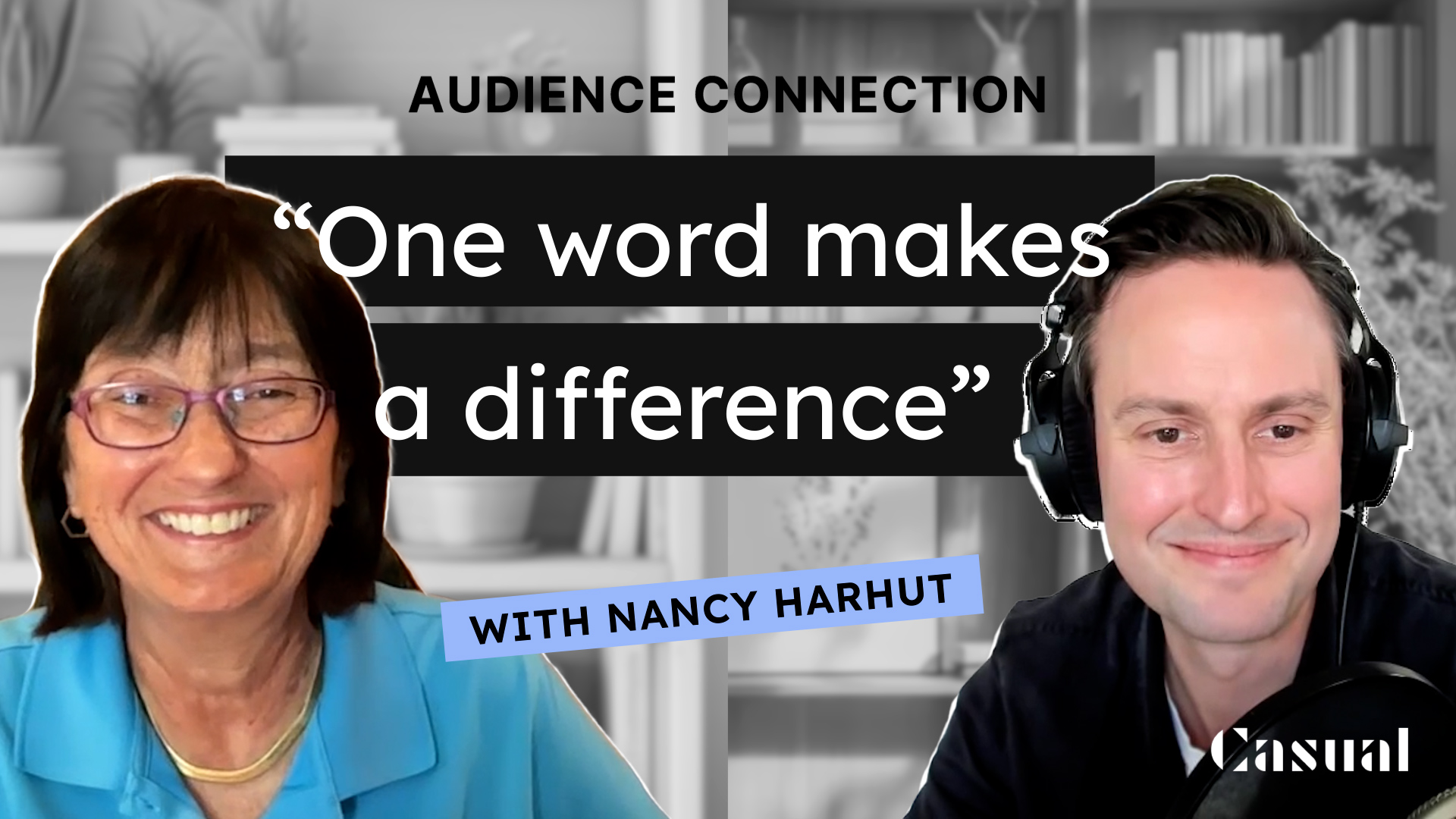
The magic word that makes you say yes with Nancy Harhut
What if the biggest barrier to your marketing isn't your budget or your production values, but the fact that you're speaking to the 5% of the brain that's actually paying attention?
Oliver Atkinson sits down with Nancy Harhut, author of Using Behavioral Science in Marketing and founder of HBT Marketing, to explore why the same campaign, with a little science layered on top, can perform dramatically better. Nancy has built a career on turning behavioral science into double and triple-digit lifts, and she brings the receipts. She walks through the life insurance campaign that drove a 469% sales lift using extremist aversion, the pull of the magnetic middle. She unpacks the nationwide reciprocity play, a framed New Yorker cartoon with the recipient's name in the caption, that generated $68 million in incremental revenue.
Along the way she breaks down the power words that quietly move people: why "because" is an automatic compliance trigger, why "small $5 shipping fee" beat "$5 shipping fee" by 20%, and why the BYAF technique ("but you are free") can double response. She and Oliver get into the autonomy bias behind disabled crosswalk buttons, the labeling effect that lifted voter turnout by 15%, and why emotional B2B headlines still outperform rational ones.
If you're a marketer, creative director, or brand strategist, this one is dense with tactics you can test tomorrow. The through-line: most people decide on autopilot, so stop writing for the conscious 5%.
Podcast Transcript
[INTRODUCTION]
Oliver: This is Audience Connection, the podcast where we go into what content actually connects and why it sticks. Sponsored by Casual, where behavioral science meets storytelling to build trust with your audiences. And here are your hosts. I'm Oliver Atkinson.
Lydia: And I'm Lydia Chan. Hello and welcome back to the show, everyone. Today's episode is packed with practical insights you can implement tomorrow, so have your note-taker ready.
Oliver: We have an expert marketer on who is layering behavioral science on top of tried-and-true marketing techniques, and really breaking down why certain content connects and certain content doesn't, which is what the show is all about.
Lydia: Yeah, exactly. So we've had a lot of guests on talking about behavioral science, and the brilliant thing about Nancy Harhut is that she is applying this. She's using it daily. She's the author of "Using Behavioral Science in Marketing" and the founder of HBT Marketing. She's spent her career doing just that, and the results are consistently double- and triple-digit lifts, not from bigger budgets or flashier production, but just from understanding how people make decisions.
Oliver: Yeah, we've heard this a lot from our other guests, right? That 95% of decision-making is happening on autopilot, subconsciously. So Nancy makes a good argument that people are creating content that speaks to that 5% of conscious thought. So if your video or email ad campaign requires someone to think carefully in order to respond, you've already lost most of your audience. And look, Audience Connection 101: don't lose your audience.
Lydia: Yeah. Beware the cognitive load, right? We haven't done our jobs if any of that happens. So we get into some pretty remarkable real-world proof of that, like how adding just one word to a product description drove a 20% lift in sales for a particular brand. The power word "because," and the reciprocity principle, one of the classics. I can't believe we haven't had it on the show already.
Oliver: It's all super relevant to the work that we do, and to what this all means for video specifically. All right, well, let's get right into it. Here's Ollie and Nancy Harhut.
[THE 469% LIFT THAT MADE HER GO PUBLIC]
Oliver: Hello and welcome back to Audience Connection. I'm really excited today to have Nancy Harhut, who we've been trying to get on the show for a little while now. So I'm delighted to talk through some behavioral science with you and unpack some of your experience. Welcome to Audience Connection. You've spent a career proving that the same marketing techniques, with a little bit of science sprinkled on top, actually perform dramatically better. So let's start right there. When did you really stop being interested in just the marketing and the theory, and when did you start to push the two together and apply it?
Nancy: It was a gradual evolution, if you will. A colleague of mine, a mentor, gave me Robert Cialdini's book "Influence: The Psychology of Persuasion." I know a number of your guests have probably read it and referenced it. I was reading it, and I was making margin notes and underlining things and thinking about the pieces of business that I was working on. And I began to slowly try some of these tactics, and I was observing that they were working quite well.
And then a little time passed, and I was hired by a new agency. About two weeks into that new job, I found out that their biggest piece of business was in play. The client had put the agency on notice that they weren't particularly happy, and they really wanted to see the agency step up. So everyone's looking at me. I'm the new creative director. So I'm like, okay. And I said, you know what, I'm a big believer in behavioral science, so let's start applying some of it. In other words, we're going to go public with it.
The assignment the client had given us was: we want you to get dentists to buy more life insurance. And they had previously been trying all the logical, rational reasons that you should. "Hey, if your practice grows, if your family grows, you need to make sure that what you bought a couple of years ago is still adequate for what you have now." And all of this made sense, but none of it did particularly well.
So I said, all right, this is what we're going to do. We're going to use something called extremeness aversion, or what Cialdini refers to as the pull of the magnetic middle. And basically what that means is that, for the most part, most people don't like to be way out on the bleeding edge, and they don't like to feel like they're lagging behind. They feel most comfortable in the middle.
Oliver: So why is that, Nancy? Why do we feel more comfortable right in the middle? Why is it so repellent to be near those edges?
Nancy: I think it's a safety-in-numbers thing. If everyone's clustered in the center, we feel that's a good place to be. We don't feel as exposed. It's a pretty safe choice. We feel confident about being there because so many other people are there with us. If we're way out ahead, it can be a little risky. And sometimes that's great. Sometimes we like to be the first one to have something, no question about it. But sometimes it can be very risky when we're hanging out there all alone and we don't see anyone around us, and we're wondering, am I exposed? Did I do the right thing? Did I overextend myself? And similarly, if we're lagging behind, we feel like we're being left behind, being left out of it. We measure ourselves. It's human nature. We measure ourselves against other people, and we feel deficient in some way because they're all up ahead and we're trailing.
So, generally speaking, most people like to stay in the middle. They gravitate toward the middle. If you give people three options, we have a tendency to choose the middle option. So what we did is we put together a message that included a graph. At one end we had $3 million, the most insurance anyone could have from this company, because that's all they sold. And at the other end, $0, the least you could have. And we deliberately chose people who had less than $1.5 million, less than half the amount, which, to be fair, was most of their clients. And we showed them on the graph where they were. "You are here. You have $200,000 of insurance." And you look at that, and in a glance you have a visceral reaction. You feel like you're behind, because it goes from $0 to $3 million. $1.5 million is the middle, and you're maybe sitting here at $200,000. You're left of center, you're lagging behind.
And we didn't expect that people would immediately say, "Oh my gosh, I should have $3 million worth of coverage." But we did think it would move them closer to the center. And this client got a 469% lift in sales based on this. And it wasn't people calling or talking to an agent or saying, "send me more information." It was actual sales. A triple-digit lift. A 469% lift in sales. And I think that was when I realized this really does work. I'd been trying it quietly here and there, saying, "yeah, it seems to work." But this time everything was on the line, and I went public with it. I shared it with the team and said, "are we in?" And the team was like, "yeah, let's do it." And it paid off big. And that was, I'd say, the point of no return. I doubled down on it.
Oliver: And there are a couple of things going on there. It's a version of social proof, that extremeness aversion, isn't it, because you want to be in that safe middle, in the pack. So you personalized it. The graph was personalized. That personalization really speaks to somebody, doesn't it? You feel like, "all right, this isn't some company just sending out a generic message to all of us. They know who they're talking to. They're talking to me. They're showing me where I am."
Nancy: As they should. I bought the coverage from them, they should know. But a lot of companies don't. A lot of companies should have this data on their customers, and they don't, or they don't trust the data. They don't think it's necessarily accurate or clean. And as a result, you get these more generic letters or emails or ads or messages, and you're like, "they don't really know me." But you're absolutely right, this was personalized. And the flip side of that too is, how often do you spend time thinking about your insurance? If I said to you, "how much life insurance do you have?" you probably couldn't tell me.
Oliver: I couldn't tell you what I have. I can tell you how much I spend a month, but I can't tell you my cover level or anything like that.
Nancy: And so by saying to people, "you should probably have more insurance," well, that's very vague. If you say, "listen, here's where you are relative to how much you could possibly have," that does make a difference. It makes it more tangible, more top of mind, easier for you to think about. So there was a lot going on there, which I think led to that triple-digit lift.
[WHY B2B BUYERS ARE STILL HUMAN]
Oliver: It really resonates with me as a story, in terms of reading through the theory and then trying to apply it to our business at Casual, and what we're doing with behavioral science. When you first started talking to clients about behavioral science, how did they react? What was the initial reaction to the idea of layering this social science into the work? Was it rejected in some ways, or was it an easy sell?
Nancy: It was interesting. As I was saying, when I first started to experiment, I knew I was doing it, but I wasn't telling anybody else. On this one, I told the team, because I thought, "hey, we've got a piece of business riding on this, so we're either all in or we're not." And the team was all in. But then, when do you tell the client? In this particular case, we told them after the results came in. And that makes all the difference. But then we hung our hat on this and said, "right, this is how we're going to approach business going forward. We're going to infuse behavioral science into all of the work we do for our clients." And we would talk to them about that when we presented the work, and when we pitched new business.
And I have to say that, for the most part, clients were very receptive. And I think the reason why is that we were pointing to outside experts. So it wasn't, "well, Nancy thinks this is how it should be written. Nancy thinks blue is an attractive color." It wasn't my opinion versus their opinion, or my best guess. We were saying, "listen, there was a Stanford study. There was a Harvard study. There's market research where a company tested this, and these are the results they got." And that made clients feel a bit more confident. They felt like there was some scientific rigor coming to the work, that there was less personal preference in it. And we would always say, "listen, there's no magic wand. We can't guarantee that 100% of the people are going to do 100% of what you want 100% of the time. It doesn't work that way. But we're going to test our hypothesis, and you're starting from a more informed place. You're starting from a place that's going to give you a head start, that's going to make it more likely that you'll see the response you're looking for." And clients seemed to be really interested in that. It was reassuring to them. And certainly, if the work we did paid off, then they were all in.
And a lot of times they would say, "there's really no need to test a few versions, just give us your best thinking." And of course, we would always like to test. Even if we were testing two or three different behavioral science principles against each other to see which one is going to do best in a particular instance. And sometimes they'd say, "no, just give us your best shot. We're loving this, it's really working better than anything any other agency has shown us."
Now, every once in a while we would get a client who would say, "well, that's not how I behave." Or, "that's interesting, but we're in a business-to-business situation, we're targeting professionals who are controlling multi-million-dollar budgets. Certainly they aren't subject to these behavioral science principles and decision-making shortcuts and cognitive biases. No, no, no, they're perfectly rational and making well-informed decisions." And we would have to say, "we understand why you say that, and you're not entirely wrong, but you're also not entirely right." Yes, a businessperson is making well-thought-out decisions for the good of their company. But there's still a person in that businessperson. And those biases pop up even without people realizing it. Everyone is beholden to someone else. I need to know what my boss thinks of me, or what my colleagues think of me. And my boss reports to his or her boss, and that boss ultimately reports to a board. There's always someone. "You've got to serve somebody," as Bob Dylan said.
Oliver: Absolutely.
Nancy: And so you wonder, "where do I stand with that person? How am I going to look to this person? Is this going to make me look better or worse? Is it going to further my cause or set me back? If I champion this new software system, am I going to get home to my family and have dinner with them, or am I going to be stuck here nights and weekends trying to implement it and onboard the employees?" These things factor in, either consciously or, often, less consciously, just under the radar. And as communicators, we need to be aware of them, because that will allow us to craft the most resonant, most persuasive message that really connects with our target.
Oliver: And I think that really applies to video and film, especially when you think about the subjective nature of art and film, and creating something for a brand where so many voices get into a room. It's actually really refreshing to say, "well, look, this is the science behind it." It's an evolving field where we can start to see there are these ways of measuring how people will engage with your content, or what they might go on to do. So we're finding it a really useful tool to move away from "you know what, I just don't like it," and toward "well, if you do this, it means this will probably happen." And if you point to the studies, you've got nice, impartial information there, linked to a behavior.
[A SMALL $5 FEE BEATS A $5 FEE]
Oliver: So let's talk about taking the abstract theory and applying it. Can you take an ordinary, by-the-book piece of marketing advice, and tell us what happens to engagement and response when you start to thread behavioral science in? Have you got any stories or examples where you've really seen a difference once the behavioral science layer is in?
Nancy: I'm going to go back to what I said earlier, which is: we can't wave a magic wand. So I can't tell you this is absolutely going to work. But what we see is that we're winning more than our fair share when we're up at bat. At HBT Marketing, we work with a variety of clients. Do we succeed every time we put something out in the marketplace? No. Do we succeed more often than most? Yes. We can talk about double- and triple-digit lifts over benchmarks and over controls, and our clients are really happy with that.
I think what happens is, you can have a great product, a great price, and all of these wonderful features and benefits that you're talking about. But if you don't serve that message up the right way, that can hamper its effectiveness. The old adage is: the right message to the right person at the right time. And all of that holds. But you also have to deliver it in the right way. And that's, in my opinion, in a brain-friendly way. In a way that's going to make your target more likely to notice it, understand it, recall it, and act on it.
There have been a number of studies that show the difference of one word or phrase over another has a huge, outsized economic impact. There's a study I didn't run, but I read: a company had to introduce a $5 shipping fee. We all know what $5 is. But they had to decide between saying "$5 shipping fee" or "a small $5 shipping fee." One could argue that if you say "small," you might make people angry, because they're not happy they have to pay it anyway, and you're kind of jabbing them. Or you could argue that you're taking up more space, and the more space something takes up, the more attention it calls to itself, and this wasn't really good news, so let's just make it as succinct as possible. But they tested both. And what they found was they got a 20% lift in sales when they referred to it as a "small $5 shipping fee." The reason, behavioral scientists believe, is that they framed it. They influenced how you thought about it. Sure, $5 is $5, we all know what it is. But by saying it's a "small $5 fee," it made that idea more top of mind. People thought, "yeah, it's only $5, it's small, let's go with it."
So it's really interesting. A change in a word or a phrase, or in the design or layout of an email or a landing page. You might think, "what difference is it going to make to shift this from here to here, or change that word to this word? It's essentially the same thing." And yet it does make a difference.
Oliver: And if I take that back to video, even in video you've got text on screen, you've got things happening, you've got calls to action happening there. So you can actually play with font sizes and words even more easily, right? Things appear on screen, you don't have to justify it, and it's not there the whole time. So there's an opportunity there in video as well.
Nancy: Absolutely. And speaking of video, you might think, "we're going to have someone talk about our product, or talk about their reaction to our service." You're thinking, "all right, I've got this person, and they're clearly in favor of it, good, we've checked that box." But there are certain nuances. You want the person to maybe look out and make eye contact, because humans are attracted to other people's faces, and particularly to their eyes. So you want that eye contact, or you want the eye gaze to be directing your viewer to what you want them to see. Maybe it's the product, maybe it's the price you put up in the video, maybe it's something else. It's not enough to just check the box and say, "yes, I have a happy customer talking about how satisfied they are." There are things like the eye contact, the eye gaze, the tone of voice, whether they're smiling or nodding, even the color of the shirt they're wearing, that can all make a difference. And again, it's these little things that deliver these outsized impacts.
[THE $68 MILLION NEW YORKER CARTOON]
Oliver: And talking of outsized impact, can you tell us the Nationwide story? Just to clarify for a few of our listeners or viewers in the UK, this isn't Nationwide the building society in the UK, this is Nationwide in the US, a slightly different company. Would you mind running us through that one?
Nancy: I'd be happy to. So it's Nationwide Financial Services, and they employ financial advisors to sell their retirement funds. These financial advisors could represent other companies along with Nationwide. And Nationwide was tracking this group of financial advisors, and they noticed that all of a sudden they had just stopped selling Nationwide products. So they reached out. The wholesalers would call the financial advisors, they would email them, trying to get them re-engaged, and they had a small amount of success. But there was still this group of financial advisors who'd been humming along, selling product, and then stopped. And now about a year had passed. So Nationwide came to the agency where I was working and said, "can you help us? It's been a year now, and we can't seem to get through to them." So we said, "sure, we'll take on the assignment."
And if you think about it, a year is a long time. It's not that they stopped for a month, maybe they went on vacation. It's not that they stopped for a couple of months, maybe they were trying out somebody new. It's been a year. They've made a decision. They've moved on. So we said, "we're going to try the reciprocity principle." And the reciprocity principle, as a quick refresher, is the idea that when someone does something for you, when they do a favor for you, when they give you a gift, whether or not you asked for it, once you're the recipient of it, you feel like you want to return the favor. You want to reciprocate. You don't like to feel like you're the person who's beholden, the person who owes. Someone did something for you, you want to do something for them. Ollie, if you sent me a birthday card, I would make a mental note to find out when your birthday is and make sure I send you one on your birthday. We like to even the score.
So we had the wholesalers send out an email to these financial advisors who hadn't been selling Nationwide for over a year. And the email said, "hey, watch your postal mail, because you're going to be receiving a gift we've picked out especially for you." And then a couple of days later, this white corrugated cardboard box shows up in the mail, and inside is a framed New Yorker cartoon. So there's a cartoon by a New Yorker magazine artist, and they're considered quite high-end. And it was a very appropriate cartoon for someone in the financial services industry. And when you read the caption, you realize your name is in it. So mine would have "Nancy" embedded in it, yours would have "Ollie" embedded in it. So it's personalized. And then there was a little paragraph about this particular New Yorker artist, because again, it was quite prestigious. And then there was a letter with some information from Nationwide saying, "hey, we've missed you. We'd love to continue working with you. We've enclosed some practice-building ideas that might help you grow and build your practice, and we'd love to re-engage."
And Nationwide got back to us and said that this particular campaign, that single email and the direct mail piece, the framed cartoon, generated $68 million in incremental revenue. Revenue they would not have realized had they not undertaken the campaign. And you can imagine, if you were a financial advisor, you get this thing, it's pretty cool, you're going to put it on your wall or on your desk. Now it's top of mind. And next time you're talking to somebody, you think, "Nationwide has a product that might be good for them." Or the wholesaler calls, and you'd feel like such a jerk saying to your administrative assistant, "oh, tell them I'm not in the office." You just can't do it. So you got something, you didn't ask for it, but you got it, and now you're going to give something back.
Oliver: That's so interesting. And two things come to mind. Firstly, my uncle was in financial services, and he's got those sorts of things hanging in his bathroom. So I can just see people putting them in their bathroom, and every time they go, they're like, "oh yeah, Nationwide." So, like you say, it sits somewhere and constantly reminds you of the brand. It also reminds me: I was over in New York recently, and when I flew back, I was sitting next to this whole New Yorker on the flight. He was great. And what he did, as we got on the plane before we took off, was give one of the stewards a tip. And I was like, "why did you do that? Nothing's happened yet." He said, "well, I always do it before, because then they look after you better." So I think we're all doing this stuff day to day, and it's kind of built into us to do some of these things, like gift-giving. That's the reciprocity principle right there. But being able to label it is so useful, because then you can start using it purposefully. And that personalization bit is key, isn't it? It's not just sending out tat, sending out a billion little key rings. It has to be something you have to feel thought about for it to actually work.
Nancy: That's just it. We could have sent them a sleeve of golf balls. We could have sent them a coffee mug. And it's like, "another sleeve of golf balls, another coffee mug." But this was more thoughtful. It was unusual. It was surprising. And we know, even from a behavioral science perspective, that surprise helps us. When somebody is surprised by something, it focuses their attention and makes them more likely to remember what surprised them. So you get this box in the mail that surprises you, you open it up and find a New Yorker cartoon with your own name in it, and that surprises you. So it was a thoughtful, personalized gift. It was different from something they might have received in the past, or from another financial services provider. So you had the reciprocity, the personalization, and the surprise. There was a lot going on there, and it definitely worked.
It reminds me of a study I read afterward from a guy named Steve Martin. He ran the study at a McDonald's in Colombia. Parents would come in with their kids, and they would either hand the child a balloon on the way in, or hand the child a balloon on the way out. And they tracked how much money the parents spent. People spent 25% more when their child was given a balloon on the way in. Because you didn't ask for the balloon, but your kid is happy with it, so you spend a little bit more. On the way out, well, you've already made your purchase, you're not going to run back in and order another hamburger. So it was interesting: 25% more, and the only difference was whether the child got the balloon on the way in or on the way out. Another example of reciprocity.
Oliver: It reminds me of my seatmate, who was tipping the air steward before anything happened. He was a bit disappointed, though, because she took the tip and then went and worked in a different part of the plane, so it didn't quite work out as he'd hoped. But there we go. One other study that comes to mind was in a restaurant. Restaurants are always brilliant for behavioral science studies, aren't they? There are so many of them. And this was about tipping. When the waiter left the bill, they would leave a mint. And if they left a mint, they would get tipped a certain amount. But if they left the table, then went back and said, "here's a special mint just for you," that would give them a lift of 20% or something. Because all of a sudden you feel more special, you've got a reward for being you.
Nancy: Yeah, it's really interesting. I know the study. I can't tell you the exact percentages either, I don't have them committed to memory. Richard might, actually, he's very good at these things. But yes, if there's no mint, or if there's just a bowl of mints at the door, the tips were okay, they weren't as good. If the mint was placed on the check when it came, the tip got better. And then, as you say, if the check and the mint were put down on the table, and the server turned and then turned back and said, "oh, wait a minute, specifically for you," and put another mint down, that's when the tips really went up. Everyone wants to feel seen. Everyone wants to feel special. So that's part of it too. "Oh, they're doing it for me." But then the reciprocity principle kicks in, and you're like, "oh, they just gave me a little something extra, I'll give you a little something extra." And in that study, they found that the extra tip more than covered what the cost of the mint would have been. You could have made a really small tip to just cover the cost of the mint, or you could have left the mint, so you didn't need it. But that's not what happened. People felt special, and then they felt like they wanted to return the favor, and as a result, the tips went up.
Oliver: So I always get asked about the difference between B2C and B2B. Everyone goes, "of course this works in B2C, because it's consumer behavior, it's about you. Whereas in B2B, you've got a buying committee, it's a whole bunch of people, it's rational decision-making, you're essentially pitching to a spreadsheet, it's all very business, business, business." But that's not the case, right? Tell me a little bit about emotion and rational thinking in the B2B world. What are the similarities and differences?
Nancy: I operate in both worlds. We have clients who do business-to-consumer, and clients who do business-to-business. And it's true, there are differences. As you said, there's often a buying committee, it's a longer buying cycle, there are extenuating circumstances. One person wants one thing, but the boss knows the vendor at another company. All kinds of things happen. But at the end of the day, there are still people involved. And as much as we like to hold ourselves to a higher standard when we're at work, we can't always. We're still people, and we're still prone to certain biases and decision-making shortcuts. And emotion is huge. Emotion is why people make buying decisions. People buy for emotional reasons, and then they justify with rational reasons. And this is true even in B2B.
I worked on a campaign for a business intelligence company. They did business intelligence software. We tested a very emotionally driven headline against a more rational, problem-solution headline. And what we found was a 13% increase in purchase intention with the emotional one. That was something our client didn't expect was going to happen. We felt pretty strongly about it, we were expecting it might work. And it did. And it just turned the client around, because they had been favoring the problem-solution, benefit-oriented one. When they saw that lift in purchase intent, they swung right around and said, "no, we want this very emotionally driven one." And in my opinion, one of the reasons it worked is that the target saw themselves. They thought, "this company understands what it's like to be in my shoes, to be doing my job. And if they understand me so well, it's not a big leap to assume they've got a product that will work well for me, that will fit into my workweek."
Oliver: Yeah. One of our other guests, Christopher, talks about that with resonance. There's the reticular activating system, this part of your brain that filters out anything that's not relevant to you. So when you actually make something and it feels like part of their story, they'll engage with it, and they'll start to want to work with you. One of the things we've had working, we work a lot in pharma and tech and finance, and as you said at the start, there are a lot of people in these industries who feel like they are rational and make decisions very analytically. But it goes back to showing the behavior. If you could do a very small A/B test and show the more emotional decision is actually driving the change, then that starts to build the case for it, doesn't it?
Nancy: Yes. And I come from a background of that kind of testing, and it's wonderful, because it shifts the playing field from "my opinion, your opinion, I think, you think," and puts it squarely on the marketplace. It might turn out you're right, it might turn out I'm right, it might turn out we're both wrong and something else is making the market respond. But if you start with a small test in market, you really get to see how people are responding. And you can start to establish the best behavioral science approaches to use for a particular segment, at a particular time, for a particular product. I worked with a credit card company where we had seven different controls, the control being the thing that works best for a particular segment. Seven different ones, based on the products they offered and the segments they were marketing to. So not everyone responds to the same thing in the same way. Broadly speaking, yes, these behavioral science principles work, that's how people think, that's how people respond. But you're going to find different pockets where certain ones work better than others. And that's what the testing allows us to ascertain.
Oliver: Exactly. And to re-emphasize, it's not a magic wand, it's not going to blow sales out of the water or completely change everything. But even an incremental lift can be really good news for a large business. The other thing it makes me think of is Peter Field and Les Binet's work on effectiveness with emotional content. The IPA talks about emotional content being something like seven times better-performing than rational, data-driven work. So the more you can, like you say, it needs to be emotional, but then the rational brain needs to make sense of it as well. You can't just have all emotion, it needs to be a balance between the two.
[THE CROSSWALK BUTTON THAT DOES NOTHING]
Oliver: So let's talk about some of these triggers. I'd love to touch on triggers that happen in video and screen comms. It would be good to understand some of the ones that are really powerful. And one that feels very powerful, and is a bit counterintuitive, is autonomy. You talk about autonomy, and having choice, and how pulling back slightly can be beneficial. Can you take us through some of that?
Nancy: You're absolutely right, "counterintuitive" is a fabulous word to describe this. So what behavioral scientists have found is there's something called the autonomy bias. It's this desire we all have to feel that we're in control, that we're exerting some kind of control over ourselves and our environments. We like to feel like we're in charge, like we're not being pushed into something or backed into a corner. We like to feel like we're the ones making the decisions. So anytime you can give somebody a choice that makes them feel like they're in control, because they've got the different options and they're choosing from among them.
A number of years ago in New York, there were some behavioral scientists over from Israel, I think, and they were just observing human behavior out in the wild, as they like to call it. And they saw what they thought was a great example of autonomy bias. In New York, they changed the way the walk signals operated at a crosswalk. Normally you'd come up to a crosswalk, there'd be a pole, on the pole would be a button, you'd press the button, and it would make the walk sign come up. And they decided to just automate the walk signal, so every few minutes the walk signal would just appear. And in New York they began to remove the buttons from the poles. But they got partway through and realized the process was getting very expensive. So they said, "you know what, just leave the rest of the buttons where they are, we're going to disable them." So now you've got a situation where you approach a crosswalk, and there's a pole, and it might have a button, or it might not.
And if the button was there, what the behavioral scientists observed was that people would get to the crosswalk, push the button, and be more likely to wait until the walk signal appeared, even though pushing the button wasn't what made it appear. They didn't know that. They felt they had some control over their environment, and as a result, it affected their behavior. The scientists observed that when people got to a crosswalk and there was no button to push, they'd be more likely to just look both ways and run across the street, even though it said "don't walk." "Oh, I can make it." And it was a great example of autonomy. So if the button was there, you felt you had some control, and it affected your behavior. No button, you didn't have that control, and you were just going to do whatever you wanted.
So what that means for us in marketing and business and communications is: when we can give people some feeling of control, whether it's real or artificial, they are much more likely to do what we want them to do. And adjacent to this is something called the BYAF technique. It stands for "but you are free." What behavioral scientists have found is you can tell someone what you want them to do, you can ask them to do it, but then if you follow that request with a phrase like "but you are free to choose," or "the choice is yours," or "it's up to you," you can, on average, double the likelihood that people will do what you're asking.
And speaking of counterintuitive, you might say, "why would I ever say that? I've built my case, I've made my argument, I've gotten someone to that call to action, I've got them right where I want them, I'm asking them to do it. Why would I then say, 'but you know what, Ollie, it's up to you,' or 'the choice is yours,' or 'your call'?" It's like you're giving people permission to walk away, to not do what you're asking. But it's that very idea that makes them realize they're coming to the decision of their own accord, that they're not being forced to do this, they're choosing to. And on average, it makes people twice as likely.
Oliver: Twice as likely, that's a lot, isn't it? And it's these nuances. That's the amazing thing, these are tiny changes you can make. Like the difference between "free" and "complimentary." There is a difference between those two, right? We lean more toward "free."
Nancy: Absolutely. I think it was Worldata that analyzed millions and millions of emails every year, and they found you can get twice as many opens with "free" in a subject line versus "complimentary" in a subject line. And Dan Ariely, the world-renowned behavioral economist and author of "Predictably Irrational," has an entire chapter in his book about the pulling power of the word "free." What he says is it creates such an emotional charge in us that we're almost powerless in front of it. We find that free item unbelievably difficult to resist. We love things that are free.
Oliver: Yeah, well, we're going to a festival soon with loads of merch, so I can see that. But just to jump back to the button thing, firstly, that explains why I've had so many conversations growing up about whether this button works or not on the traffic lights. But also, I don't know what it is, but I get irrationally upset when everybody's stood around not pressing the button. You get people stood there waiting, and you've got the red guy up there and no one's moving, and I'm like, "someone press the button." So firstly, that's fascinating. But the compliance side of it is something we don't think about. And also saying "feel free to say no to this" up front, you can do that, can't you, and it just opens up the conversation, it feels easier. It's stuff we probably do naturally before labeling it, but it's really useful once you know these heuristics and shortcuts.
[THE POWER OF "BECAUSE"]
Oliver: And there was another one about the word "because," wasn't there? The "because" effect. Could you take us through that? I think that's a really interesting one.
Nancy: We talked about the power of the word "free," but another incredibly powerful word is "because." What scientists have done is identify it as an automatic compliance trigger. When we see or hear the word "because," we just start to agree, before we've consciously processed what comes next. Once we hear the word "because," we're already starting to nod. We just assume whatever's coming next is going to be a good, legitimate reason.
There's a Harvard-educated researcher named Ellen Langer, and a number of years ago she ran what's become known as the photocopier study. There were a bunch of people lined up to use a photocopying machine, a Xerox machine. And she sent someone to the head of the line, and instructed that person to say, "excuse me, can I cut in front of you?" And 60% of the time, this person was allowed to cut, which I thought was kind of high. When I read the research, I thought, "Nancy, you're not the nice person you think you are, because you would have said, 'hey, look, the line starts back there.'" Nancy isn't going to let you cut in front of her. But 60% of the time, people said, "sure, go ahead."
Then Langer repeats the experiment a second time, but this time she instructs the person to say, "excuse me, can I cut in front of you, because I'm in a hurry and I have some copies to make?" And here the 60% number shoots up to 94%. And you might say, "well, they said they were in a hurry." Even Nancy might have said, "all right, you're in a hurry, go ahead." But then Langer repeats it a third time, and instructs someone to go to the head of the line and say, "excuse me, can I cut in front of you, because I have some copies to make?" And here the 94% number drops to 93%, statistically insignificant. Still that same huge lift over the baseline 60%.
Now, everybody standing in line at the copy machine was standing there because they had copies to make. You don't stand in line at the Xerox machine to get a Starbucks latte. But Langer identified that the word "because" is an automatic compliance trigger. We see it, we hear it, and we just start to nod yes, start to agree. We just assume whatever's coming after it is a good, legitimate reason.
Oliver: Is that because our brain is jumping ahead, going, "this is what normally happens, someone will only be pushing in because they need to do something in a hurry, so ignore it, they have a good reason, a legitimate reason"?
Nancy: Yeah, yeah. It was fascinating when I first read about the study. And so now what I try to do is weave it into any marketing copy I write. I try to have that reason why, knowing it's going to be one of many things I've included that will help me get the response I'm looking for. What's interesting is that the reason why doesn't have to be this ironclad, bulletproof reason. They weren't saying, "can I cut in front of you, because I'll give you $100 if you say yes." And what that means for companies and brands is that we don't have to say, "become a customer of ours and we'll make you a millionaire," or "become a customer of ours and you'll get seven days of work done in one day." These are incredible claims. If we could make them, that's great, but we can't, they're not true. As marketers, as businesspeople, as communicators, we need to be honest and not mislead people. But what it suggests is that just having a reason is better than no reason at all. Even if the reason isn't this incredible reason, simply having a reason makes people more likely to say yes.
Now, she did continue to push out the study, and when the request got less and less reasonable, she did see more and more pushback. So it's not like we're complete idiots as we wander through life. When the requests started to get really outlandish, fewer people said, "oh yeah, sure, go ahead" automatically. They were like, "oh, wait a minute, do you mind if I take the whole photocopier with me?" "No, you can't do that." "I want to get an hour's worth of photocopying if I cut in front of you." We're just kind of cruising along on autopilot, and so often that describes us at any given moment. We're trying to conserve mental energy, we're relying on decision-making shortcuts. Somebody sneezes, we say "bless you," we don't really think about it, it's just by rote. It's the same thing with "can I cut in front of you, because."
[LABEL PEOPLE AND THEY'LL LIVE UP TO IT]
Oliver: Another area you talk about is labeling, telling people who they are in order to shape what they do. Can you talk us through that one?
Nancy: This is really very interesting. There was a study done in Chicago, shortly before an election. The researchers talked to a bunch of people who were voting age, and they talked to them about the candidates on the ballot, the questions on the ballot. They got some demographic and psychographic information, and then they took all the answers and all the information, pushed it off to the side, and did nothing with it. Instead, they randomly put people into one group or another. It had nothing to do with any of the answers or the interview. It was just random. Some people were in one group, some in the other. And they went to one of the groups and said, "you guys are the more politically active group." And then the researchers just watched and waited to see what was going to happen on Election Day.
And what they found was that 15% more of the people who were told they were in the politically active group actually showed up to vote. Why? Well, what would a politically active person do on Election Day? They would vote, wouldn't they? Now, you might say, "it wasn't 100% of them," and you're right. But by just changing a little bit of language in our videos and marketing and conversations, to realize a 15% uptick, it would be worth it, wouldn't it? So what we want to do is label people as part of a group, because what scientists have found is that when you label them as part of a group, they automatically start to behave like the other members in that group, even if they hadn't previously thought of themselves as a member of that group. You can literally change how they think about themselves by telling them they're part of a group, and they automatically start to behave like the others in it.
So what it means is that we want to make sure the labels we use are consistent with the ultimate call to action. If we're selling accounting software, we might want to refer to somebody as a "budget-minded CFO," and then it would make sense that they'd want this new accounting software. Or maybe we represent a small startup, and we're going up against the big guys, so we want to label the target as an "independent thinker." "You're an independent thinker, you don't feel like you have to follow the crowd, you make the decision that's best for you and your company," which is essentially why you might consider a startup versus the bigger, more established competitor. And of course, there are limits to this. If you're selling steak by mail, and you say, "you're a discerning carnivore, you really appreciate our steaks by mail," but you happen to be a vegetarian, it's not going to automatically make you a carnivore. So the label has to be neutral at the very least, and aspirational at the best. You want to label somebody in a way that they won't find distasteful, that maybe they even find complimentary. But when you label somebody, it activates that persona in their brains, and they're more likely to behave like the other members in that group.
Oliver: And the idea, we touched on this a bit earlier, of the self-story. The story your audience is already telling themselves. And then by saying, "you're part of this group, and this is part of the story you're already living," that's really powerful. And one of the mistakes, another guest, Christine Alemany, talks about, is the mistake of the brand making themselves the hero, a list of benefits, a list of features. But actually, the brand needs to be the tool that makes the audience's journey better and makes them the hero. And that labeling starts to do that, doesn't it? It starts to say, "you're this, this is who you are, this is the journey you're on, and we can help you with it."
Nancy: It absolutely is more effective. There's some research that indicates using a noun is the most powerful. So I could say, "I like to run," or I could say, "I'm a runner." This is the noun-identity effect. The noun just seems more concrete. If I say, "I'm a runner," you see me out there every day, rain or shine, because I'm a runner. If I call myself a runner, then that's what I'm going to do. If I say, "I like to run," well, that's fine, if the weather is right, if it's not too hot, not too cold, not too sunny but not too rainy, then I'll go out for a little jog. So there's a difference between the noun and maybe just an adjective or a verb. And there was research done among toddlers, where they asked kids to help tidy up the room, and they said either "help clean up" or "be a helper." And when they were asked to be a helper, more of the kids participated in tidying up the room. And that's at a very young age.
Oliver: That is me writing that down immediately and calling my daughter a helper as well.
Nancy: What it means is we can label somebody as one of our top supporters, or one of our best customers, and maybe they hadn't previously thought of themselves that way, but once you tell them that's who they are, they have a tendency to behave in that fashion. The other thing you can do, one thing is to label somebody, and the other is to get somebody to self-select their label. So imagine I'm selling a CRM system for salespeople. I'm talking to a room full of salespeople, and I say, "there are two kinds of salespeople in the world. One kind is relentless, they'll hammer away at you and won't let you out of the room without a yes. And then there's another type, much more consultative, they care about customer satisfaction and Net Promoter Score and referrals." When you hear those two descriptions as a salesperson, you might think, "oh, that first one sounded kind of slimy, that's not who I am. No, I'm this one, who's consultative and cares about my customers, I belong to that group." And then, as the salesperson representing the CRM system, you simply say, "well, there are these two kinds, and our CRM system was actually developed with the second group in mind, for the salespeople who are much more consultative." And people are sitting in the room going, "oh man, it's for me," because they've already self-selected their own label. So just another flavor of labeling.
[MAKE IT TIMELY: TEMPORAL LANDMARKS]
Oliver: All really useful stuff. And finally, I wanted to talk about the EAST framework, isn't there? Easy, Attractive, Social, and Timely. It's a good way of identifying how to apply behavioral science. And the last one, making it timely, is really important. If you imagine an internal team launching new values inside a company, when you launch that campaign is a really important thing to think about, because it's more sticky, right, if it lands at a certain time.
Nancy: Scientists talk about something called temporal landmarks. What they found is that we have 365 days in a year, but not every day is the same. There are certain days where people imbue more importance. These are the days where we feel like we're closing the door on who we used to be, and opening the door on who we can become. So I'm going to close the door on Nancy 1.0, with everything I didn't accomplish, all the mistakes I made, all my shortcomings, and open the door on Nancy 2.0, and I've got a blank slate. In fact, some behavioral scientists, I think Katy Milkman coined the term, call it the "fresh start effect," because you've got a blank slate in front of you. It's a chance to do things the way you really want to. And it's during these periods that scientists have found people feel more confident they're going to achieve their goals. They feel like, "okay, maybe things didn't work out before, but this time they're going to work out, this time I'm going to accomplish what I want to accomplish." And so, as a result, those are the times when people are much more open to taking on a new vendor, a new initiative, trying something they hadn't previously done, a new approach. These are the times people are more open to it, because they feel confident they're going to succeed.
So what that suggests is, if we're trying to get a new behavior established, introduce a new product, or get people behind a new initiative, choosing one of those periods of temporal landmarks would make a lot of sense. And the biggest one, of course, is the beginning of the new year. That's when everyone makes their New Year's resolutions. No one says, "oh, it's December 28th, I'm having my last cigarette." It's January 1st when they're never going to smoke again. So the beginning of the year, but also the beginning of the month, the beginning of the season, the quarter, the semester, and the beginning of the week. Every Monday is a chance to start fresh, because maybe you didn't get stuff done last week, but this week, this week you're going to do it. So timing these initiatives and launches around temporal landmarks can be incredibly beneficial.
And those are fairly universal ones, beginning of the year, beginning of the week. But then there are personal ones. My birthday is a temporal landmark. My anniversary, the day I get promoted, the day I start a new job, the day I retire, the day I have a child or a grandchild, the day I move into a new home or a new city. These are all fresh-start moments. It's the time when who I was is in the past, and the future me is right in front of me, wide open. So on a customer's anniversary, on the anniversary of when they made their last purchase, when they're brand new and just became a customer, these also represent temporal landmarks. If you happen to know that one of your clients just got promoted, that's a temporal landmark. So these are all times we can make work for ourselves when we're trying to introduce something new.
The flip side is, if we want to retain our customers, if we want to make sure we don't lose them, we need to realize that these are the times when they're more in play, when they're more open to a competitor's overture. So that's when we want to double down on making them feel appreciated where they are, valued where they are, that they belong to us. That's using labeling too: "you are a Casual client, don't go running off to another agency." That's when you want to double down on keeping people where they are, because they're also more susceptible to a competitive overture during these times.
Oliver: So if you're starting an engagement with a new client, a really good thing to do would be to go through their calendar, find out when their financial year ends, find out what celebrations they have through the year, when they're doing certain things, without prying too much early on in the engagement, trying to understand when those moments are, so you can join in with them. The other question I had is: is there a risk that we become slightly tuned out from all of this?
Nancy: Yes and no. I think the more top of mind something is, the more we're focusing on it, the more likely we are to recognize it and say, "you know what, I've seen this before." I went to book a hotel room, and I'm so tired of seeing "oh, only three left at this price." If we're really consciously aware of it, we maybe start to get a little tired of it, a little jaded, and maybe it doesn't work as well.
That said, we have a biological imperative to conserve mental energy, and as a result, most of the time we do cruise along on autopilot. Up to 95% of purchase decision-making takes place in the subconscious mind. Very often we're cruising along on autopilot, relying on decision-making shortcuts, decision defaults, because it helps us conserve mental energy. Sometimes we do put our thinking caps on, sometimes we're in the moment, analyzing things, weighing the pros and cons, but often we're not, often we're just reacting. And so, as a result, these things don't poke up and make us go, "oh yeah, I see what that is, they're using social proof, they're using the reason why, they're using labeling." If we're looking for it, if we're concentrating on it, we may see it, and as a result be less affected by it. But so often we're cruising along on autopilot.
We talked early on in the episode about reciprocity. One day I was on vacation. I walked into a bar, I wanted a glass of wine, and I looked at the wine list and didn't recognize anything. So the bartender came over and said, "can I help you?" And I said, "yeah, I'm looking for a glass of red, I don't recognize any of these, I like something that's got a little tannin, a little leather." And he says, "oh, sure, no problem, I recommend this one." And I glanced down, and it's the most expensive glass of wine. So I thought, "I don't know him, I'm just going to be honest, I don't care if I come off like a cheapskate." I said, "I don't want to spend that much, I'm sure it's good, but that's a little bit more than I want to spend. What's your second recommendation, that's maybe a little more affordable?" "Absolutely, I would recommend this one." I said, "great, I'll take that."
A little later, the bartender returns, and he has two glasses, with a little bit of wine in each one. And he said, "I brought over a taste of both of my recommendations for you." Now, I didn't ask for those. But here he is with them, and I taste them, and they're both good. But you know what, Ollie? The first one he recommended, the more expensive one, really was quite nice. And I thought to myself, "Nancy, you're on vacation, you work hard, you know what, live a little, you deserve it, have the more expensive glass of wine." And I did. That night, I'm back in my hotel room, and I go, "oh my gosh, that was the reciprocity principle." I justified to myself why I was buying the more expensive glass of wine, but really I was responding to the reciprocity principle. I didn't ask for those two samples, but he brought them over, and as a result, I wanted to return the favor. "You know what, I could spend a little bit more, I didn't ask for the samples, but he did it for me, so I'm going to do something for him, I'm going to buy the more expensive glass of wine," which results in a bigger tip. But it didn't hit me until I got back to the hotel room. And that's what I mean, we cruise along on autopilot.
Oliver: Out of interest, was there more of a story around the more expensive wine? Did he sell it in a bit more, or was it just the two?
Nancy: That's a great question. No. At the time, I said I like something that's got some leather and tannin, and he said, "oh, I recommend this one." He didn't hard-sell it. And I said, "what's the next best one?" He said, "oh, then it would be this one." He didn't go into a lot of detail, as I recall. But then he came back with those two samples.
Oliver: The reason I ask is because I read a book recently, I was looking at the neuroscience of this, and apparently they did a study where they dyed white wine red and served it. They had white wine and red wine, but they were both white wine, exactly the same, just food coloring. And when people drank the "red" wine, they were like, "oh, it's a red wine," and they had all these red notes coming through, just because the brain was like, "it's a red wine," and all of a sudden you were tasting all these things. So I wondered whether there was a story connected to that, because that's what our brain looks into. Maybe because you'd asked for those notes and that type of wine, and he'd recommended it, the brain was already going there.
Nancy: To the best of my recollection, that didn't happen. But what you're talking about is very interesting, the effect of expectations. If you expect it to taste like red, you taste it. They handed people two glasses of red wine, they expected them to be red even though one of them was white with food coloring, so they experienced it as red, because they expected it to be red. It's the effect of expectations. What you expect to experience is often what you do, which is fascinating.
[ETHICS: WORK WITH THE BRAIN, NOT AGAINST IT]
Oliver: Again, for marketers. Okay, so if we're making these shortcuts and it's automatic, there's a risk of manipulation here, isn't there? There's a risk of using this to persuade people to do something they don't want to do. How do we steer around that?
Nancy: You're absolutely right. And what it comes down to is: who are you as a marketer? Who are you as a businessperson, as a communicator? Are you ethical? Are you responsible? Or are you sleazy? Yes, you can use these to manipulate people, or you can use these to motivate people. There are many other tools marketers have at their disposal that can also be used appropriately or misused. What it comes down to is: do you want to be a responsible marketer, or do you want to try to cheat people? And the thing is, if you mislead someone, if you use one of these behavioral science principles and you're found out to be lying, if you said there was a limited supply and there wasn't, if you said this was reserved for certain people but anybody could get it, if you're found out to be misleading people or lying, your brand will take a hit, and you may never recover. You may never rebuild that trust with your customers, you may never recover your reputation, and it's just not worth it. You go in for that short-term win, but in the long run, you're doing a lot of damage.
You can use them for the wrong reasons, but you shouldn't. That shouldn't be the kind of brand you are, the kind of company you are, the kind of marketer you are. What you want to do is work with the brain, not against it. You want to serve up your message in a way that makes it more likely to be paid attention to, understood, remembered, and acted upon. We want to make it easy for the brain to do these things, but we don't want to mislead people. We don't want to manipulate people. We don't want to lie to them. If you wouldn't say it to your mother or your friend, don't say it to your customers and prospects.
Oliver: We had Imran Rashid on, who was talking about having a marketer's oath, a bit like the Hippocratic Oath. Market as if you're marketing to your grandma.
[AI AND BEHAVIORAL SCIENCE]
Oliver: That makes me think of AI, and how people could use AI. Do you think AI makes behavioral science more important now? Or is it becoming automated, with people using AI and understanding behavioral science more and blending it all together? And is that ethical, or where does that land for you at the moment?
Nancy: Everyone always wants to talk about AI. Well, that's your million-dollar question. The advances just keep coming, and we can talk about it as of today, but next week, next month, next year, it could be a completely different thing. I think one of the biggest opportunities I see is the blending of AI and behavioral science, in terms of AI being able to get a lot of research done for you quickly and efficiently, reviewing transcripts, research papers, white papers. Just the human hours it would take to accomplish some of these things, you could get at the data insights you want much more quickly and efficiently using AI. And then, with the appropriate data, you use the science. So maybe you use AI to figure out who to target, which segment, where to find them, what the best offer is for each segment, what product is right for them. And then you use the behavioral science to craft the actual message, the actual offer. We know who we want to target, what offer we want to give them, and where we can find them. But how we serve it up is going to be infused by the behavioral science.
I know there are some advances being made now with virtual focus groups, where you can create a synthetic focus group based on artificial intelligence. It's certainly way less expensive than convening people in a room, or even online. I'm told by people working in the field that they've got about an 80% accuracy rate, which isn't 100%, but it's still pretty darn good, and at a fraction of the cost. So there are certainly advances being made in the field that I think are going to be very beneficial.
Oliver: Quick question on that. Sorry, but if you've got synthetic data, isn't that based on rational thinking, and therefore misleading, because it's not in the subconscious?
Nancy: That's a great question, and I can't answer it. I'm not from one of these companies. I've listened to some of their presentations, and they apparently have figured out a way to create these synthetic focus group participants that are based on customer personas and, in theory, are supposed to respond the way your customers would if they were right in front of you. What goes into that, and the data that fuels it, I can't speak to. I raise it just as a potentially interesting application of AI and behavioral science. I think where things can go south is when people say, "oh, I listened to this podcast, or I read this book, and I think social proof and loss aversion and reciprocity could be good, I'm going to plug those in, and AI is going to spit out some copy for me to use." And then you end up with predictable and soulless copy, and you think, "oh, I've just used behavioral science effectively," but you really haven't. And I think that's a real danger. So I have mixed feelings about it. It's here, it's changing the way we work, it's not going away. There are incredible pitfalls we need to be wary of, but there are also incredible efficiencies we're about to realize, or are already starting to realize.
Oliver: That really resonates with me. When we first started down this journey on behavioral science, I was like, "great, let's get behavioral science, put it into AI, write an email for me, and people will just see these cues and they'll all be emailing me back." And it worked to some degree. And then you're like, "hang on a minute." If I received that email, I would feel a bit cheated, a bit yucky. We need to scale this, but it needs to be subtle, we need to make it more human. And so, like a lot of things with AI, it's the human understanding and that touch that actually makes it a really useful tool, rather than just charging ahead with it.
Nancy: Yeah, you're right. It is transforming how we're working. But hopefully. In our world as well, the AI-generated video is starting to get really quite good, and people are engaging with it more than ever. You really can't tell the difference now. But then, where you've got that craft and that labor illusion, where you can see the human element behind it, there's always going to be a place for that. There'll be this AI world where people use that for fast-turnaround work, and then there will be the part where you need to speak to your staff, speak to your clients, or do thought leadership, where you don't want to see something AI-generated. You want to see the person, the people in the organization. So I think there's a place for both, thankfully. But we'll see.
[CLOSE]
Oliver: Well, brilliant. Thank you so much for coming on, Nancy. I've loved our conversation. And just so everybody knows, Nancy has a book you can go out and buy, it's called "Using Behavioral Science in Marketing." How many principles are in there, Nancy?
Nancy: It's 288 pages, 17 chapters, and over 21 different, very specific, easy, actionable, proven behavioral science tactics that you can use to increase engagement and response. Thank you very much for asking.
Oliver: No problem. It's been great to have you on. I'd love you to come back on and talk about things again. We'll share this with lots of people out there. We'll put some links in the show notes for Nancy's book. Whereabouts can people find it, Nancy, if they want to buy it?
Nancy: You can jump online and get it at Amazon. You can get it at Kogan Page, that's the publisher. Barnes & Noble. Many places where fine books are sold. And if anyone wants to follow up with me about anything we talked about, or any questions that arise, I'm active on LinkedIn, so I encourage your listeners and viewers to connect with me, and I'd be happy to chat with them and answer any questions.
Oliver: Thanks so much, Nancy. We'll see you next time, and thanks for coming on Audience Connection.
Nancy: Thank you so much for having me. It's been a complete pleasure. I totally enjoyed chatting with you. Thank you.
Oliver: If this episode sparked something, curiosity, a new way of thinking, or something you're going to take back to the team, we'd love to hear about it.
Lydia: Absolutely. Make sure you're subscribed, leave us a rating, and drop us a comment. Tell us what stuck and what you want us to explore next. We want to know. This is Audience Connection, sponsored by Casual, the video partner for global brands trying to build trust with their audiences. We'll see you next time.

Fix up quick smart.
Find out more about how Smart-Casual can help
improve your video content
